A look back at the leadership guiding the Edwards Aquifer Authority.
2015
Board of Directors
Honoring the board members serving the Authority in 2015.
2019
Board of Directors
Continuing a legacy of stewardship, service, and regional leadership.
2023
Board of Directors
Recognizing the leaders shaping the Authority’s present and future.
2024
Board of Directors
Celebrating another chapter of public service and aquifer stewardship.
2025
Board of Directors
Today’s leadership continuing the mission of protection, management, and sustainability.
It’s our 30th Anniversary
Celebrating 30 years of stewardship, science, service, and leadership in protecting the Edwards Aquifer and supporting the communities that depend on it.
Milestones
Explore the defining moments, achievements, and milestones that shaped the Edwards Aquifer Authority—from its historical foundations to three decades of stewardship, science, conservation, and public service.
1973
Endangered Species Act
The 1973 Act provided for the conservation of ecosystems upon which threatened and endangered species of fish, wildlife, and plants depend.
1975
Sole Source Aquifer
The Edwards was designated by the U.S. Environmental Protection Agency as a sole or principal source of drinking water for the San Antonio area.
1993
Catfish Farm
The Pucek Catfish Farm lawsuit was settled. The accompanying YouTube video provides more insight into the history of the Catfish Farm.
September 1995
EAA Temporary Board
The EAA Temporary Board of Directors, established by HB 3189, held its first organizational meeting on Sept. 8, 1995, marking a major step toward establishing the Authority.
June 28, 1996
Edwards Aquifer Authority
The EAA officially began operations.
June 28, 1996
EAA Act
The EAA Act was adopted by the Texas Legislature in 1993 in response to the legal threat of federal takeover of the aquifer under the Endangered Species Act. Legal challenges delayed the EAA from operating until June 28, 1996.
December 1996
Appointment of Officials
The first 15 elected EAA directors and two newly appointed non-voting directors received their oaths of office and were seated as members of the board. The Board also adopted another installment of its first permitting rules.
December 1996
Swearing-In
Luana Buckner swearing-in ceremony.
1997
Well Metering Program
The Authority initiated the Edwards Aquifer Well Metering Program, which improved discharge estimation with direct pumpage data.
January 1998
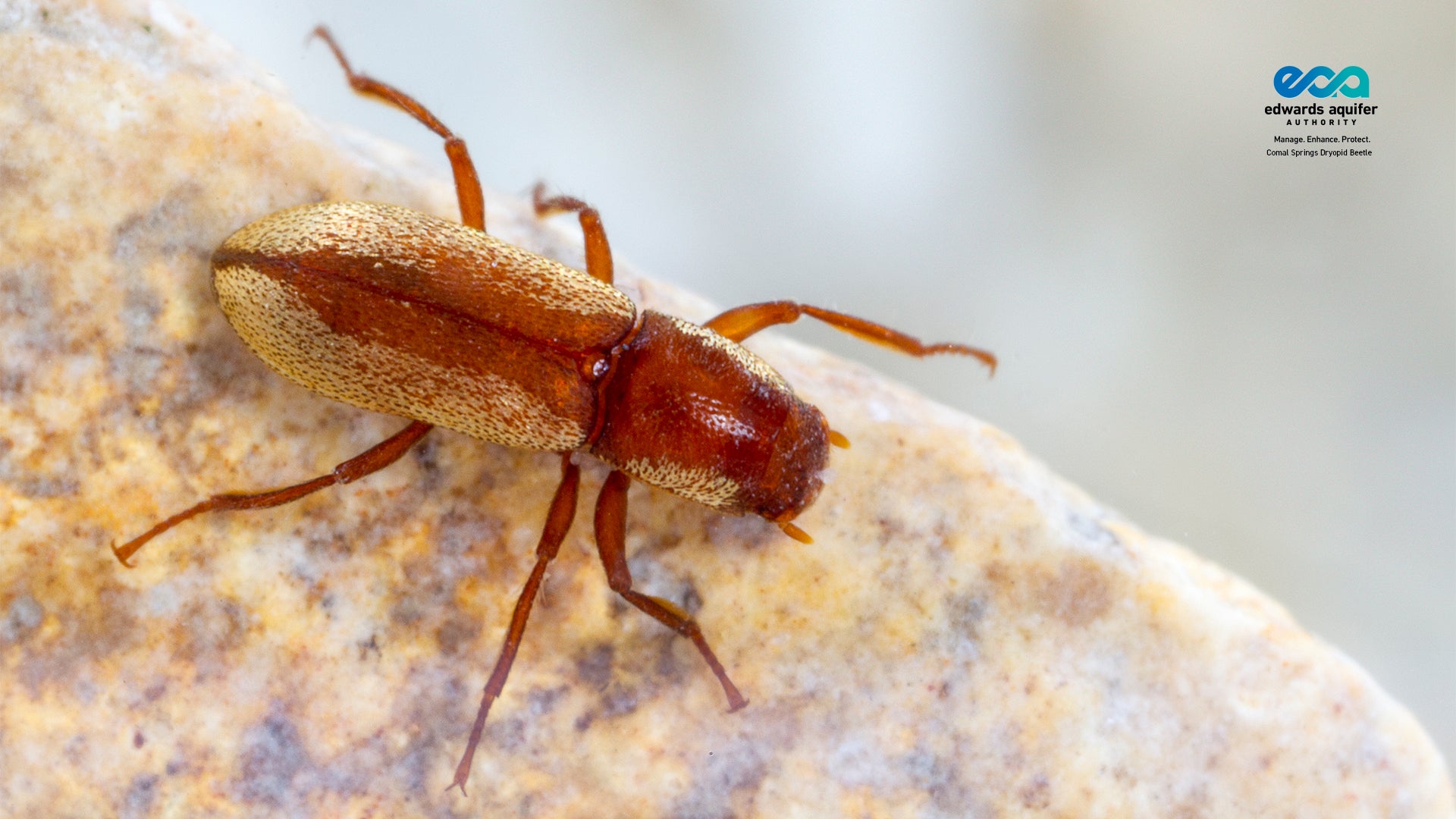
Additional Endangered Species Listed
The USFWS listed the Comal Springs riffle beetle, Comal Springs dryopid beetle, and Peck’s Cave amphipod as endangered.
January 2001
First Regular Permit Issued
The first initial regular permit was issued to the Stein family in Medina County for 224 acre-feet per year of groundwater for irrigation use.
2001
Well Permitting System
A well permitting system was introduced, requiring all new wells drilled in the Edwards Aquifer to have a well construction permit.
2002
Critical Period Management
The EAA implemented a Critical Period Management Plan to help sustain aquifer and springflow levels during periods of little or no rain.
October 2002
Fuel Storage Tank Rules
The EAA Board adopted water quality rules prohibiting new underground fuel storage tanks on the Edwards Aquifer Recharge Zone.
December 2003
First Interim Proportional Adjustment Order
The EAA Board issued its first interim proportional adjustment order to ensure the total of all issued regular permits did not exceed the applicable pumping cap.
2004
Comprehensive Water Management Plan
The EAA issued its Comprehensive Water Management Plan for the Aquifer as required by the EAA Act.
March 2005
Plan to Protect Threatened and Endangered Species
The EAA submitted a partially completed draft plan to the USFWS for protecting threatened and endangered species and their habitat.
October 2006
USFWS Recovery Implementation Program
The USFWS made a presentation to the EAA Board about the possibility of performing a recovery implementation program.
May 2007
Senate Bill No. 3 and House Bill No. 3
Texas omnibus water bills amended the EAA Act, raised the pumping cap, placed CPM into statute, and created EARIP.
March 2010
Federal Register Notice
A Federal Register Notice documented development of the Edwards Aquifer Habitat Conservation Plan.
2011
EARIP Program Documents
The EAA Board approved the EARIP program documents and the multi-party Joint Funding Agreement.
January 2012
EAHCP Funding and Management Agreement
The EAHCP Funding and Management Agreement became effective, and an application for an incidental take permit was filed.
March 2012
Joint Funding Agreement
The multi-party Joint Funding Agreement for implementation of the Habitat Conservation Plan became effective.
June 2012
Stakeholders Committee First Meeting
The EAHCP Stakeholders Committee conducted its first organizational meeting.
November 2012
EARIP
The program advanced collaborative conservation measures and aquifer management efforts associated with the Edwards Aquifer.
December 2012
Final Environmental Impact Statement
The USFWS issued its Final Environmental Impact Statement relative to the EAHCP ITP application.
January 2013
Biological and Conference Opinions
The EAA Board approved a Joint Funding Agreement with the Nueces River Authority, and the USFWS issued its Record of Decision.
February 2013
USFWS Issues Incidental Take Permit
The USFWS issued Incidental Take Permit No. TE63663A-O, authorizing habitat restoration and springflow protection measures under the EAHCP.
March 2013
EARIP/EAHCP Processes
The Incidental Take Permit permittees entered into an Implementing Agreement with the USFWS, and Phase I of the EAHCP began.
May 2013
Senate Bill No. 1241
The Texas Legislature passed Senate Bill No. 1241, improving the EAA’s administration of its permitting program and creating limited production exempt wells.
January 2014
First EAHCP Steward Newsletter
The EAHCP Steward monthly newsletter began highlighting collaborative efforts to protect threatened and endangered species and habitat.
2014
VISPO
VISPO supported irrigation users who enrolled to help protect springflow for federally listed threatened and endangered species.
June 2014
Edwards Aquifer Conservancy
The Edwards Aquifer Conservancy was created to support and benefit the work of the EAA by raising funds to support EAA programs.
October 2014
VISPO Forbearance
Low water levels triggered VISPO forbearance, and the EAA issued a Notice of Commencement of a Forbearance Year for VISPO enrollees.
2015
No Water Withdrawals for 2015
All VISPO participants were required to forbear from making withdrawals from the Aquifer from their enrolled Edwards permits during all of 2015.
2015
EAA Assumed Responsibility for ASR Leasing
The EAA assumed responsibility for the Aquifer Storage and Recovery leasing program and expanded springflow protection efforts.
March 2015
EAHCP Report 1
The National Academy of Sciences published its first review of the Edwards Aquifer Habitat Conservation Plan and offered recommendations.
2016
Regional Water Conservation Program
The contract between the EAA and SAWS effectively completed implementation of a springflow protection measure under the Regional Water Conservation Program.
March 2016
Texas Environmental Excellence Awards
A milestone in the EAHCP effort, recognizing collaborative work and implementation progress with the U.S. Fish & Wildlife Service and BIO-WEST.
2017
EAHCP Report 2
The National Academy of Sciences built on earlier recommendations and evaluated hydrologic and ecological modeling and conservation measures.
2018
EAHCP Report 3
The National Academy of Sciences evaluated whether biological objectives and conservation measures would likely meet the plan’s biological goals.
2019
Distinguished Lecture Series
2019 marked the 27th lecture in the series with guest lecturer Dr. Ronald Green.
2019
Texas Wild-Rice Success
Texas wild-rice coverage increased 129% from summer 2013 to summer 2019 through restoration and enhancement efforts.
April 2019
Refugia Facility Grand Opening
The EAHCP Refugia Facility opened at the San Marcos Aquatic Resource Center to support threatened and endangered species.
May 2019
Signing Phase 2 Resolution and Order
Resolution No. 05-19-001 validated the transition to the second phase of the EAHCP program.
May 2019
Comprehensive Phase II Work Plan
The EAHCP Implementing Committee approved the Comprehensive Phase II Work Plan and Strategic Adaptive Management resolution.
October 2019
Partnership with Morgan’s Wonderland Camp
The EAA announced a partnership with Morgan’s Wonderland Camp to advance water education and public engagement.
November 2019
EAA Field Research Park
The EAA named the Cibolo Vista site the EAA Field Research Park for sustainable land management and field research.
2020
Construction of the Educational Outreach Center
The EAA began construction of its Educational Outreach Center in conjunction with Morgan’s Wonderland and opened its Field Research Park.
March 2020
Phase I & II of the EAHCP
Phase I of the EAHCP was completed and Phase II began, while SAWS completed implementation of the Regional Water Conservation Program.
2021
VISPO & ASR Programs
The EAA completed enrollment goals for the amended VISPO and ASR programs for another five-year term.
2021
Automated Meter Reading Program
The AMR program helped well owners meet their obligation to report groundwater use to the EAA.
September 2021
Rain Catcher Award
The EOC Texas Native Plant Demonstration Garden received the Texas Water Development Board Rain Catcher Award.
April 2022
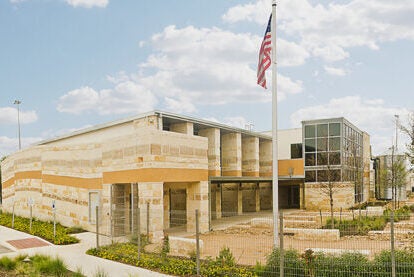
EOC Grand Opening
The country’s first Ultra-Accessible aquifer education center opened in San Antonio, marking a major step forward for water education.
2022
First Responders Program
The program centralized regulated-substance and site information to support fire departments responding to incidents on the Recharge Zone.
2022
In 10 Years of EAHCP
2022 marked the 10th year of implementing the EAHCP and advancing regional habitat conservation. Click the image to view the 2022 Annual Report.
April 2023
Bureau of Reclamation Grant
The EAA received funding to upgrade manual flowmeters with digital registers and SCADA-compatible automation.
May 2023
EAHCP Awarded $1 Million Grant
A $1 million grant from the U.S. Fish and Wildlife Service was awarded for the EAHCP permit renewal work.
November 2023
Excellence in Financial Reporting
The EAA received the Certificate of Achievement for Excellence in Financial Reporting from the GFOA.
April 2024
Dischinger-Brehmer Ranch Conservation Easement
A conservation easement on the Edwards Aquifer Recharge Zone was finalized in 2024 and is held by the Edwards Aquifer Conservancy.
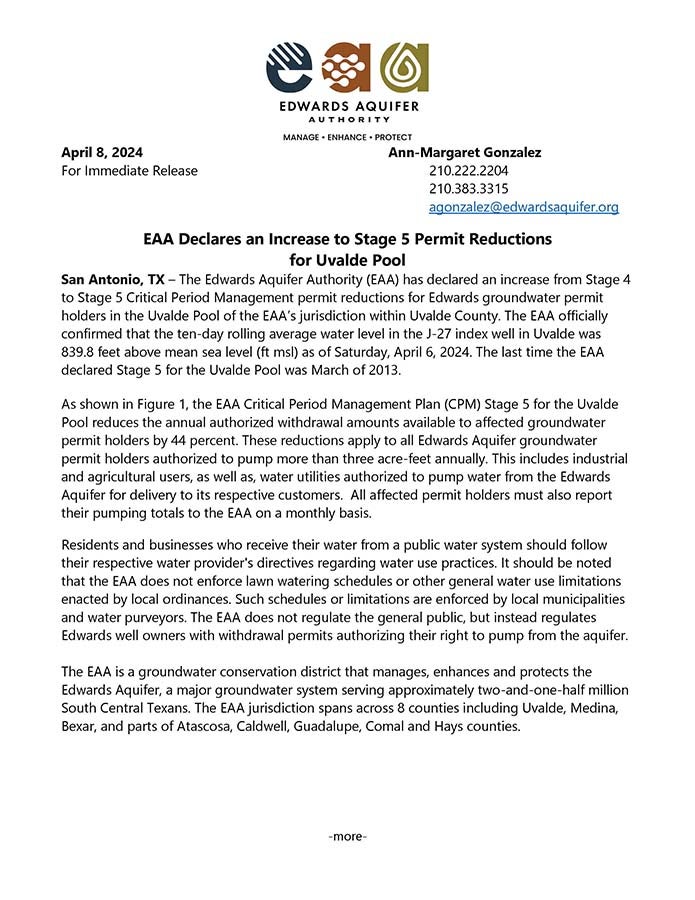
April 2024
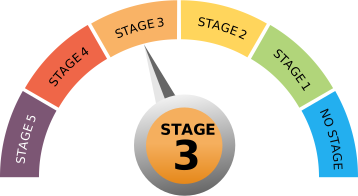
EAA Declares an Increase to Stage 5 Permit Reductions for Uvalde Pool
The EAA declared an increase from Stage 4 to Stage 5 Critical Period Management permit reductions for the Uvalde Pool. Click the image to open the PDF.
April 2024
Park Development Innovations Award
The City of New Braunfels partnered with the EAHCP and received the Park Development Innovations Award for the Landa Park Aquatic Complex project.
March 2025
Informational Session for Public Office Candidates
The session provided a basic understanding of the EAA’s mission, equipping candidates to advocate for water conservation and sustainability.
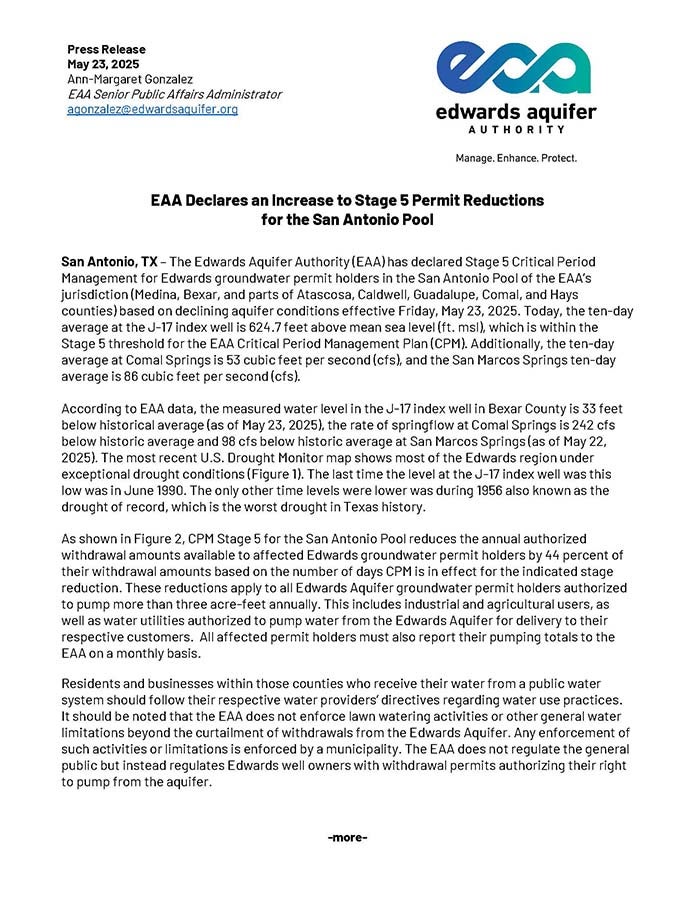
May 2025
EAA Declares an Increase to Stage 5 Permit Reductions for the San Antonio Pool
The EAA declared Stage 5 Critical Period Management for Edwards groundwater permit holders in the San Antonio Pool. Click the image to open the PDF.
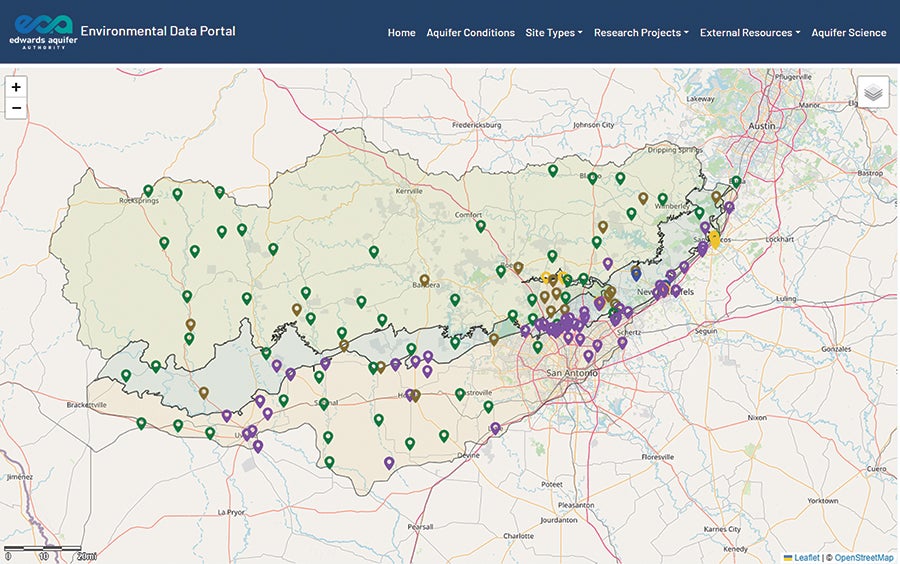
June 2025
EAA Data Portal
The Environmental Data Portal launched to provide public access to vetted environmental data across the Edwards Aquifer region. Click the image to visit the EAA Data Portal.
August 2025
EAA Rebranding
The Edwards Aquifer Authority unveiled a new logo and corporate identity program to better brand the organization.
December 2025
EAA EOC Reaches 11,000 Visitors
The EAA Education Outreach Center reached a milestone with 11,000 visitors in 2025.
Featured Moments
Explore defining stories, milestones, people, and achievements that reflect the Edwards Aquifer Authority’s first 30 years of service and impact.
Browse photographs from the Edwards Aquifer Authority’s history, programs, people, events, and fieldwork that reflect three decades of stewardship, science and service.
This calculator is only available December 31st - January 31st. Please check back on December 31, 2025, to calculate your reductions for the year.
Online Payments
As part of a comprehensive effort to streamline processes for our permit holders and the regulated community, the EAA now offers an online payment program that allows individuals and business entities to pay for their transactions by credit card (American Express, Discover, MasterCard, or VISA) or by electronic check.
The payment site is operated and maintained by a secure, third party, payment processor. A convenience fee of 2.75% applies to all credit card transactions (a $2 minimum fee) and a $2.00 fee applies to e-check transactions. The EAA does not keep any portion of these convenience fees. After confirmation of payment, the EAA will coordinate internally to ensure your payment is posted to the correct account. This process may take up to 72 hours.


 Aquifer Conditions




 CURRENT AQUIFER CONDITIONS