

 Aquifer Conditions
Science & Data Document Library
Science and Data Resources
Geochemical and Isotopic Analyses of Waters Associated with the Edwards Limestone Aquifer, Central Texas

Description: Inorganic chemical analyses of various Edwards Aquifer samples circa 1976 using new field methods
Location: Edwards Aquifer, Balcones Fault Zone, San Antonio Segment
Summary:The results of analyses of 14 common chemical species dissolved in 92 samples of waters associated with the Edwards Limestone aquifer are tabulated. Additional analyses for stable carbon and radiocarbon and stable sulfur isotopes on 34 of these samples are also tabulated. Field collection and field and laboratory analytical techniques were designed to make these analyses useful for geochemical studies. Edwards waters can be grouped into five chemical types recharge, main fresh water, varied, and two types of transitional and saline waters. All types are saturated with calcite and all transitional and saline waters are saturated with dolomite as well. Some saline samples are also saturated with gypsum, celestite, strontianite, and fluorite .
File Memorandum on Review of Water Quality Changes in Edwards Reservoir-Especially Near the Bad Water Line
Description: File memorandum on review of water quality from monitoring wells near the bad water line through 1967 Note: Page-size and large-format size of original plate are at the end of the document.
Location: Edwards Aquifer, Balcones Fault Zone, San Antonio Segment
Summary:This memorandum presents the results of a review of the water quality data for the observation wells through 1967. It also includes some observations on the general water quality of the Edwards. The primary purpose of reviewing the water quality observation well data has been to identify where
and when changes in water quality have occurred and the nature of the changes.
PRINCIPAL CONCLUSIONS AND RECOMMENDATIONS
1. The water quality changes in individual wells have to date mostly been small. No large, lateral shift in the position of the bad water line is apparent from the data available, and none is believed to
have occurred in historical times.
2.. The present study indicates that there are considerably more wells in which water quality variations occur than have been recognized, or were recognizable, in the past. This is probably
due mostly to a longer period of record now being available for some of the wells over periods when larger and more prolonged changes in stage of the reservoir have occurred.
3. Wells located very close to the bad water line tend to show larger and more easily recognizable changes in quality than other wells, but some changes in water quality are noted for wells located
some distance both north and south of the bad water line.
4. It does not appear that a more exhaustive study of the bad water line is warranted at present, but additions to the present network of wells sampled, particularly in Bexar County, appear to be
warranted.
Because of the potential importance to San Antonio of quality changes along the bad water line in Bexar County and inasmuch as quite a few small changes are apparently occurring, it is recommended that additional wells both along the bad water line and south of the bad water line be included in the semi-annual sampling program of the USGS cooperative study. Table 5 lists all the wells in Bexar and Atascosa Counties that we recommend be in the program.
Some of those listed are already a part of the program, and nearly all have been included at one time or another. Each well should be sampled each year in January and August and a preliminary
type analysis made. In addition, a search for additional, existing wells in Bexar County located both close to the bad water line and also south of the bad water line should be made, and probably all
wells found should be added to the program.
Using Geophysical Logs in the Edwards Aquifer to Estimate Water Quality Along the Freshwater/Saline-Water Interface (Uvalde to San Antonio, Texas)
Description: Note: Large-format versions of the plates for this report are available in a companion document. Analysis of geophysical logs and well data to redefine the boundary of the freshwater/saline interface in the Edwards Aquifer Balcones Fault Zone San Antonio Segment.
Report Number: 92-03
Location: Edwards Aquifer, Balcones Fault Zone, San Antonio Segment, Freshwater/Saline Interface, Uvalde to San Antonio, TX
Summary:Note: Large-format versions of the plates for this report are available in a companion document.
Over one hundred geophysical logs from locations near the freshwater/saline-water interface of the Edwards aquifer between Uvalde and San Antonio, Texas, were acquired and analyzed. In conjunction with these logs, test data from several wells along the interface in San Antonio and to the northeast were used to verify a high correlation between estimated and measured water quality parameters. Geochemical conditions such as specific conductance and dissolved solids in the freshwater/saline-water transition zone in the Edwards aquifer can be interpreted from geophysical logs.
Results of the estimated water quality data determined in this study indicate that the freshwater/saline-water interface is irregular, both vertically and horizontally, and extends downdip into Frio County in the area of the Frio-Zavala County line, contrary to the location previously estimated. Concurrently, a similar condition exists west of Devine, Texas, where the estimated position of the freshwater/saline-water interface is again downdip and farther south than has been shown in earlier studies.
Data such as rock color, information indicating lost circulation and/or caverns, and reports of freshwater on well tests supplements geophysical log-derived water quality parameter maps in supporting the concept of the occurrence of freshwater between the previous freshwater/saline-water interface and the position of the estimated freshwater/saline-water interface determined by this report.
Investigation of the Fresh/Saline Water Interface in the Edwards Aquifer in New Braunfels and San Marcos, Texas Executive Summary
Description: Attempts to define the freshwater/saline water boundary and its movement in the New Braunfels/San Marcos area from monitoring well data.
Report Number: 92-02
Location: Edwards Aquifer, Balcones Fault Zone, San Antonio Segment, New Braunfels, San Marcos
Summary:The purpose of this investigation was to develop site-specific information at selected sites along the fresh/saline-water interface and to establish a long term monitoring system. The report discusses the drilling,construction, and testing of a series of monitoring wells located in New Braunfels and San Marcos, Texas. Data collected as a result of this study will continue to provide information needed to determine whether encroachment of poor quality water presents a serious problem to maximum use of the aquifer as natural and man-made stresses on the aquifer system occur.
The conclusions to be drawn from this pump test are not definitive of saline water intrusion because the production well used was a transition well (containing both fresh and saline waters). However, an increase in salinity in the production well could indicate that the interface between the fresh/saline zones moved. This is supported by a low sloping cone of depression during the pump test combined with the ability of water to flow from the saline zone to this transitional well. However, the well must have also drawn fresh water to it, for the salinity values did not increase to the same values observed in the saline zone. Nevertheless, the data suggests that an element of caution should be considered during periods of increased hydrologic stress on the aquifer system in this area.
2011 Hydrologic Data Fact Sheet for Precipitation, Groundwater Levels and Drought Conditions
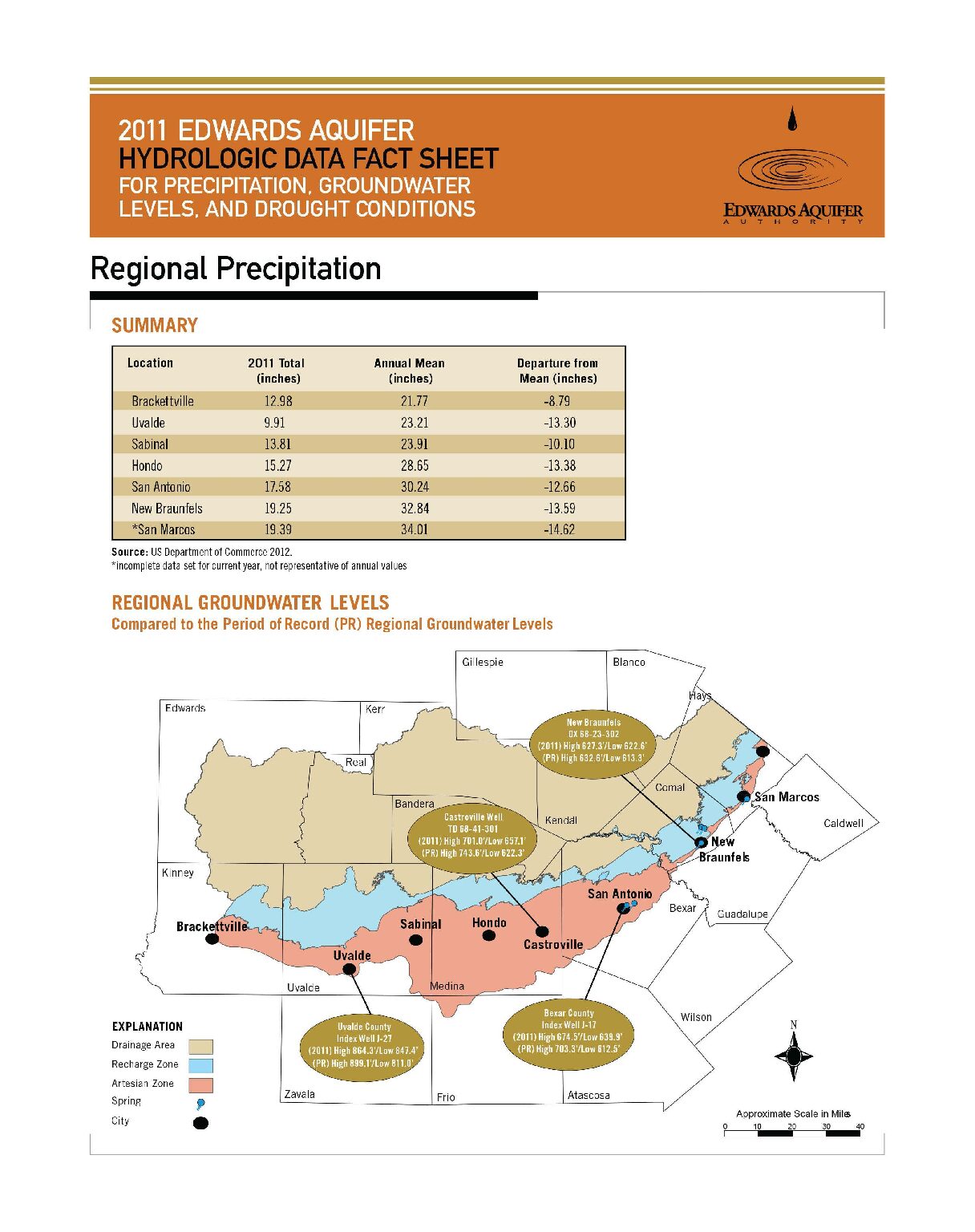
Description: Summary for 2011 on precipitation, groundwater levels, and drought in the Edwards Aquifer San Antonio Region
Location: Edwards Aquifer - San Antonio Area
Summary:Each year, the Edwards Aquifer Authority (Authority) publishes a comprehensive Hydrologic Data Report offering an extensive compilation of data on the Edwards Aquifer. This fact sheet is a sampling of the information that can be found in that report.
1994 Review and Update of the Position of the Edwards Aquifer Freshwater/Saline-Water Interface from Uvalde to Kyle, Texas
Description: 1994 attempt to describe the location of the freshwater/saline-water interface accurately from Kyle to Uvalde, Texas
Report Number: 94-05
Location: Edwards Aquifer Balcones Fault Zone San Antonio Segment, Freshwater/Saline-Water Interface, Kyle, Lytle, Medina County, Uvalde
Summary:This report is the latest attempt to accurately describe the location of the freshwater/saline-water interface from Kyle to Uvalde, Texas. Multiple sources were used to obtain high quality measured specific conductance and total dissolved solids values. All comparisons relating specific conductance to total dissolved solids have shown a high degree of correlation in every area near the interface. Total dissolved solids estimates derived from quantitative geophysical log recordings agree well with actual measurements taken in the same boreholes. The practical use of merged, measured, and calculated data is demonstrated along the interface from Kyle to Lytle. where abundant measured data is observed to be sufficiently distributed among map values generated from geophysical logs. As a result, the revised interface closely parallels former estimates. The changes are dictated by added control and, to a minor degree, by the contour options on the part of the various investigators.
The area from Lytle to Uvalde is lacking an abundant supply of TDS measurements. Therefore, reliance upon TDS estimates obtained from quantitative geophysical log interpretations is necessary. This is especially true in southern Medina County. To verify the major difference between the interface location presented in EUWD Report 92-03, EUWD South Medina Observation Well #I was drilled. This well proved that freshwater was at least three miles south of the commonly accepted freshwater/saline-water interface. This test well data and other additional geophysical logs were used to enhance the TDS and specific conductance maps furnished in EUWD Report 92-03. The TDS map shown in EUWD Report 93-06 has been merged with the TDS map shown in this report (Lytle to Uvalde) to provide the most current interpretation of the freshwater/ saline-water interface position from Kyle to Uvalde, Texas. Accuracy of the interface position west of Lytle is not as sound as that shown for the area east extending to Kyle, Texas. To more precisely determine the freshwater/saline-water interface location between Lytle and Uvalde, acquisition of measured well data, which may have been overlooked in the past, and drilling of additional observation wells will be required. The position of these new wells will be dependent upon the area where the most critical information is required.
Defining the Edwards Aquifer Freshwater/Saline-Water Interface with Geophysical Logs and Measured Data (San Antonio to Kyle, Texas)
Description: Analysis of geophysical logs to define the freshwater/saline water interface in the Edwards Aquifer between San Antonio and Kyle, TX. Note: Large-format versions of the plates for this report are available in a companion document.
Report Number: 93-06
Location: Freshwater/Saline Interface, San Antonio to Kyle
Summary:Note: Large-format versions of the plates for this report are available in a companion document.
One hundred twenty six geophysical logs from locations near and downdip from the current Edwards aquifer freshwater/saline-water interface between San Antonio and Kyle, Texas, were acquired and analyzed. Measured water quality data was obtained from eighty-one water samples taken from wells within the study area. Twenty wells possessed both usable geophysical logs and measured data which were used together to verify a high correlation between estimated and measured water quality parameters. This study and Edwards Underground Water District (EUWD) Reports 92-02 and 92-03 establish good agreement between calculated and measured values of specific conductance and measured and estimated values of total dissolved solids within the study area and near the freshwater/saline-water interface between Uvalde and Kyle, Texas.
The location of the freshwater/saline-water interface derived from this study closely parallels data published by the EUWD, such as EUWD Bulletin 51 (1992), but indicates that there is slightly less area occupied by freshwater than previously shown. Maps presented in this report can be used to infer additional water quality characteristics near the interface such as rate of change of total dissolved solids, concentrations of highly mineralized water, zones of dilution downdip and indications of freshwater flow patterns.
This study suggests that a very large area of moderately saline water exists in eastern Bexar County and western Guadalupe County. The transition from moderately saline water to brine is very rapid near the common corner of Bexar, Atascosa, and Wilson counties. The large area of moderately saline water changes to water containing higher total dissolved solids northward from Guadalupe County toward the San Marcos River. A re-entrant of very saline water, which is subparallel to the San Marcos River, terminates the moderately saline zone in Guadalupe County, extends to the northwest, and is present in the City of San Marcos.
2010 Edwards Aquifer Hydrologic Data Fact Sheet for Precipitation, Groundwater Levels and Drought Conditions
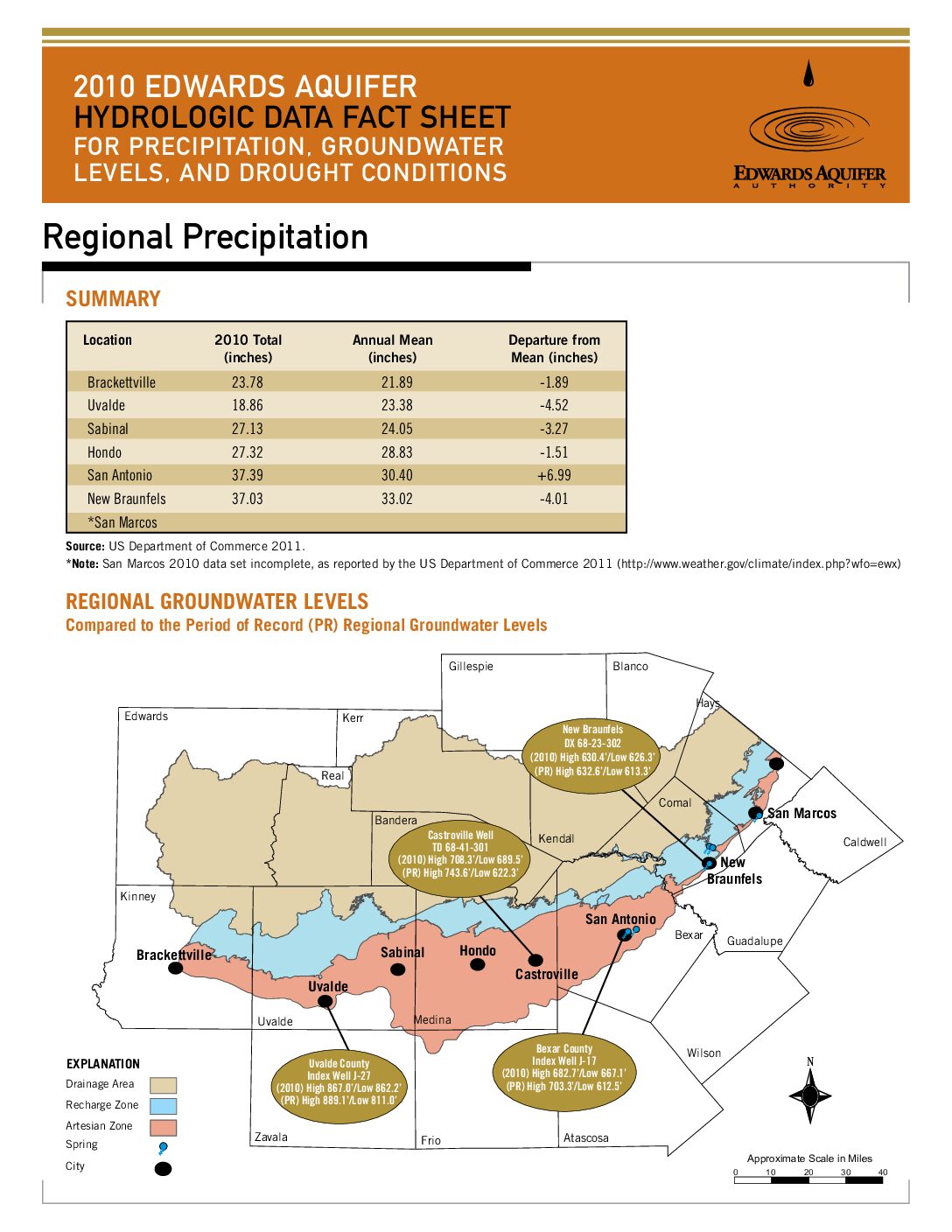
Description: Summary for 2010 on precipitation, groundwater levels, and drought in the Edwards Aquifer San Antonio Region
Location: Edwards Aquifer - Balcones Fault Zone - San Antonio Segment
Summary:Each year, the Edwards Aquifer Authority (Authority) publishes a comprehensive Hydrologic Data Report offering an extensive compilation of data on the Edwards Aquifer. This fact sheet is a sampling of the information that can be found in that report.
Refining the Conceptual Model for Flow in the Edwards Aquifer: Characterizing the Role of Fractures and Conduits in the Balcones Fault Zone Segment
Description: Hydrogeologic study using existing data on role of fractures and conduits in groundwater flow in the recharge and artesian zones of the Edwards Aquifer Balcones Fault Zone
Location: Edwards Aquifer, Balcones Fault Zone
Summary:The purpose of this study was to evaluate the influence of fractures and conduits on groundwater flowpaths in the recharge and artesian zones of the Edwards Aquifer. Hydrologic and geologic data were evaluated for evidence of karst aquifer flow regimes and specific areas are delineated for focused data collection in the future. The study was completed in January 2004 by the University of Texas Bureau of Economic Geology, Austin, Texas.
The Balcones Fault Zone Edwards aquifer of South Texas exhibits multimodal permeability. High matrix porosity and permeability are overshadowed by high permeability developed in structurally influenced karstic conduit systems. High permeability is developed in the confined part of the aquifer at depths greater than 4,000 feet below sea level, as well as in the unconfined zone. Optimization of use of this heavily subscribed aquifer requires accurate quantification and realistic mapping of the relationships between the limestone matrix, which stores most of the water, and the conduit system, which transmits water into, through, and out of the aquifer. This balance between storage and drainage is a key variable needed for predicting sustainability of flow during periods of low recharge and heavy use.
The purpose of this study is to interpret and integrate a selection of the existing diverse data to better characterize the conduit system. Data sets selected to feed into this interpretation include (1) water-level data, (2) structural information, (3) cave maps, (4) existing water-chemistry data, and (5) well hydrographs. It is intended that analysis of the existing data will supply hypotheses that will then be tested using field-based followup studies. These might include injected tracers; high frequency, closely spaced water level monitoring; conductivity monitoring; and well testing to better define flow systems.
A regionally extensive system of high-permeability zones is defined by broad troughs in the potentiometric surface in the confined zone. Indications of connections of the confined aquifer to the recharge zone are weakly defined by troughs in the available water-level data. Intersection of the Edwards/Trinity merged potentiometric surface maps with base Edwards structure maps to show that the Edwards Formation is saturated over only a part of the Edwards outcrop zone. This fact suggests that recharge flows through the Edwards into the upper beds of the underlying Glen Rose Formation before returning to the Edwards. Steep gradients of 100 ft/mi are mapped where flow crosses between the Glen Rose and the Edwards Formations, showing that the cross-formational flowpaths are much less transmissive than those in the Edwards confined zone. Spring discharge at the Edwards-Glen Rose contact suggests that perched water tables or flood-stage perched conduits might have a significant role in transmitting water through the recharge zone.
Cave maps show a persistent overprint of vadose-zone karst development, forming near-vertical shafts; however, in the horizontal segments, cave elongation shows that about half the caves are elongated along the principal fault direction. This orientation documents the role of opening-mode fractures parallel to the Balcones Fault Zone trends in controlling permeability. The other half of the horizontally elongated caves trend in other directions, reflecting multiple fracture systems in this structurally complex system.
Local gradient toward a local discharge point is interpreted to be a possible contribution to elongations of some cave patterns.
Water chemistry from Texas Water Development Board (TWDB) files is used as an indicator of flowpath geometry. High-salinity water (>3000 mg/L total dissolved solids [TDS]) indicative of long residence times is found in the deep part of the Edwards aquifer and in parts of the Glen Rose (Trinity) aquifer. These areas are therefore interpreted as regions bypassed by low-TDS recharge water moving through conduits.
Other Trinity samples have salinities in the same range as that of average Edwards water (200 to 500 mg/L) and may indicate faster flowpaths that communicate from the Trinity to the Edwards and from the Edwards recharge zone through the Trinity and back into the Edwards. About 5% of the Edwards waters in the confined Edwards are strongly undersaturated with respect to calcite, interpreted as an indicator of rapid conduit flow that has limited reactions between rock and water. Undersaturated samples are not strongly clustered in the major conduits zones defined by troughs in the potentiometric surface, suggesting that a network of conduits is active, with groundwater velocities adequate to impact chemistries. Samples with reported high (more than 30 mg/L) nitrate in the confined aquifer are tentatively interpreted as indicators of fast flowpaths from surface sources of nitrate; however, well leakage and sample contamination are alternative explanations.
Separation of representative well hydrographs recession curves shows variability in the ratio of matrix to fracture storativity. However, strong rapid drainage characteristic of conduits was not observed in the small population of hydrographs analyzed.
Stormwater Runoff for Selected Watersheds in the Edwards Aquifer Recharge Zone, Bexar County, Texas, 1996-98
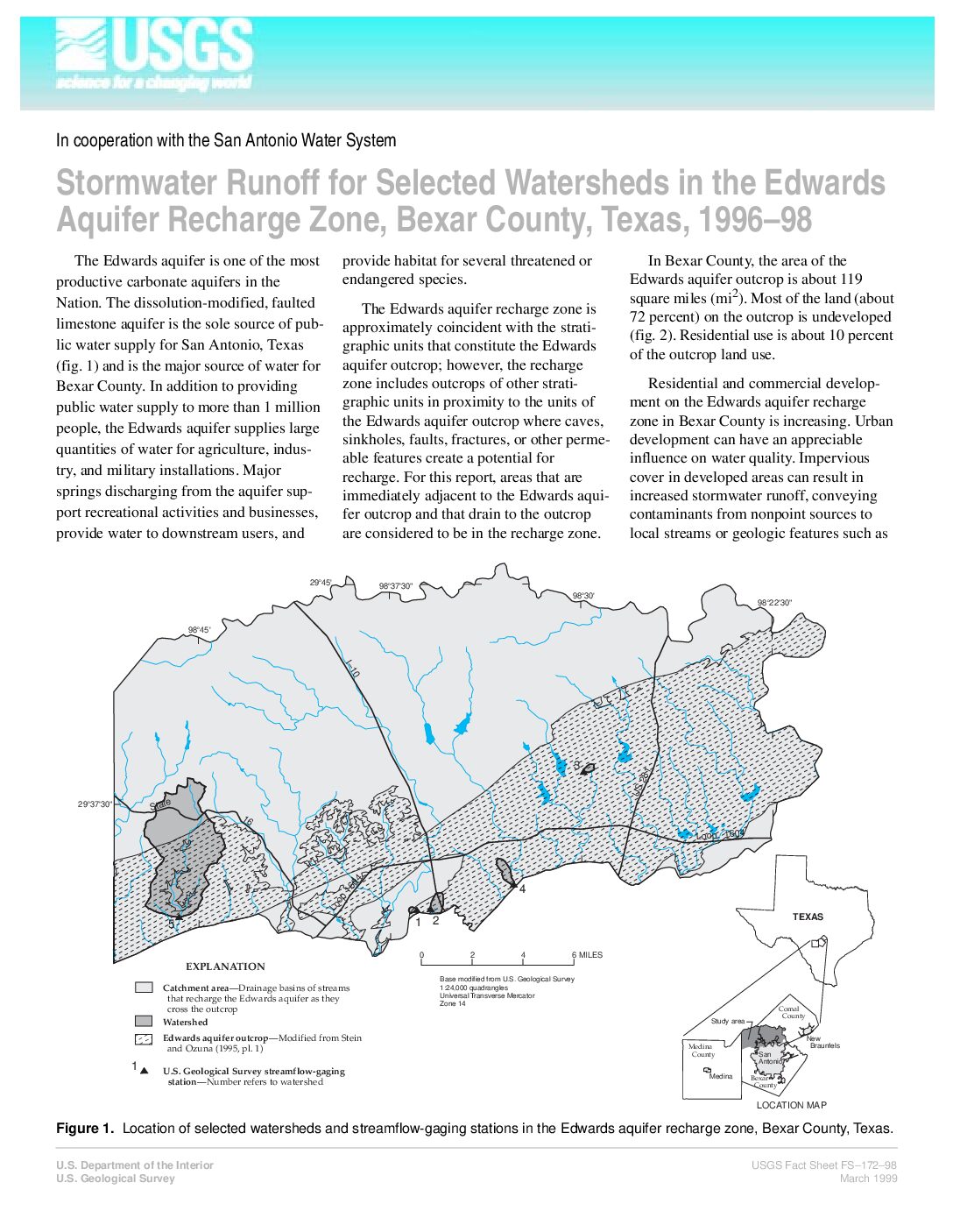
Description: Comparison of water quality in stormwater runoff from five watersheds in the Edwards Aquifer Balcones Fault Zone San Antonio Segment Recharge Zone
Report Number: USGS FS-172-98
Location: Edwards Aquifer Recharge Zone, Bexar County
Summary:In 1996, the U.S. Geological Survey (USGS), in cooperation with the San Antonio Water System, began a study to monitor the quality and quantity of stormwater runoff of five selected watersheds in the Edwards aquifer recharge zone. The purpose of the study is to further the understanding of relations between stormwater and land use and to help resource managers assess the effects of development on the Edwards aquifer recharge zone. Land use is relatively commercial in two of the watersheds and predominantly residential in two of the watersheds; one watershed is largely undeveloped (table 1). This fact sheet provides an overview of the data collection methods and selected results of analysis.
Geology and Water Quality at Selected Locations in the San Antonio Area Texas, Progress Report, 1969
Description: Surface geology and water quality monitoring in the San Antonio region in relation to development and most likely sources of pollution. Note: Page-size and large-format plate are at the end of the report.
Report Number: USGS O-FR70-272
Location: Edwards Aquifer, Balcones Fault Zone, San Antonio Segment
Summary:The Edwards aquifer is the principal source of water supply for the San Antonio area. Increasing urban development on or adjacent to the recharge area of the aquifer is causing great concern because of possible pollution of the ground water. A detailed map of the surface geology has been prepared for areas where the greatest threat of pollution exists. Water-quality data are being collected throughout the San Antonio area to provide background reference information and to detect any current pollution of the ground water in the Edwards and associated limestones.
Mapping of the surface geology will continue in areas where waste waters may be recharging the aquifer. Water-quality data will be collected at additional sites, and some sites will be resampled where pollution may be occurring or where more background data are needed.
Staff report to Board of Directors of the Edwards Underground Water District: Urban Development on the Edwards Aquifer Recharge Zone
Description: EUWD staff recommendations to the EUWD Board regarding potential cumulative impact of development over the Edwards Aquifer Recharge Zone
Report Number: 93-09
Location: Edwards Aquifer, Balcones Fault Zone, San Antonio Segment, Recharge Zone
Summary:A recent increase in development activities on the ERZ [Edwards Aquifer Recharge Zone] has heightened concerns by District staff that the current mechanisms in place to protect the Edwards aquifer from degradation associated with urbanization are not adequate. Staff believes that the cumulative impact on the Edwards aquifer of the various types of development and their associated risks is not currently being addressed. The lack of adequate comprehensive standards and regulatory controls to protect the aquifer against water quality degradation, coupled with the rapid pace of development over the ERZ at this time, and presumably for some time to come, suggests that degradation of water in the Edwards aquifer is imminent. Swift actions to implement more accurate impact assessment procedures and more stringent standards and controls on development activities are crucial if the District is to uphold its enabling legislation and resolutions adopted for the purpose of protecting the quality of the Edwards aquifer.
Report of the Technical Data Review Panel on the Water Resources of the South Central Texas Region
Description: Assessment and gap analysis of the Edwards Underground Water District Technical Data Review Panel on historical data for water use, water quality, and water supply Note: This report is included for its historical value and may have been replaced by more recent studies.
Location: South Central Texas
Summary:The report of the Technical Review Panel is thus intended as a guide to the availability and reliability principally of water quantity, use and supply data. The report does not pretend to offer the correct data. Rather it familiarizes the reader with the underlying methodologies used to collect and/ or to estimate data which arc central to any planning or policy development efforts for the use of Edwards waters. It should be clearer from this review what the data does and does not say and what are the gaps in existing information. A concluding section makes several suggestions for further technical studies to revise particular methodologies, enhance collection efforts or review the uses to which data are put in a policy context.
Hydrogeologic Framework and Geochemistry of the Edwards Aquifer Saline-Water Zone, South-Central Texas
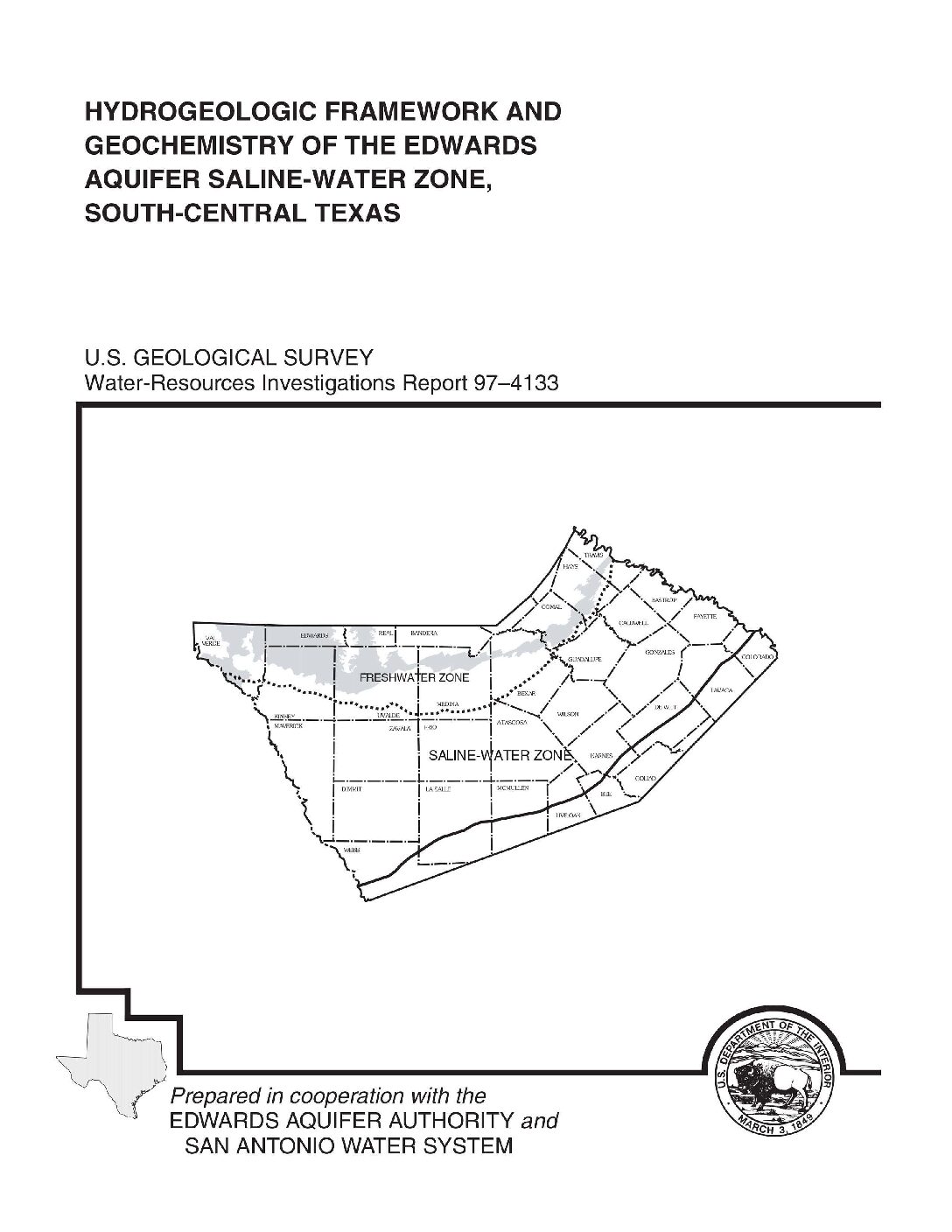
Description: Geochemical study of the Edwards Aquifer saline zone in relation to location of downdip and geological faults
Report Number: USGS WRIP 97-4133
Location: Edwards Aquifer Balcones Fault Zone San Antonio Segment, saline-water zone
Summary:The Edwards aquifer supplies drinking water for more than 1 million people in south-central Texas. The saline-water zone of the Edwards aquifer extends from the downdip limit of freshwater to the southern and eastern edge of the Stuart City Formation. Water samples from 16 wells in the Edwards aquifer saline-water zone were collected during July“September 1990 and analyzed for major and minor dissolved constituents, selected stable isotopes, and radioisotopes. These data, supplemental data from an extensive water-quality data base, and data from other previous studies were interpreted to clarify the understanding of the saline-waterzone geochemistry.
Most of the isotope and geochemical data indicate at least two distinct hydrological and geochemical regimes in the saline-water zone of the Edwards aquifer. On the basis of hydrogen and oxygen isotopes and radiocarbon data, the shallower updip regime is predominantly meteoric water that has been recharged probably from the freshwater zone within recent geologic time (less than tens of thousands of years). Also, on the basis of hydrogen and oxygen isotope data, water in the hydrologically stagnant regime (downdip) has been thermally altered in reactions with the carbonate rocks of the zone. The deeper water probably is much older than water in the shallow zone and is nearly stagnant relative to that in the shallow zone.
The geochemical grouping observed in the wellwater data from well samples in the saline-water zone indicates that the zone is hydrologically compartmentalized, in part because of faults that function as barriers to downdip flow of recharge water. These fault barriers also probably impede updip flow. Flow compartmentalization and the resulting disparity in geochemistry between the two regimes indicate that updip movement of substantial amounts of saline water toward the freshwater zone is unlikely.
Estimated in-place temperature of the samples collected indicates an increase with depth and (or) distance from the downdip limit of freshwater. The pH of the samples decreases with increasing distance from the downdip limit of freshwater, but the decrease is caused partly by the increase in temperature. Dissolved major ions and dissolved solids concentrations all indicate a progressive but monotonic increase in salinity from updip to downdip. The alkalinity of the water samples is predominantly bicarbonate because the low molecular weight aliphatic-acid anion concentrations are small relative to the bicarbonate concentrations. The dissolved organic carbon concentrations also are lower than expected for an aquifer with economic amounts of oil and gas hydrocarbons.
Statistical Summary of Water-Quality Data Collected from Selected Wells and Springs in the Edwards Aquifer Near San Antonio, Texas
Description: Compilation and descriptive statistics of water contaminants monitored in the Edwards Aquifer, Balcones Fault Zone, San Antonio Segment, from 1973-1982
Report Number: USGS O-FR 85-182
Location: Edwards Aquifer, Balcones Fault Zone, San Antonio Segment
Summary:Statistical summaries of available water-quality data collected from 90 wells and 3 springs in the Edwards aquifer near San Antonio, Texas, are presented. The statistical summaries provide information on the range in values for each water-quality constituent as well as the mean value, the standard deviation about the mean; and for those constituents with five or more analyses, the percentage of observations in which values were equal to or less than the specified values are presented.
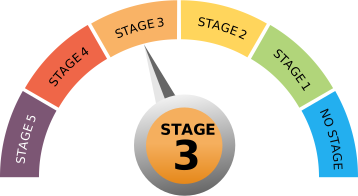


 CURRENT