
 Aquifer Conditions
Science & Data Document Library
Science and Data Resources
Preliminary Draft of Watershed Work Plan for Watershed Protection and Flood Prevention Seco Creek Watershed Medina, Bandera and Uvalde Counties, Texas

Description: Preliminary assessment for methods and costs of flood prevention in the Seco Creek Watershed Note: This report is included for its historical value and may have been replaced by more recent studies.
Location: Seco Creek Watershed, Medina County, Bandera County, Uvalde County
Summary:Seco Creek watershed comprises an area of 268 square miles in Bandera, Medina, and Uvalde Counties. It is estimated that 86.0 percent of the watershed is rangeland, 7.3 percent is cropland, 2.2 percent is pasture and bayland, 2.7 percent is wildlife-recreation land, and 1.8 percent is in miscellaneous uses such as the town of D'Hanis, public roads, railroads, farm and ranch headquarters, and stream channels. There is no Federal land in the watershed.
The principal problem within the watershed is one of frequent and extensive flooding on portions of the 17,098 acres of flood plain which results in damages to crops, grasses, soils, agricultural properties, residential and commercial properties, roads, bridges, and railroad properties. The total floodwater, sediment, erosion, and indirect damages are estimated to average $222,688 annually.
The work plan proposes installing, in a ten-year period, needed land treatment measures and nine floodwater retarding structures. Land treatment measures included are those which contribute directly to watershed protection and reduction of floodwater damages.
Land treatment measures will be operated and maintained by owners and operators of the land upon which the measures will be applied under agreement with the Medina Valley Soil and Water Conservation District and the Nueces-Frio-Sabinal Soil and Water Conservation District. The Commissioners Court will be responsible for operation and maintenance of the floodwater retarding structures. The cost of operation and maintenance for floodwater retarding structures is estimated to be $2,300 annually.
1994 Review and Update of the Position of the Edwards Aquifer Freshwater/Saline-Water Interface from Uvalde to Kyle, Texas-Plates
Description: Large-format plates for 1994 Review and Update of the Position of the Edwards Aquifer Freshwater/Saline-Water Interface from Uvalde to Kyle, Texas. See companion document.
Report Number: 94-05
Location: Edwards Aquifer Balcones Fault Zone San Antonio Segment, Freshwater/Saline Interface, Kyle, Lytle, Medina County, Uvalde
Summary:Large-format plates for 1994 Review and Update of the Position of the Edwards Aquifer Freshwater/Saline-Water Interface from Uvalde to Kyle, Texas. See companion document.
Government Canyon Geologic and Hydrologic Assessment
Description: Government Canyon geologic and hydrologic assessment
Report Number: 93-10
Location: Edwards Aquifer, Balcones Fault Zone, San Antonio Region, Government Canyon
Summary:[From the Introduction]
On March 1, 1993, the Board of Directors of the Edwards Underqround Water District requested that a geologic and hydrologic assessment of the Government Canyon property be performed by District Field Operations staff. This study was requested pursuant to the Board's approval to participate in the purchase of the subject property. The following report is the result of that study.
A literature search and field study were performed to provide a brief overview of the geologic and hydrologic conditions in the Government Canyon area. This area consists of approximately 5152 acres located 3 miles west of Helotes, Texas in northwest Bexar County.
Available literature includes publications from the Texas Water development Board, the Texas Department of Water Resources, and the USGS, as well as an unpublished MS thesis from the University of Texas at Austin. In addition, unpublished data was obtained from HDR Engineering and from various individuals.
Field study methods included reconnaissance to quality check surface geology previously mapped by the USGS, locating wells on the property accessible and suitable for geophysical logging, water quality sampling, and measuring water levels in several wells in the study area.
CONCLUSIONS
The surface and subsurface geologic investigation of the Government Canyon property indicates that recharge to the Glen Rose Aquifer and the Edwards Aquifer occurs in the area. A portion of this recharge moves southwest along the Haby Crossing Fault complex into northeast Medina County. An unknown portion, as seen in water level and water quality data, may flow from the Glen Rose Aquifer across the fault into the Edwards Aquifer.
It is estimated the average annual potential recharge enhancement with a structure on Government creek at the southern Edwards recharge zone boundary would be 600 acre-feet per year. The District has operated the San Geronimo Creek recharge enhancement structure for 13 years in a drainage basin adjacent to the Government Canyon property with similar geology. Average annual recharge at this structure is estimated to be 775 acre-feet, which is similar to the amount of recharge calculated by HDR for Government Creek. Recharge during years of above average rainfall at the San Geronimo dam site contributed approximately 1400, 1100, 1200, 1600 and 2900 acre-feet during 1981, 1985, 1987, 1991 and 1992 respectively.
Since recharge to both the Glen Rose and Edwards aquifers may occur on the property it is imperative that the quality of the surface runoff entering the aquifers be maintained. Additional studies should include aquifer tests and possible tracer studies to determine the flow direction and the presence of communication between the two aquifers. Additional data from remote abandoned wells on the property should be obtained to further define the hydroloqic characteristics of the area.
Using Geophysical Logs in the Edwards Aquifer to Estimate Water Quality Along the Freshwater/Saline-Water Interface (Uvalde to San Antonio, Texas) Plates
Description: Full-size plates from Using Geophysical Logs in the Edwards Aquifer to Estimate Water Quality Along the Freshwater/Saline-Water Interface (Uvalde to San Antonio, Texas). See companion document.
Report Number: 92-03
Location: Edwards Aquifer, Balcones Fault Zone, San Antonio Region, Freshwater/Saline Interface
Summary:Full-size plates from Using Geophysical Logs in the Edwards Aquifer to Estimate Water Quality Along the Freshwater/Saline-Water Interface (Uvalde to San Antonio, Texas). See companion document.
1990 Hydrologic Data Report Compilation of Hydrologic Data for the Edwards Aquifer, San Antonio Area, Texas, 1990, with 1934-90 Summary-Plates
Description: Large-format plates for the 1990 Hydrologic Data Report - see companion document.
Report Number: Bulletin 50
Location: Edwards Aquifer Balcones Fault Zone San Antonio Segment
Summary:Large-format plates for the 1990 Hydrologic Data Report see companion document.
Defining the Edwards Aquifer Freshwater/Saline-Water Interface with Geophysical Logs and Measured Data (San Antonio to Kyle, Texas) Plates
Description: Analysis of geophysical logs to define the freshwater/saline water interface in the Edwards Aquifer between San Antonio and Kyle, TX. Note: These are large-format versions of the plates for the companion document.
Report Number: 93-06
Location: Edwards Aquifer, Balcones Fault Zone, San Antonio Segment, Freshwater/Saline Interface, San Antonio to Kyle, TX
Summary:Large-format plates from analysis of geophysical logs to define the freshwater/saline water interface in the Edwards Aquifer between San Antonio and Kyle, TX. See companion document for small-format plates and text.
Bad Water Line Transect Pumping Test at San Antonio City Water Board’s Artesia Station, March 25, 1987
Description: Pumping test at the San Antonio Artesia Station to determine stability and recovery of wells from stress. Note: Page-size and large-format plates are at the end of the document.
Location: Edwards Aquifer, Balcones Fault Zone, San Antonio Segment, San Antonio, Artesian Zone
Summary:This report discusses the pumping test that was made of wells located at the City Water Board's Artesia Station to stress the Edwards aquifer. Artesia Station is located at the north end of a line of monitor wells that comprise the Edwards Aquifer Bad Water Line Transect in San Antonio.
The pumping test was planned jointly by the City Water Board, U. S. Geological Survey, and William F. Guyton Associates, Inc. It consisted of a 12-hour non-pumping period during which water levels at the various wells were measured to identify water-level trends, a 12-hour period of continuous pumping at a constant rate
from three of the production wells at Artesia Station, and a 6-hour non-pumping period during which water-level recovery measurements were made at the non-pumping wells. In addition, two sets of water samples were collected from each of the pumped wells during the test for chemical analysis by the U.S. Geological Survey. Data from the test were analyzed to determine hydraulic conditions in the aquifer in the vicinity of the Bad Water Line Transect and the impact of this large-scale nearby pumping.
The results from the test show an apparent transmissivity for the Edwards aquifer that is large and in the range from about 6,000,000 to 8,000,000 gallons per day per foot. Because of the way in which hydraulic boundaries affect the results from pumping-test analysis, the actual transmissivity of the Edwards between boundaries is believed to be considerably larger than this.
Drawdowns of water level occurred in both the fresh and saline zones of the aquifer as a result of pumping at a rate of 36 million gallons per day for 12 hours, and ranged from less than 2-1/2 feet at the non-pumped wells at and near Artesia Station to about 1.4 feet at Well J-17 located about 3-1/4 miles north of the station.
Chemical analyses show there was no significant change in the quality of the water produced by the pumped wells during the 12-hour pumping period.
Investigation of the Fresh/Saline Water Interface in the Edwards Aquifer in New Braunfels and San Marcos, Texas Appendices
Description: Attempts to define the freshwater/saline water boundary and its movement in the New Braunfels/San Marcos area from monitoring well data - Appendices
Report Number: 92-02
Location: Edwards Aquifer, New Braunfels, San Marcos
Summary:APPENDIX I: Charts containing water level, conductance, and temperature measurements for recovery tests performed at various depths intervals with: 1) residual drawdown versus time graphs which include transmissivity values; and 2) graphs plotted for conductivity versus time
APPENDIX II: Charts containing water level, conductance and temperature measurements for pump tests performed with observation wells with drawdown and Theis curves
APPENDIX Ill: Video summaries
APPENDIX IV: Thin section descriptions
Analysis of Data from Test-Well Sites along the Downdip Limit of Freshwater in the Edwards Aquifer, San Antonio, Texas, 1985-87
Description: Geochemical and hydrochemical study of the Edwards Aquifer downdip area and saline-freshwater interface in the San Antonio area
Report Number: USGS WRIP 93-4100
Location: Edwards Aquifer, Balcones Fault Zone, San Antonio Segment, Downdip
Summary:Many researchers have studied the downdip limit of freshwater in the Edwards aquifer or various aspects of the saline-water zone and its relation to the freshwater zone. These studies were summarized and used to synthesize a consistent hydrologic and geochemical framework from which to interpret data from field studies. The concept derived from the previous work on the downdip limit of the freshwater zone is that fresh recharge water entered the aquifer and developed a vast flow system controlled by barrier faults.
Some recharge water flows into the saline-water zone rather than toward major freshwater discharge points. The water that enters the saline-water zone continues to dissolve gypsum and dolomite, and calcite precipitates out of the water.
This process of dedolomitization has helped to develop the large secondary porosity of the freshwater zone as the downdip limit of the freshwater zone progressively moved downdip in recent geologic time.
The drilling of test holes and installation of monitoring wells began in 1985 and helped to define the downdip limit of the freshwater zone at one location. Dolomite was found in greater amounts in rocks from the saline-water-zone test hole than in rocks from the freshwater-zone test hole. Other mineralogic and lithologic contrasts between the saline-water-zone test hole and the freshwater-zone test hole support the conceptual model of dedolomitization. Geophysical logs and test-hole survey logs helped to define the stratification of freshwater and associated altered rock textures, secondary porosity development, and water chemistry in the freshwater-, saline-water-, and transition-zone test holes.
The differences in actual measured head among the seven completed monitor wells varied over time, especially during periods of substantial water use. The water levels in two monitor wells completed at the freshwater zone (siteD; wells Dl and D2) responded quickly and strongly to withdrawals. In the transition zone (site C; wells C1and C2), the water level in the shallow monitor well (C1) completed in a cavern responded quickly, but because it was farther from the water-supply wells near site D, it did not respond as strongly to changes in withdrawals at the nearby well field. The water levels in the three saline-water wells at site A (A1, A2, and A3) and the deep site C well (C2) were less responsive to stresses relative to the water-level changes in the freshwater wells (D1, D2, and C1).
Large amounts of freshwater were produced from the upper 300 to 350 feet of the aquifer in the freshwater zone (site D). Water produced from below this interval was as saline as that from the saline-water zone (site A). The cavern near the top of the aquifer in the transition zone (site C) produced large amounts of freshwater. The freshwater produced from the cavern was of a different geochemical type than the water from the other wells.
The saline-water-zone test hole (site A) produced small amounts of water having specific conductance generally about 5,800 to 6,200 microsiemens per centimeter at 25 degrees Celsius. A consistent trend in the water quality was not detected in the monitor-well data for July 1986-April 1987. This was caused, in part, by the average to above-average rainfall and by the lack of large withdrawals during the period. The water quality of samples from several of the wells was similar to the water quality determined by a previous study of the area. Geochemistry of the oil- or gas-well brines from downdip in the saline-water zone had slight resemblance to the geochemistry of the water at the downdip limit of freshwater; updip flow of saline water toward the freshwater zone was not indicated.
Environmental Tritium in the Edwards Aquifer Central Texas 1963-71
Description: Analysis of tritium in 50 wells and springs in the San Antonio area
Report Number: USGS O-FR 74-362
Location: Edwards Aquifer, Balcones Fault Zone, San Antonio Segment
Summary:Tritium concentrations of samples from 50 wells and springs in the Edwards aquifer in the San Antonio area of Texas have been analysed. Tritium now in the aquifer is partly natural cosmic ray produced tritium, but most is tritium produced by atmospheric thermonuclear tests in the 1950's and early 1960's. The tritium levels in atmospheric precipitation and streams recharging the Edwards are presented for comparison with the ground-water data.
In general, tritium distribution within the Edwards confirms the accepted pattern of water flow within the aquifer. Concentrations of greater than 20 tritium units occur in the recharge areas, while less than 1 tritium unit is present along the aquifer's southern and southeastern boundary.
Investigation of the Fresh/Saline Water Interface in the Edwards Aquifer in New Braunfels and San Marcos, Texas Report
Description: Attempts to define the freshwater/saline water boundary and its movement in the New Braunfels/San Marcos area from monitoring well data - Report
Report Number: 92-02
Location: Edwards Aquifer, Balcones Fault Zone, San Antonio Segment, New Braunfels, San Marcos
Summary:Two well transects, one In New Braunfels and one In San Marcos, were drilled for the purpose of: 1) collecting hydrogeologic data regarding the Interface between the fresh and saline zones of the Edwards Aquifer; and 2) monitoring the movement of the interface over a long period of time. Water samples, drill cuttings, and conductivity measurements were collected at various Intervals during the drilling of each well. Thin sections were made from the drill cuttings and then analyzed. Pump tests and geophysical logging were also performed at each well at various depths within the Edwards Aquifer. The data and resulting analyses presented in this report, therefore, details the hydrogeologic setting at each transect slte, and lays a technical foundation for the long-term monitoring of the fresh/saline Interface, as well as for other hydrogeologic studies regarding the Edwards Aquifer.
For both sites, the transmissivity values were lower in the saline-water zone than in the fresh-water zone which corresponded with the lithology and porosity conditions observed in the geophysical logs, thin sections, and rock cutting descriptions. The water quality evidence also correlated with the trends related to the rock properties.
In addition, the petrographic evidence revealed that at both San Marcos and New Braunfels, the rock where the wells were drilled was once exposed to fresh water. The drilling of both transects proved that the fresh/saline boundary was much closer to the major springs than previously believed.
The most significant Information regarding the New Braunfels transect is that the interface between the fresh/saline zones was well defined and that a bottom saline layer persisted underneath the fresh-water zone where the wells were drilled. Thus, during some of the pump tests, the conductivity values in the wells increased. This change in water quality lead to a conservative conclusion that public supply wells in the same fault block should be monitored.
The San Marcos transect did not cross an interface between the fresh/saline zone, rather only saline water was found. The transect however, did reveal a trend of Increased transmissivity toward the San Marcos Springs Fault. Moreover, though the quality of water was saline in the well closest to this fault, the water quality did improve over time during some of the pump tests. This Is believed to be caused by the Increase of transmissivity near such a major fault. However, communication from the lower block, where the wells were drilled, up the San Marcos Springs Fault to the spring orifices have yet to be established.
Hydrogeologic Data from a Study of the Freshwater Zone/Salinewater Zone Interface in the Edwards Aquifer, San Antonio Region, Texas
Description: Initial hydrogeological study of the freshwater/saline water boundary and potential for saltwater intrusion in the Edwards Aquifer, Balcones Fault Zone, San Antonio Segment
Report Number: USGS O-FR 87-389
Location: Edwards Aquifer, Balcones Fault Zone, San Antonio Segment
Summary:The purpose of this study is to assess the potential for salinewater intrusion into the freshwater zone. The purpose of this report is to present hydrogeologic data collected during the test drilling and initial testing phase of the study. Information regarding flow tests, water quality, geophysical logs, and lithology are provided in this report. The study was conducted by the U.S. Geological Survey in cooperation with the San Antonio City Water Board, the Edwards Underground Water District, and the Texas Water Development Board.
Water samples were collected during each cumulative-depth flow test and interval flow test. Water-quality data collected include the field determination of pH, temperature, alkalinity, and specific conductance. Laboratory analyses include determination of inorganic concentrations of the major cations and anions. Results of laboratory analysis for the cumulative-depth flow tests and interval flow tests for wells A-1, C-1, and D-1, and from all seven completed monitor wells taken in March and July 1986, are listed in tables by well in the Hydrogeologic Data section of this report.
With the completion of drilling, testing, and monitor-well construction, a long-term (50 years) monitoring program is now in effect. Continuous water-level recorders have been installed on each well to establish a record of water-level fluctuations. Water-quality samples are being collected monthly for chemical analysis to establish a record of any variations in water quality.
Potential for Updip Movement of Salinewater in the Edwards Aquifer, San Antonio, Texas
Description: Modeling the shift of the freshwater-saline water interface under various conditions over a 10-year period
Report Number: USGS WRIR 86-4032
Location: Edwards Aquifer, Balcones Fault Zone, San Antonio Segment
Summary:The salinity front, locally known as the bad-water line, in the Edwards aquifer separates the freshwater from the salinewater and occurs where the aquifer is confined. The concentration of dissolved solids of the salinewater at the salinity front is 1,000 milligrams per liter. The concentration of dissolved solids in water within the freshwater zone of the aquifer usually ranges from 250 to 350 milligrams per liter. A digital model was used to investigate the potential movement of the salinity front by simulating the transport of salinewater into the freshwater zone as a result of pumping from the freshwater zone.
The model simulations indicate that a large range in the quantity of solute transported from the salinewater zone into the freshwater zone is possible. This uncertainty is caused by the range of estimates of transmissivity, the magnitude of water-level decline, and porosity. Simulated transmissivity values for the Edwards aquifer within the salinewater zone ranged from 134 to 3,340 feet squared per day and resulted in potential lateral shifts of the salinity front from 16 to 425 feet updip into the freshwater zone at the end of a 10-year simulation. A simulated decline in water levels from an altitude of 660 to 582 feet above sea level resulted in a potential lateral shift in the salinity front of 133 feet updip into the freshwater zone at the end of the 10-year simulation. Simulated porosity values from l to 20 percent resulted in lateral shifts of the salinity front from 42 to 854 feet updip into the freshwater zone at the end of the 10-year simulation. An evaluation of the results of the model simulations indicates that contamination created by the movement of salinewater into the freshwater zone of the Edwards aquifer will be limited to an area within 0.2 mile of the present salinity front under the tested conditions.
South Medina County Observation Well Project
Description: Drilling and evaluation of a new test well in South Medina County to refine the location of the freshwater / saline water interface in the Edwards Aquifer interface between San Antonio and Uvalde, Texas
Report Number: 93-11
Location: Edwards Aquifer, Balcones Fault Zone, San Antonio Segment, Medina County
Summary:In 1992, the Board of Directors of the Edwards Underground Water District released Report No. 92-03, written by Mr. Alvin L. Schultz. [qv] The report summarizes the results of a study designed to better define the freshwater/saline-water interface between San Antonio and Uvalde, Texas. Mr. Schultz utilized the evaluation of water quality data calculated from geophysical logs in order to determine that the freshwater/saline-water interface in this area is actually located further south than previously mapped.
Based on the results of the study, a location was chosen to evaluate Mr. Schultz's conclusions by drilling and testing an Edwards aquifer observation well in an area where the current and proposed interfaces were several miles apart. The well location was also chosen in an area with good geophysical log control, but with very little measured water quality data available. The referenced observation well location is in southwest Medina County (Figure 1), approximately four and one-half miles southwest of Yancey, Texas. The well is located approximately three miles south of the currently mapped interface.
The South Medina County well encountered fresh water, as defined by measured total dissolved solids, throughout the Edwards aquifer section to total depth of the well. Analyses of the water samples obtained from different depths indicate fairly uniform quality, with the highest TDS values occurring in the uppermost zone tested. This suggests that any wells drilled in this area should drill at least 200-250 feet of Edwards porosity to obtain good quality water. Sulfate concentration in the water can be lowered by aeration. Significance of detectable chromium found in the well will need to be further evaluated.
The South Medina County Observation Well is completed with the entire Edwards aquifer section open for future monitoring and testing. A pressure transducer is being installed to monitor hydrostatic pressure changes in the aquifer at this location. Future testing should include a pumping test conducted at a pumping rate far in excess of 300 gal/min in order to produce measurable drawdown and subsequent recovery. Water quality samples should be obtained on a quarterly to semi-annual basis to evaluate changes in quality as aquifer levels fluctuate. If water quality changes are noted, discrete intervals should be sampled in the well.
The final conclusion of this project is that the freshwater/ saline-water interface in this portion of the Edwards aquifer is located to the south of the South Medina County Observation Well. Refinement of the calculated data from Report 92-03, utilizing measured versus calculated data from this project, should better define the interface in western Medina and Frio counties. The data and conclusions will also be forwarded to the Texas Natural Resources Conservation Commission with the recommendation that the position of the freshwater/saline-water interface should be re-evaluated in light of the new data made available by this project.
Drilling, Construction and Testing of Monitor Wells for the Edwards Aquifer Bad Water Line Experiment
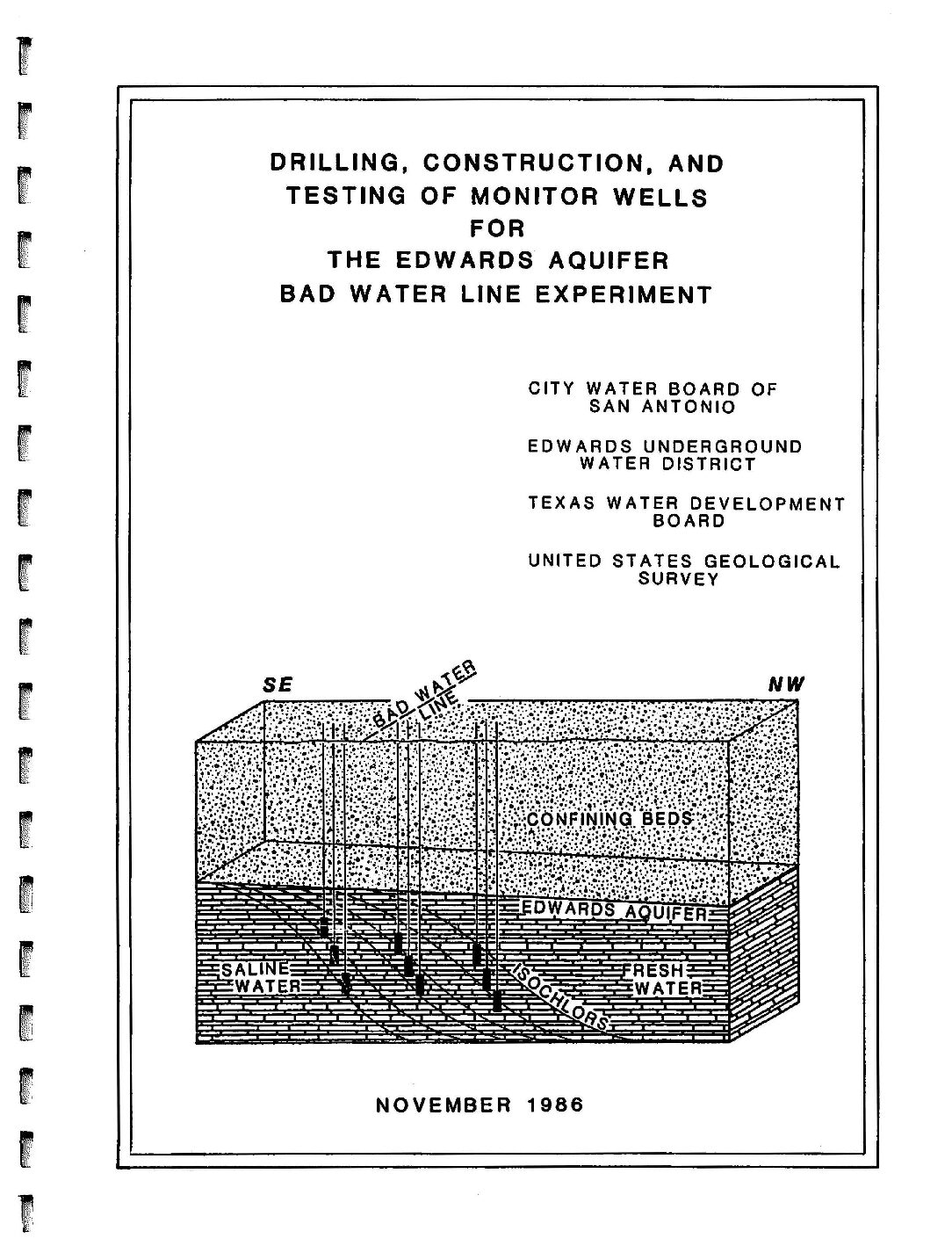
Description: Study of the fresh water-saline interface using new monitoring wells in the San Antonio Artesia Water Field. Note: This report is included for its historical value and may no longer reflect current conditions.
Location: Edwards Aquifer, Balcones Fault Zone, San Antonio Segment, Artesia Well Field
Summary:Note: This report is included for its historical value and may no longer reflect current conditions.
The primary purpose for the Edwards aquifer bad water line experiment is to establish a long-term monitoring system and develop site-specific information at one location along the bad water line. Ongoing analysis of information obtained as a result of this project is expected to help in determining whether encroachment of poor quality water presents a serious problem to maximum use of the aquifer as natural and man-made stresses of the aquifer come to pass, and in determining ways to avoid the problem to the extent it exists.
This report discusses the drilling, construction, and testing of monitor wells along a transect of the Edwards aquifer bad water line and the data that were obtained during those operations. The transect is the first of a number of similar transects that are planned for various locations along the bad water line of the Edwards aquifer in the San Antonio region. It is located near the City Water Board of San Antonio's Artesia Well Field in the eastern part of San Antonio, Texas.
Seven monitor wells were constructed during this part of the Edwards aquifer bad water line experiment. The wells are completed at different depths in the Edwards aquifer at three sites along the transect. Three wells are located at the bad-water zone site, the southernmost site, two are located at the transition-zone site, and two are located at the fresh-water zone site, which is adjacent to the Artesia Well Field and a little more than a mile north-northwest of the bad-water zone site.
The U.S. Geological Survey through a cooperative program with the City Water Board and the Edwards Underground Water District is currently making a more detailed analysis of conditions along the transect. This analysis will include microscopic examination of drill cutting samples and detailed study of geophysical logs, bore hole surveys, and geochemistry. Long-term monitoring of water levels and water quality will provide information for determining whether the bad water line shifts as a result of stresses imposed on the aquifer, and if so, how this is likely to affect the availability of fresh ground water.
In view of the presence of poor quality water in the lower part of the Edwards aquifer at the northernmost drilling site, it will be desirable to extend the transect northward into and beyond the Artesia Well Field to find out if poor quality water is present in the lower part of the aquifer in a much larger part of the area. Construction of additional monitor well transects of the Edwards aquifer bad water line will be needed in other areas to better establish how conditions along the bad water line are likely to affect the availability of fresh ground water from the aquifer on a regional basis.
Consideration needs to be given to constructing a transect of the bad water line in the New Braunfels or San Marcos areas to the north, and another one in the D'Hanis or Uvalde areas to the west. The bad water line in the areas to the north may be related to faulting, whereas in the areas to the west, it may be related to rock permeabilities. These areas are in or near major groundwater flow paths. Therefore, the information obtained from these transects also will contribute to a better understanding of regional hydrology.


 CURRENT