

 Aquifer Conditions
Science & Data Document Library
Science and Data Resources
Edwards Underground Water District strategic plan (1994-2004)

Description: Goals and objectives for the Edwards Underground Water District from 1994-2004. Note: This document is included for its historical value and has been replaced by more recent ones.
Location: Edwards Aquifer Balcones Fault Zone San Antonio Segment
Summary:Goals and objectives for the Edwards Underground Water District from 1994-2004. Note: This document is included for its historical value and has been replaced by more recent ones.
San Antonio & Guadalupe River Basins Study (Report to US Congress)
Trans-Texas Water Program West Central Study Area Phase I Interim Report Volume 5 / Comments Received from the Advisory Committee for Public and Technical Input
Description: Comments on public input for Phase I of the Trans-Texas Water Plan for West Central Texas
Location: West Central Texas
Summary:Comments on public input for Phase I of the Trans-Texas Water Plan for West Central Texas
Edwards Underground Water District Drought Management Plan
Description: Trigger conditions and actions to manage the Edwards Aquifer under conditions of drought. Note: This document is included for historical value and may have been replaced by more recent documents, including the Habitat Conservation Plan.
Location: Edwards Aquifer
Summary:[Note: This document is included for historical value and may have been replaced by more recent documents, including the Habitat Conservation Plan.]
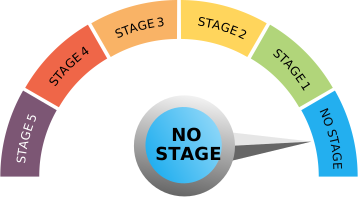
The Drought Management Plan (DMP) provides objective standards for determining that drought conditions exist, how long they continue and when a drought has ended. These standards also define increasing stages of drought severity. Drought conditions and stages are defined by hydrologic parameters which will be monitored by the District. Reduction goals and demand reduction measures are also established for each stage of drought severity.
Upon declaration of a drought, users will be required to initiate demand reduction measures to reduce pumping of the aquifer. Minimum demand reduction measures are defined in this document.
Additional measures will be identified in User Drought Management Plans (UDMPs) which the users must prepare pursuant to District rules. The combination of this District Drought Management Plan document and the UDMPs constitute the District's complete drought management program.
Programmatic Assessment: Proposed Rules 31 TAC Chapters 701, 702, 703, 705, 707, 709, 711 Part 2
Description: Part 2 of report on interviews of stakeholders and analysis of how to implement the Edwards Authority Act
Location: EAA geographical jurisdiction
Summary:[from the Executive Summary]
In 1993, the Texas Legislature passed the Edwards Authority Act (the Act), which created the Edwards Aquifer Authority (EAA, or Authority). The Act mandates that the Authority restrict and reduce the withdrawals of groundwater from the Edwards Aquifer, which is the primary water supply for more than 1.5 million Texans in and near San Antonio. The primary aim of the Act is to ensure that the region complies with the federal Endangered Species Act, a law that protects endangered and threatened species that rely on aquifer-fed spring flows for their habitat. The Authority's initial rules will limit permitted withdrawals to 450,000 acre-feet per year (AFY), which is less than needed for existing and future municipal, industrial, and irrigation purposes .
The Authority is in the process of adopting rules to implement the Act. Under Texas law, the Authority must complete several assessments specified in the Government Code. The assessments are intended to help the Authority to choose among policy options and to disclose the effects of the rules to the public. This report is a Programmatic Assessment of the initial rules prepared by the Authority's Rules Assessment Team. The Authority invites the public to review and comment on this document so the Authority's Board of Directors can make decisions based on the best available information.
In making the findings contained in the Programmatic Assessment and reported in this Executive Summary, the Assessment Team interviewed representatives from major stakeholder groups, used quantitative models to estimate certain economic and environmental effects, and evaluated regulatory alternatives.
The principal direct effects of the proposed rules are: (1) to limit withdrawals from the Edwards Aquifer, which will leave many users (especially municipalities) short of water and therefore facing increased costs to acquire replacement supplies; (2) to increase fees paid by users of Edwards water; and (3) to create a marketplace that will function primarily to cause abandonment, retirement, and transfer of irrigation rights.
Trans-Texas Water Program West Central Study Area Public Participation / Stakeholder Involvement Program Final Report
Description: Summary of stakeholder involvement in the 1998 Trans-Texas Water Program West Central Study Area
Location: West Central Texas
Summary:Summary of stakeholder involvement in the 1998 Trans-Texas Water Program West Central Study Area. Personal information has been omitted. Note: This report is included because of its historical value. It has been replaced by more recent plans.
Trans-Texas Water Program West Central Study Area Letter of Intent Analysis
Description: Feasibility and cost analysis for providing surface water to San Antonio from the Guadalupe River. Note: This report is included because of its historical value but has been replaced by more recent plans.
Location: San Antonio Region-Guadalupe River Basin
Summary:This is a detailed feasibility and cost analysis for providing surface water to San Antonio from the Guadalupe River.
Note: This report is included because of its historical value but has been replaced by more recent plans.
Programmatic Assessment: Proposed Rules 31 TAC Chapters 701, 702, 703, 705, 707, 709, 711 Part 3
Description: Part 3 of report on interviews of stakeholders and analysis of how to implement the Edwards Authority Act
Location: EAA geographical jurisdiction
Summary:[from the Executive Summary]
In 1993, the Texas Legislature passed the Edwards Authority Act (the Act), which created the Edwards Aquifer Authority (EAA, or Authority). The Act mandates that the Authority restrict and reduce the withdrawals of groundwater from the Edwards Aquifer, which is the primary water supply for more than 1.5 million Texans in and near San Antonio. The primary aim of the Act is to ensure that the region complies with the federal Endangered Species Act, a law that protects endangered and threatened species that rely on aquifer-fed spring flows for their habitat. The Authority's initial rules will limit permitted withdrawals to 450,000 acre-feet per year (AFY), which is less than needed for existing and future municipal, industrial, and irrigation purposes .
The Authority is in the process of adopting rules to implement the Act. Under Texas law, the Authority must complete several assessments specified in the Government Code. The assessments are intended to help the Authority to choose among policy options and to disclose the effects of the rules to the public. This report is a Programmatic Assessment of the initial rules prepared by the Authority's Rules Assessment Team. The Authority invites the public to review and comment on this document so the Authority's Board of Directors can make decisions based on the best available information.
In making the findings contained in the Programmatic Assessment and reported in this Executive Summary, the Assessment Team interviewed representatives from major stakeholder groups, used quantitative models to estimate certain economic and environmental effects, and evaluated regulatory alternatives.
The principal direct effects of the proposed rules are: (1) to limit withdrawals from the Edwards Aquifer, which will leave many users (especially municipalities) short of water and therefore facing increased costs to acquire replacement supplies; (2) to increase fees paid by users of Edwards water; and (3) to create a marketplace that will function primarily to cause abandonment, retirement, and transfer of irrigation rights.
Evaluation of the Availability of Additional Water Supplies from the Edwards Aquifer
Description: Decision analysis of eight strategies for their utility in a possible adjustment of the Edwards Aquifer withdrawal cap
Location: Edwards Aquifer, Balcones Fault Zone, San Antonio Segment
Summary:The project team consisting of Daniel B. Stephens & Associates, Inc., Freese and Nichols, Turner, Collie and Braden, and George Veni and Associates has screened 25 studies and 8 strategies through a decision analysis process to identify any study or strategy that could be used to justify an adjustment of the Edwards Aquifer withdrawal cap. At present, two implemented water management strategies, The Edwards Aquifer Authority's (Authority's) Precipitation Enhancement Program and the San Antonio Water System's (SAWS) Aquifer Storage and Recovery (ASR) project, passed the water-budget based screening process. These strategies currently appear to fall somewhat short of meeting some of the objectives required to justify adjusting the withdrawal cap.
The ASR strategy appears to be the more promising of the two. As the SAWS ASR project goes forward, and an operational track record is established, it may well provide the basis for a cap adjustment in the future.
In addition to the SAWS ASR project and the Precipitation Enhancement Program, the project team identified several other studies and strategies that have the potential to support an adjustment to the withdrawal cap once more conclusive information is developed or more reliable performance records are developed.
Draft 30-Year Water Supply Plan
Description: Draft of 30-year water supply plan for 2000-2030 as part of the Authority's Comprehensive Water Management Plan, adapted from the pertinent parts of the South Central Texas Regional Water Plan
Location: Edwards Aquifer Authority Jurisdiction
Summary:The Authority has adopted the recommendations presented in the South Central Texas Regional Water Plan [SCTRWP] as the 30-year water supply plan component of the Authority's Comprehensive Water Management Plan. Relevant information has been extracted from the regional water plan for the portion of the South Central Texas Regional Water Planning Area that is within the Authority's jurisdiction. This includes information pertaining to currently available water supply, projected water demands, projected water supply needs, and recommended strategies and their estimated costs. The Authority has adopted the recommendations presented in the SCTRWP with the understanding that regional water supply planning is a dynamic process and that SCTRWP is to be updated at a minimum every five years. Accordingly, water management strategies recommended for implementation may be modified to reflect changing conditions or new information. Also, it is understood that other water management strategies that are of interest to the Authority will continue to be evaluated for possible inclusion in the SCTRWP and the Authority's water supply plan in the future.
In preparing this plan, the Authority relied on published information contained in the initially prepared draft and final draft of the SCTRWP and its appendices. In addition, extensive coordination occurred with South Central Texas Regional Water Planning Group's engineering and planning contractor to ensure the accuracy of the information presented in the Authority's water supply plan.
The Authority's 30-year water supply plan is organized into three sections. Section 2.0 presents an overview of projected water demand and currently available water supply for the Authority's jurisdictional area. Also presented is a summary of water supply needs derived from the comparison of estimates of currently available water supply with projected water demands. This supply/demand analysis is presented for a baseline scenario of 340,000 acre-feet per year of withdrawals from the Edwards Aquifer, which is the water availability scenario adopted for planning purposes and used in the SCTRWP.
Section 3.0 of this plan provides a summary of water management strategies currently underway and the water management strategies recommended in the SCTRWP for implementation within the Authority's jurisdictional area. This includes information regarding the quantities and timing of water supplies to be provided by each strategy.
Section 4.0 presents a summary of the water supply plan for the Edwards Aquifer Region as presented in the adopted water plan for the South Central Texas Regional Water Planning Area.
Programmatic Assessment: Proposed Rules 31 TAC Chapters 701, 702, 703, 705, 707, 709, 711 Part 1
Description: Part 1 of report on interviews of stakeholders and analysis of how to implement the Edwards Authority Act
Location: EAA geographical jurisdiction
Summary:[from the Executive Summary]
In 1993, the Texas Legislature passed the Edwards Authority Act (the Act), which created the Edwards Aquifer Authority (EAA, or Authority). The Act mandates that the Authority restrict and reduce the withdrawals of groundwater from the Edwards Aquifer, which is the primary water supply for more than 1.5 million Texans in and near San Antonio. The primary aim of the Act is to ensure that the region complies with the federal Endangered Species Act, a law that protects endangered and threatened species that rely on aquifer-fed spring flows for their habitat. The Authority's initial rules will limit permitted withdrawals to 450,000 acre-feet per year (AFY), which is less than needed for existing and future municipal, industrial, and irrigation purposes .
The Authority is in the process of adopting rules to implement the Act. Under Texas law, the Authority must complete several assessments specified in the Government Code. The assessments are intended to help the Authority to choose among policy options and to disclose the effects of the rules to the public. This report is a Programmatic Assessment of the initial rules prepared by the Authority's Rules Assessment Team. The Authority invites the public to review and comment on this document so the Authority's Board of Directors can make decisions based on the best available information.
In making the findings contained in the Programmatic Assessment and reported in this Executive Summary, the Assessment Team interviewed representatives from major stakeholder groups, used quantitative models to estimate certain economic and environmental effects, and evaluated regulatory alternatives.
The principal direct effects of the proposed rules are: (1) to limit withdrawals from the Edwards Aquifer, which will leave many users (especially municipalities) short of water and therefore facing increased costs to acquire replacement supplies; (2) to increase fees paid by users of Edwards water; and (3) to create a marketplace that will function primarily to cause abandonment, retirement, and transfer of irrigation rights.
An Evaluation of the 1997 Edwards Aquifer Irrigation Suspension
Description: Evaluation of Edwards Aquifer Authoritys Irrigation Suspension Program in 1997 and alternatives
Location: Edwards Aquifer Authority Jurisdiction
Summary:In early 1997, the Texas Edwards Aquifer Authority implemented a pilot Irrigation Suspension Program (ISP) with the objectives of increasing springflow and providing relief to municipalities during drought. Irrigators were paid $2,350,000 to suspend water use. The price paid per suspended acre was substantially higher than regional lease rates and land prices would imply. The region experienced a wet spring, but estimates show if conditions had been dry, that suspending irrigation would have substantially reduced pumping and augmented critical springflow. Effects on the local economy appeared to be small. We evaluate the ISP and two alternatives: (1) subsidizing more efficient irrigation technology and (2) buying land. The irrigation suspension is a more cost-effective source of critical water than subsidizing more efficient irrigation because it can be put in place only when water is most needed. But land purchases would reduce program cost if the bid levels remained at the level observed in the 1997 program.
1995_TWDB-etal_AlternativeDiversionsCriteria
The Edwards Underground Reservoir and the Edwards Underground Water District: Uvalde, Medina, Bexar, Comal and Hays Counties
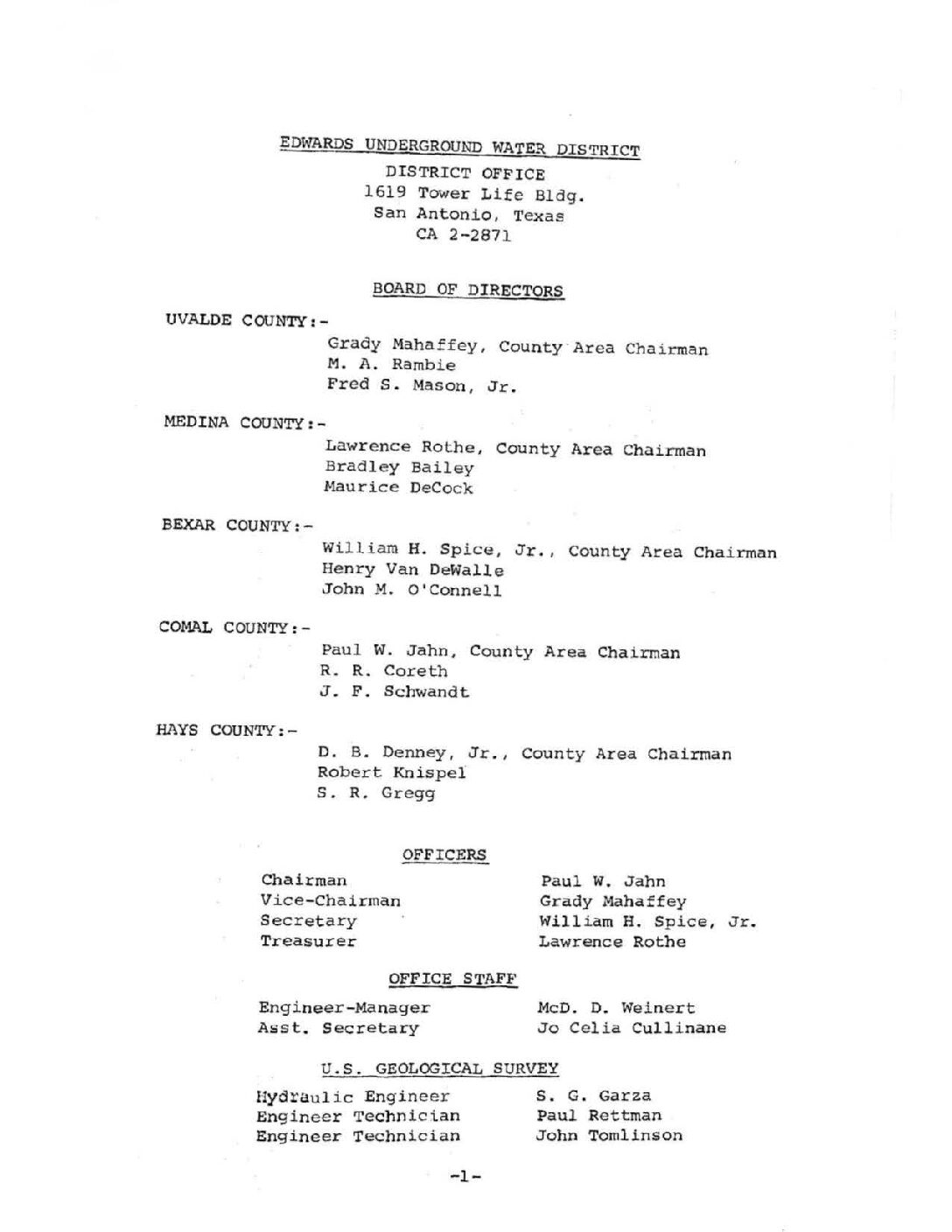
Description: General description of the Edwards Aquifer and the Edwards Underground Water District. Note: No cover page. This document is included for its historical value and has been replaced by more recent ones.
Summary:General description of the Edwards Aquifer and the Edwards Underground Water District. Note: No cover page. This document is included for its historical value and has been replaced by more recent ones.
Evaluation of Stormwater Control Techniques and Programs
Description: Note: This report is included for its historical value and may have been replaced by more recent studies.
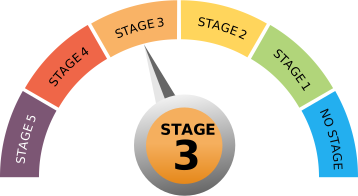


 CURRENT