
 Aquifer Conditions
Science & Data Document Library
Science and Data Resources
Chemical Analyses of Water from Observation Wells in the Edwards and Associated Limestones, San Antonio Area, Texas, 1966

Description: Chemical analyses of water from 37 wells to define the boundary of the freshwater-saline water interface in the Edwards Aquifer Balcones Fault Zone San Antonio segment in 1966. Note: This report is included for its historical value; results may have been superseded by more recent studies.
Report Number: Bulletin 13
Location: Freshwater/Saline Interface, Edwards Aquifer Balcones Fault Zone San Antonio Segment
Summary:Note: This report is included for its historical value; results may have been superseded by more recent studies.
A program to resample observation wells tapping a zone of transition between water of good quality and saline water in the Edwards and associated limestores was begun in 1959. The chemical analyses of the resampling program are being used to detect possible encroachment of saline water into the fresh-water areas as the head in the aquifer changes. Those analyses compiled through 1965 were published by the Edwards Underground Water District (Garza, 1962b, 1964, 1965, 1966), and this report presents the chemical analyses compiled during 1966. This program is part of a more extensive hydrologic investigation carried on by the U.S. Geological Survey in cooperation with the Edwards Umerground Water District, the Texas Water Development Board, and the city of San Antonio.
Listed in this report are chemical analyses from 37 wells, most of which are sampled twice a year, but some are sampled only once a year because they are little used. The number of wells was reduced in 1966 from 72 to 37, but the original 72 will be sampled again when water levels drop to those levels near and below the recorded lows.
The water samples are analyzed in the laboratory of the U. S. Geological Survey in Austin, Texas, for specific conductance, pH, chloride, sulfate, bicarbonate, and hardness. A more complete analysis has been made for one sample from each well, and these analyses are on file in the offices of the Geological Survey in Austin and San Antonio. Locations of wells and other data pertaining to the resampling program may be found in tables in the report.
Chemical Analyses of Water from Observation Wells in the Edwards and Associated Limestones, San Antonio Area, Texas, 1965
Description: Chemical analyses of water from 72 wells to define the boundary of the freshwater-saline water interface in the Edwards Aquifer Balcones Fault Zone San Antonio segment in 1965. Note: This report is included for its historical value; results may have been superseded by more recent studies.
Report Number: Bulletin 10
Location: Freshwater/Saline Interface, Edwards Aquifer Balcones Fault Zone San Antonio Segment
Summary:This report is included for its historical value; results may have been superseded by more recent studies.
A program to resample observation wells tapping a zone of transition between water of good quality and saline water in the Edwards and associated limestones was begun in 1959. The chemical analyses of the resampling program are being used to detect possible encroachment of saline water into the freshwater areas as the head in the aquifer changes. Those analyses compiled through 1964 were published by the Edwards Underground Water District (Garza, 1962b, 1964, 1965), and this report presents the chemical analyses compiled during 1965. This program is part of a more extensive hydrologic investigation carried on by the U.S. Geological Survey in cooperation with the . Edwards Underground Water District, the Texas Water Commission, and the city of San Antonio.
Listed in this report are chemical analyses from 72 wells most of which are sampled twice a year, put some are sampled only once a year because they are little used. The water samples are analyzed in the laboratory of the U.S. Geological Survey in Austin, Texas, for specific conductance, pH, chloride, sulfate, bicarbonate, and hardness. A more complete analysis has been made for one sample from each well, and these analyses are on file in the offices of the Geological Survey in Austin and San Antionio. Locations of wells and other data pertaining to the resampling program may be found in tables in the report.
Chemical Analyses of Water from Observation Wells in the Edwards and Associated Limestones, San Antonio Area, Texas, 1964
Description: Chemical analyses of water from 80 wells to define the boundary of the freshwater-saline water interface in the Edwards Aquifer Balcones Fault Zone San Antonio segment in 1964. Note: This report is included for its historical value; results may have been superseded by more recent studies.
Report Number: Bulletin 7
Location: Freshwater/Saline Interface, Edwards Aquifer Balcones Fault Zone San Antonio Segment
Summary:Note: This report is included for its historical value; results may have been superseded by more recent studies.
A program to resample observation wells tapping a zone of transition between water of good quality- and saline water in the Edwards and associated limestones was begun in 1959. The chemical analyses of the resampling program are being used to detect possible encroachment
of saline water into the fresh-water areas as the head in the aquifer changes. Those analyses compiled through 1963 were published by the Edwards Underground Water District (Garza, 1962, 1964), and this report presents the chemical analyses compiled during 1964.
This program is part of a more extensive hydrologic investigation carried on by the U.S. Geological Survey in cooperation with the Edwards Underground Water District, the Texas Water Commission, and the city of San Antonio.
Listed in this report are chemical analyses from 80 wells which usually are sampled twice a year, but some of the wells are sampled only once throughout the year because their use is limited.
The water samples were analyzed in the laboratory of the U.S. Geological Survey in Austin, Tex., for specific conductance, pH, chloride, sulfate, bicarbonate, and hardness. A more complete analysis was made for one or the samples from each well, and these analyses are on file in the offices of the Geological Survey in Austin and San Antonio. Locations o£ wells and other data pertaining to the resampling program may be found in tables in the report.
Chemical Analyses of Water from Observation Wells in the Edwards and Associated Limestones, San Antonio Area, Texas, 1963
Description: Chemical analyses of water from 100 wells to define the boundary of the freshwater-saline water interface in the Edwards Aquifer Balcones Fault Zone San Antonio segment in 1963. Note: This report is included for its historical value; results may have been superseded by more recent studies.
Report Number: Bulletin 4
Location: Freshwater/Saline Interface, Edwards Aquifer Balcones Fault Zone San Antonio Segment
Summary:Note: This report is included for its historical value ; results may have been superseded by more recent studies.
Ground water users in the San Antonio area have been concerned about possible encroachment of saline water into the fresh-water-bearing part of the Edwards and associated limestones as the head in the aquifer changes. As a result, the program to resample observation wells tapping the zone of transition between water of good quality and saline water in the Edwards and associated limestones was begun in 1959. Chemical analyses compiled through 1962 were published by the Edwards Underground Water District (Garza, 1962), and this report presents the chemical analyses compiled during 1963. The resampling program is part of a more extensive hydrologic investigation carried on by the U. S. Geological Survey in cooperation with the Edwards Underground Water District, the Texas Water Commission, and the city of San Antonio.
Chemical analyses of water from 100 wells are listed in this report. Most of the wells are sampled twice a year, but some of the wells are not in continuous use and it is not possible to sample them that frequently. About 80 wells are sampled twice a year; the remainder have been placed on standby to be resampled when the wells are in use.
The water samples are analyzed in the laboratory of the U.S. Geological Survey in Austin, Tex., for specific conductance , pH, chloride, sulfate, bicarbonate, and hardness . A more complete analysis has been made for one of the samples from each well, and these analyses are on file in the offices of the Geological Survey in Austin and San Antonio. Locations of wells and other data pertaining to the resampling program may be found in tables in the report.
Chemical Analyses of Water from Observation Wells in the Edwards and Associated Limestones, San Antonio Area, Texas [1959-1962]
Description: Chemical analyses of water from 129 wells to define the boundary of the freshwater-saline water interface in the Edwards Aquifer Balcones Fault Zone San Antonio segment,some data going back to 1959. Note: This report is included for its historical value; results may have been superseded by more recent studies. Last page of file is full-size plate.
Report Number: Bulletin 1
Location: Freshwater/Saline Interface, Edwards Aquifer Balcones Fault Zone San Antonio Segment
Summary:Note: This report is included for its historical value; results may have been superseded by more recent studies.
The city of San Antonio and other water users in the San Antonio area have been concerned about the possibility of the encroachment of saline water into the fresh water-bearing part of the aquifer supplying the area. As a result, a program was begun in 1959 to resample wells tapping the zone of transition between water of good quality and saline water in the Edwards and associated limestones, in order to detect changes in quality of the water as the head in the aquifer changed. This program is part of a more extensive hydrologic investigation being carried on by the U.S. Geological Survey in cooperation with the Edwards Underground Water District, the Texas Water Commission, and the City of San Antonio. As part of this program, about 120 wells are resampled twice a year; the water is analyzed in the laboratory of the Geological Survey in Austin, Tex., for specific conductance, pH, chloride, sulfate, bicarbonate, and hardness. A more complete chemical analysis is made for one of the samples from each well in the program. These more complete analyses are on file in the offices of the Geological Survey in Austin and San Antonio.
Chemical analyses of water from 129 wells are shown in the table in this report. The analyses of samples collected before 1959 for many of the wells are shown also. Some of the wells are no longer in use, but chemical analyses of previous samples from these wells are carried in the records, although future sampling may not be possible. Figure 1 shows the location of the resampled wells and an arbitrary boundary line between water of good quality, containing less than 1,000 parts per million (ppm), and saline water, containing more than 1,000 ppm of dissolved solids (Garza, 1962, p. 38 ).
Groundwater Quality Monitoring Plan Edwards Aquifer Authority
Description: Groundwater quality management plan for the Edwards Aquifer Authority 2003-2006
Location: Edwards Aquifer Authority Jurisdiction
Summary:Water quality data provide the primary indicator of the state of water quality in the Edwards Aquifer, and are a key component in assessing its general condition. Water quality samples also provide the primary source of data for understanding and monitoring contaminant loading and migration in the Aquifer. This plan includes sections on data quality objectives (DQOs), sampling programs, analytical methods, field procedures, activities of other agencies, and guidelines for annual plan review.
The purpose of this plan is to provide a guidance document that ensures useful, consistent and defensible water quality data are produced by implementing appropriate procedures and methods when collecting and analyzing water quality samples. Water quality samples are currently collected under five sampling programs at the Edwards Aquifer Authority (the Authority). Data quality requirements vary by program and are discussed in Sections 2 and 3. The water quality sampling programs currently undertaken by the Authority are:
*Routine Water Quality Sampling
*Event Sampling
*Surface Water Sampling
*Spring Sampling
*Confirmation Sampling
The purpose of this plan can be achieved by implementation of the objectives listed below and discussed in detail herein. Each staff member charged with the responsibility of collecting water quality samples should be familiar with this plan, and the objectives and procedures outlined in it. The objectives of this plan are:
*Obtain quality data that are defensible for their intended purpose.
*Analyze field samples in an appropriate and consistent manner such that the results are accurate, and repeatable.
*Collect samples for laboratory analysis in an appropriate and consistent manner that will ensure accurate and reliable analytical results with a minimal amount of anomalous data.
*Select sample sites and time periods that will provide representative water quality data, for a range of aquifer conditions.
*Review and revise the plan on an annual basis as needed.
San Antonio Regional Water Resource Study-Summary
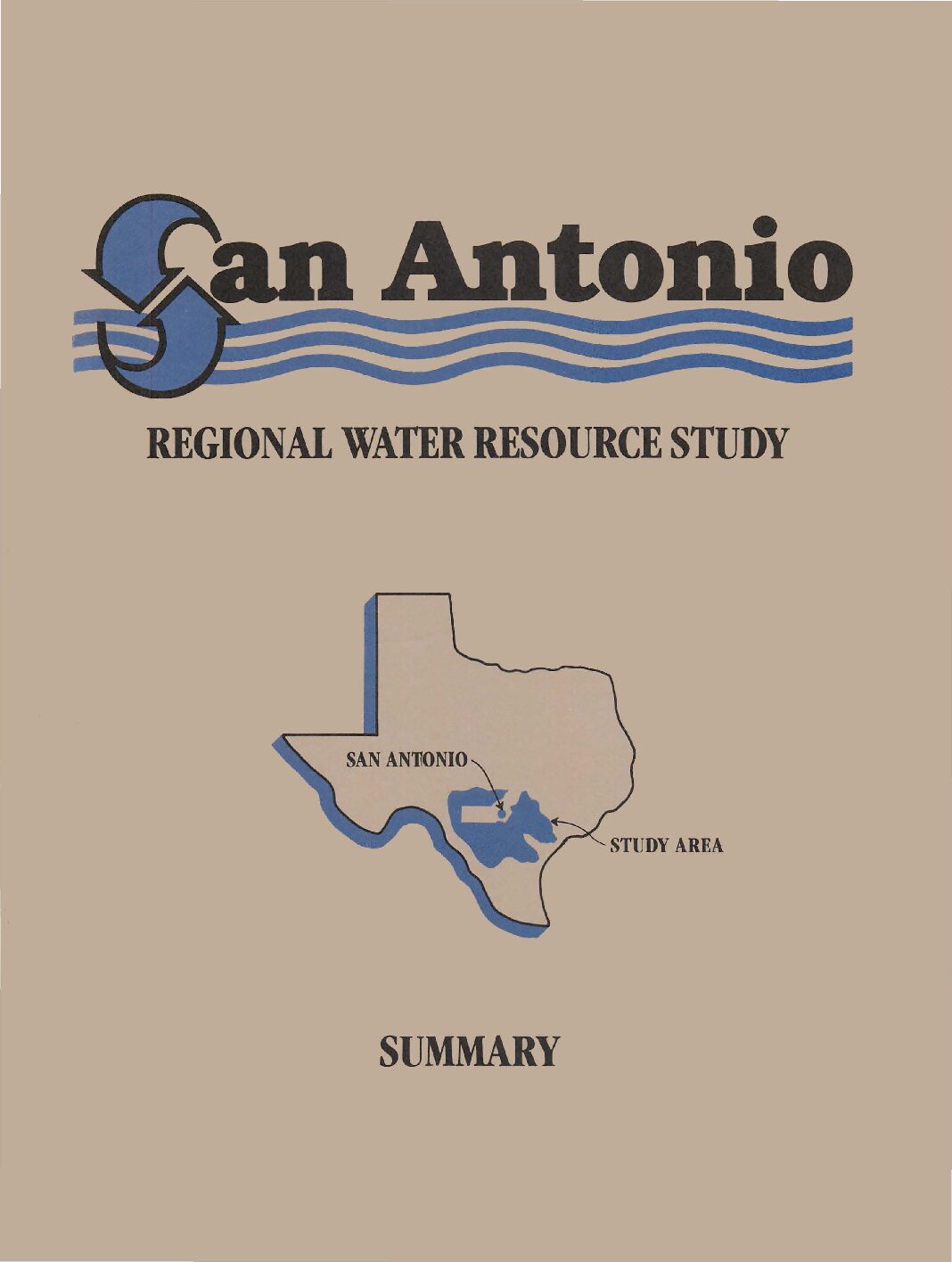
Description: Non-technical discussion of various alternatives for ensuring water supply for the greater San Antonio region through 2040, a 60-year horizon. Note: This report is included for its historical value and may have been superseded by more recent studies.
Location: Uvalde County, Medina County, Bexar County, Comal County, Hays County
Summary:Note: This report is included for its historical value and may have been replaced by more recent studies.
Continued long-term availability of water from the Edwards Aquifer requires both a technical knowledge of the quantity it can supply, and an understanding of the inseparability of quantity and the quality of the water in the Aquifer. Protection of quality is of primary importance to the future of the Region. Present efforts directed toward water quality protection must be continued and must be intensified if necessary. The Regional Study and this implementation effort have as their focus and intent the achievement of a Regional consensus on those measures and actions required to provide the Region's water users with an adequate long-term water supply of high quality. To this end, the study set out to provide a report that will:
*Enable reasonable people to make responsible decisions concerning public and private investments in the water resources of the Region,
*Insure that those decisions are consistent with regional economic development and environmental integrity and
*Inspire long-term confidence in these decisions.
The Regional Study has provided a framework to solve these regional problems:
*Provide an adequate and reliable water supply for a population expected to grow from 1.1 million people in 1980 to 3.2 million people in 2040.
*Meet short and long term water demands even when droughts occur.
*Protect water quality in the Edwards and the stream systems both from direct pollution and from movement of poor quality water into the Aquifer during periods of prolonged overpumping.
*Share water resources and costs for their development and use fairly among all purposes and parts of the Region.
*Recognize primary uses of water as they differ from East to West in the Region and permit choices of solutions that are tailored to fit needs and preferences of each area.
*Avoid crisis decisions whether forced by droughts, floods, or recessions.
*Retain control of costs and choices of resource allocation at the most appropriate local level.
*Maintain flexibility over time to respond properly to changing conditions as the people in the Region choose.
*Avoid committing either money or resources before they are needed for recognized and agreed purposes.
*Retain management control of decisions at the most local level of government appropriate.
Preliminary Feasibility Assessment of Edwards Aquifer Saline Water Treatment and Use
Description: Feasibility of desalination from the Edwards Aquifer for public drinking water
Report Number: SwRI Report CNWRA-EAA-01
Location: Edwards Aquifer, Balcones Fault Zone, San Antonio Segment
Summary:The Edwards Aquifer is the primary source of water for more than one million people in and near San Antonio, Texas, and supplies potable water as well as water for agricultural, industrial, and recreational purposes throughout an 8,000-square-mile area of south-central Texas. In the last five decades, increased population growth and water demand in San Antonio and surrounding areas have resulted in dramatic increases in average pumping from Edwards Aquifer wells. Water resource planners project that by the year 2020, demand for water in the Edwards Aquifer region could be 863,000 acre-feet per year. Water authorities and other entities in the Edwards Aquifer region, as well as in other parts of Texas, are concerned about potential shortfalls in future water supplies relative to future needs. For example, the 2002 Texas State Water Plan warns that about 900 cities and water user groups in Texas could face water shortages during droughts within the next fifty years unless demand for water is reduced and/or additional water sources are developed. In response to these concerns, public and private entities in Texas are evaluating and implementing desalination projects as alternative water sources. Desalination is a process that removes substances and minerals from brackish (or saline) ground and surface water, or seawater. Desalination is recommended in the 2002 State Water Plan as a water management strategy to produce additional water supplies in several regions of Texas, including the south-central Texas region. The technology is particularly promising for the Edwards Aquifer region because of the presence of an extensive saline-water zone in the Edwards Aquifer, downdip of the fresh water zone. The saline-water zone has not been tapped as a water source due to the high dissolved solids concentration (1,000 to over 10,000 mg/L), but it has the potential to be an important source of water if desalination technology becomes an economically viable choice.
As demand for water in the Edwards Aquifer region starts to exceed the availability of fresh water from the aquifer, desalination of water pumped from the saline-water zone likely will become increasingly important. This document was prepared for the Edwards Aquifer Authority and presents a preliminary study on the feasibility of pumping and treating saline water from the Edwards Aquifer to produce potable water. The report provides background technical information on reverse osmosis (RO) and electrodialysis reversal (EDR)-the dominant desalination technologies for municipal water treatment plants, and summarizes information on existing and planned municipal water treatment plants employing similar technologies. Preliminary cost curves are calculated for the treatment of saline waters as a function of operating parameters. The estimated costs are compared with cost data from existing plants and with estimated costs taken from the literature or provided by a vendor. In addition, preliminary estimates of potential yield from wells that may tap the Edwards Aquifer saline-water zone are made to determine if sufficient saline water could be drawn from the aquifer for use as feedwater for the desalination facility.
Investigation of Volatile Organic Compounds in Groundwater Uvalde, Texas Edwards Underground Water District Field Activities from January 1984 through April 1988
Description: Survey of groundwater to determine the source of tetrachloroethylene (PCE) in the Edwards Aquifer near the Uvalde, TX airport
Location: Edwards Aquifer - Uvalde Area
Summary:The Edwards Underground Water District (EUWD) has been involved in an investigation to determine the source of volatile organic compounds (VOCS) in the Edwards aquifer in the Uvalde, Texas area (fig. 1). Existing Edwards aquifer wells were used to trace voc contamination up the hydraulic gradient in a west-northwest direction from the point of initial discovery to an area where highly contaminated wells exist. Wells further up the hydraulic gradient and in a distinct area around the contaminated area are free of VOC contamination. A monitor well drilling and sampling program was employed to better define the source area. Surface and subsurface geophysical techniques were used to reinforce monitor well data and further delineate a source area.
From September 1983 through February 1984 the u.s. Geological Survey (USGS) collected water samples from selected wells to provide baseline data on volatile organic compounds (VOC) in the Uvalde area. The samples were collected under a cooperative contract with the EUWD. Most samples were collected from public supply wells, however, some samples were collected from private wells. In February 1984 five wells were sampled for VOCs in the Uvalde area (see Appendix B for details of all sampling events).
The only VOC found was tetrachloroethylene (PCE) at a level of 6.4 micrograms per liter (ug/l) in a municipal well located at the Uvalde County airport (Garner Field). This VOC contaminated groundwater sample prompted further investigation.
To verify contamination in the vicinity of the municipal airport two sampling events were conducted in April and August, 1984. A total of eight wells were sampled including the airport well. Of the eight wells four showed PCE contamination.
Four wells drawing water from the Edwards aquifer were polluted with the same compound. This was sufficient evidence to rule out contamination by well construction materials or laboratory error. At this point it was reasonable to assume the volatile organic compound tetrachloroethylene (PCE) existed in the Edwards aquifer in the vicinity of the municipal airport.
Water Quality at Selected Locations in the San Antonio Area, Texas: Progress Report, 1972
Description: Results of water quality testing at selected sites in the Edwards Aquifer from September 1969 August 1971
Location: Edwards Aquifer Balcones Fault Zone San Antonio Segment
Summary:The U.S. Geological Survey, in cooperation with the Edwards Underground Water District and the Texas Water Development Board, is conducting a continuing investigation of water quality in the aquifer formed by the Edwards and associated limestones in the San Antonio area.
The program was initiated in 1968 to collect historical reference data for determining changes in water quality and to detect any current pollution of the ground water. Results of the study from August 1968 to August 1969 are reported by Reeves and Blakey (1970) .
This report includes water-quality data collected from September 1969 to August 1971 and some data from selected analyses made prior to 1969.
Chemical and Bacteriological Quality of Water at Selected Sites in the San Antonio Area, Texas February 1975-September 1977
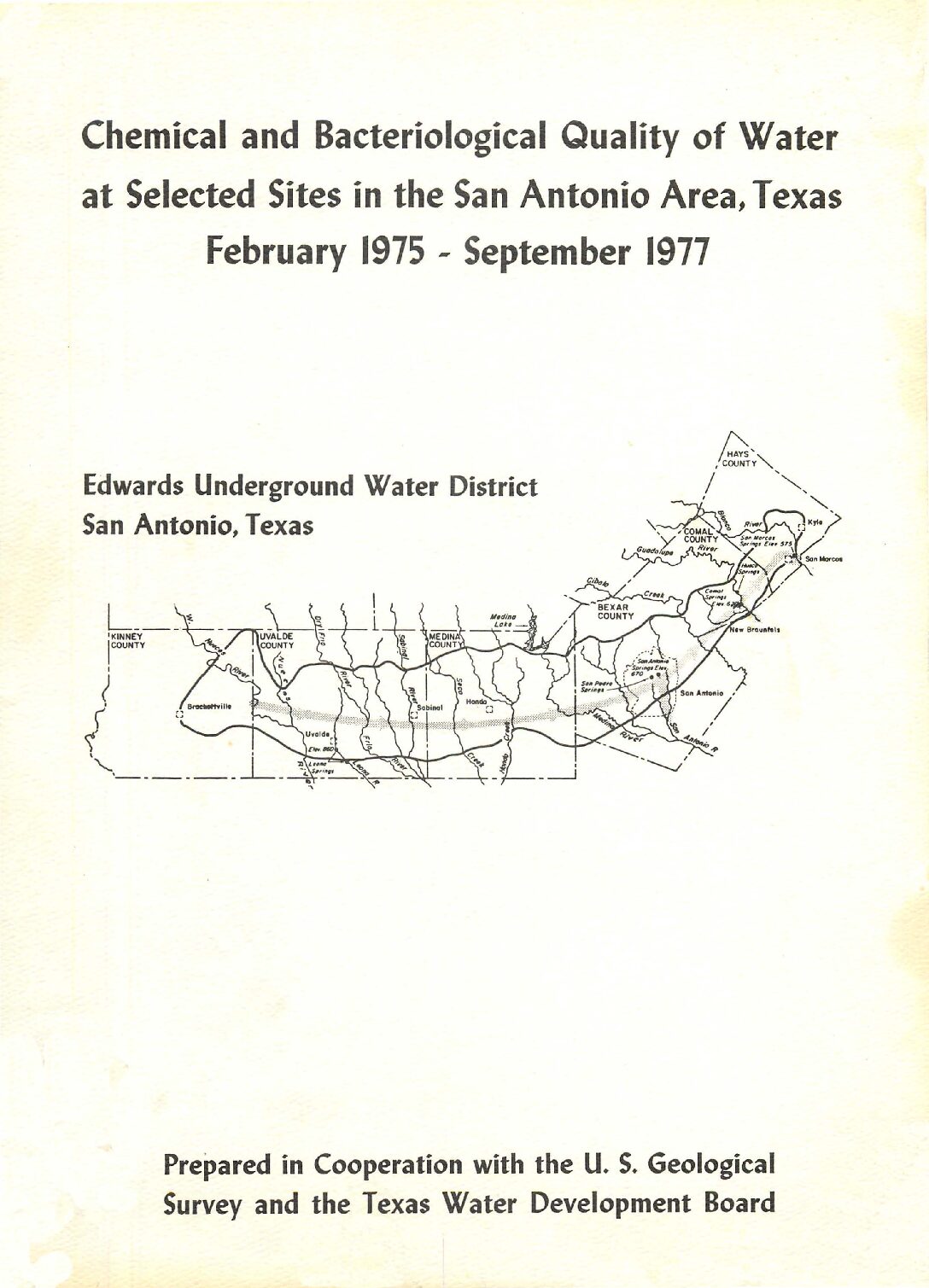
Description: Surface and groundwater quality monitoring in the San Antonio area, 1975-1977. Note: Page-size and full-size plate are at the end of the document.
Location: Edwards Aquifer, Balcones Fault Zone, San Antonio Segment, and associated surface water
Summary:Water samples collected from 79 wells and 3 springs in the Edwards aquifer were analyzed for more than 50 properties or constituents, most of which affect the suitability of the water for domestic use. The samples were analyzed for bacteria; major inorganic constituents; minor elements, including heavy metals; and pesticides.
Water quality of the Edwards Aquifer and streams recharging the aquifer in the San Antonio region, Texas (Map)
Description: Low-resolution maps and discussion of water quality in the Edwards Aquifer Balcones Fault Zone San Antonio Segment. Note: file size for full-size maps is too large.
Report Number: USGS Hydrologic Investigations Atlas HA-723
Location: Edwards Aquifer Balcones Fault Zone San Antonio Segment
Summary:Low-resolution maps and discussion of water quality in the Edwards Aquifer Balcones Fault Zone San Antonio Segment. Note: file size for full-size maps is too large.
Chemical and Bacteriological Quality of Water at Selected Sites in the San Antonio Area, Texas August 1968-January 1975
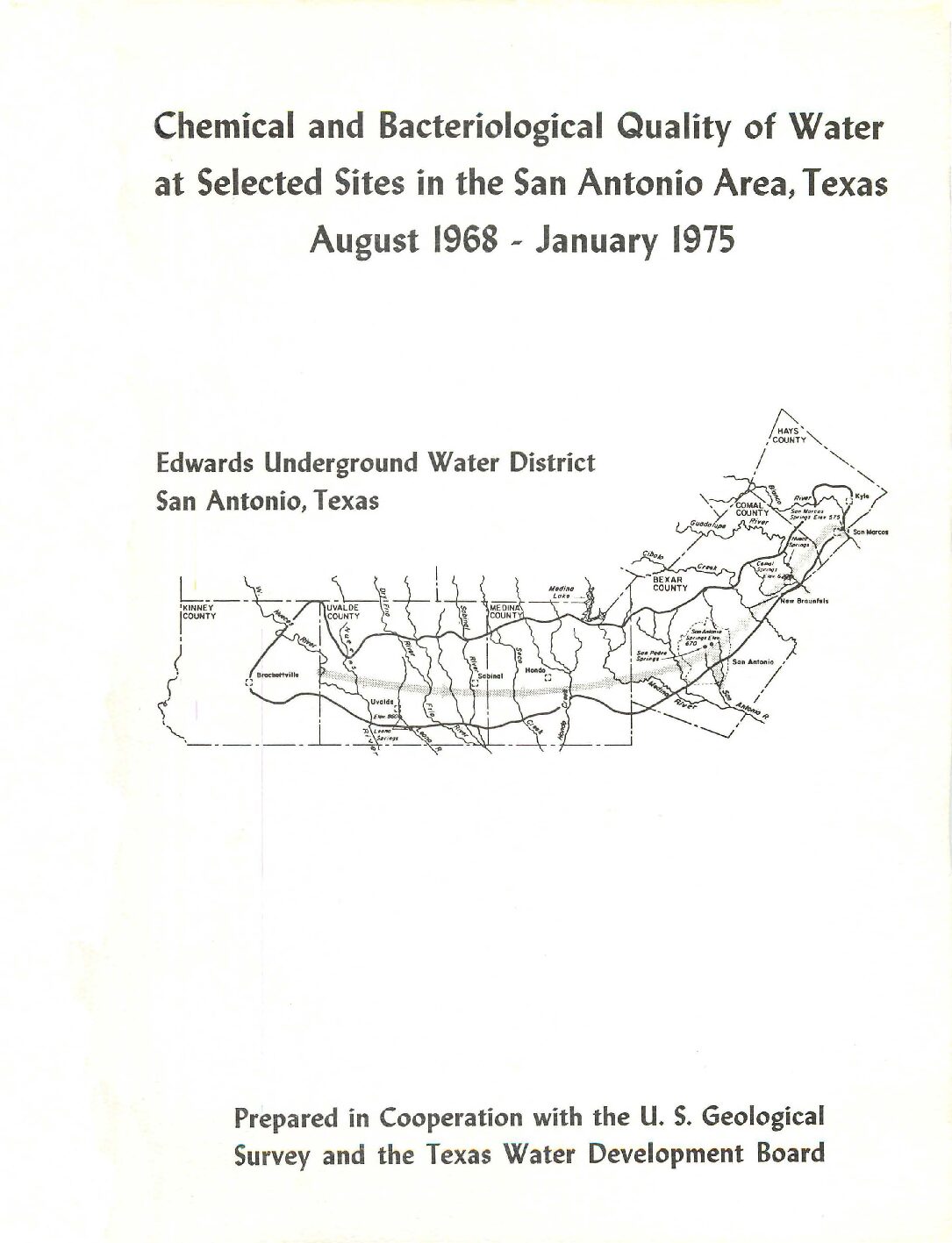
Description: Surface and groundwater quality monitoring in the San Antonio area, 1968-1976. Note: Page-size and full-size plates are at the end of the document.
Location: Edwards Aquifer, Balcones Fault Zone, San Antonio Segment, and associated surface water
Summary:Water samples collected from 161 wells and 3 springs in the Edwards aquifer and at 36 sites on streams that cross the recharge zone of the aquifer were analyzed for more than 50 properties or constituents, most of which affect the suitability of the water for domestic use. The samples were analyzed for bacteria; major inorganic constituents; minor elements, including heavy metals; pesticides; and several other properties or constituents.
None of the concentrations of major inorganic constituents, minor elements, or pesticides exceeded the U.S. Environmental Protection Agency's maximum contaminant levels for public water systems or maximum.acceptable limits for raw water used for drinking-water supplies. The concentrations of dissolved solids in samples from wells and springs ranged from about 200 to 527 mg/l (milligrams per litre) and the dissolved chloride and dissolved sulfate concentrations ranged from 3.7 to 130 mg/l and from 0.0 to 83 mg/l, respectively. The total nitrite plus nitrate nitrogen and total phosphorus concentrations in the ground water ranged from 0.00 to 5.5 mg/l and from 0.00 to 0.12 mg/l. The water is very hard (greater than 180 mg/l as calcium carbonate) and is of the calcium bicarbonate type.
The recharge zone or water-table part of the aquifer is characterized by areas of thin soils or bare rock, and the aquifer is susceptible to contamination in these areas. The presence of fecal coliform and fecal streptococci bacteria, the variations in the number of total coliform bacteria, and the concentrations of total nitrite plus nitrate nitrogen and total phosphorus in samples from some wells in the water-table part of the aquifer show that contamination can and does occur. However, the data indicate that such contamination at the present time (1976) is very localized, and is small in comparison to the volume of water available for dispersion and dilution. In the artesian zone of the reservoir, samples from improperly constructed wells have contained coliform bacteria; but samples collected from properly constructed and sealed wells were free of coliform bacteria.
There is no evidence of significant degradation of water quality throughout most of the ground-water reservoir, but the data collected during this study indicate that the nearly unrestricted movement of liquids· from the surf ace to the aquifer in the recharge zone presents an ever-present hazard if surface spills of toxic substances should occur. In addition, the many poorly-constructed wells in the artesian part of the aquifer could allow toxic substances to enter the aquifer.
Chemical and Bacteriological Quality of Water at Selected Sites in the San Antonio Area, Texas August 1968-April 1972
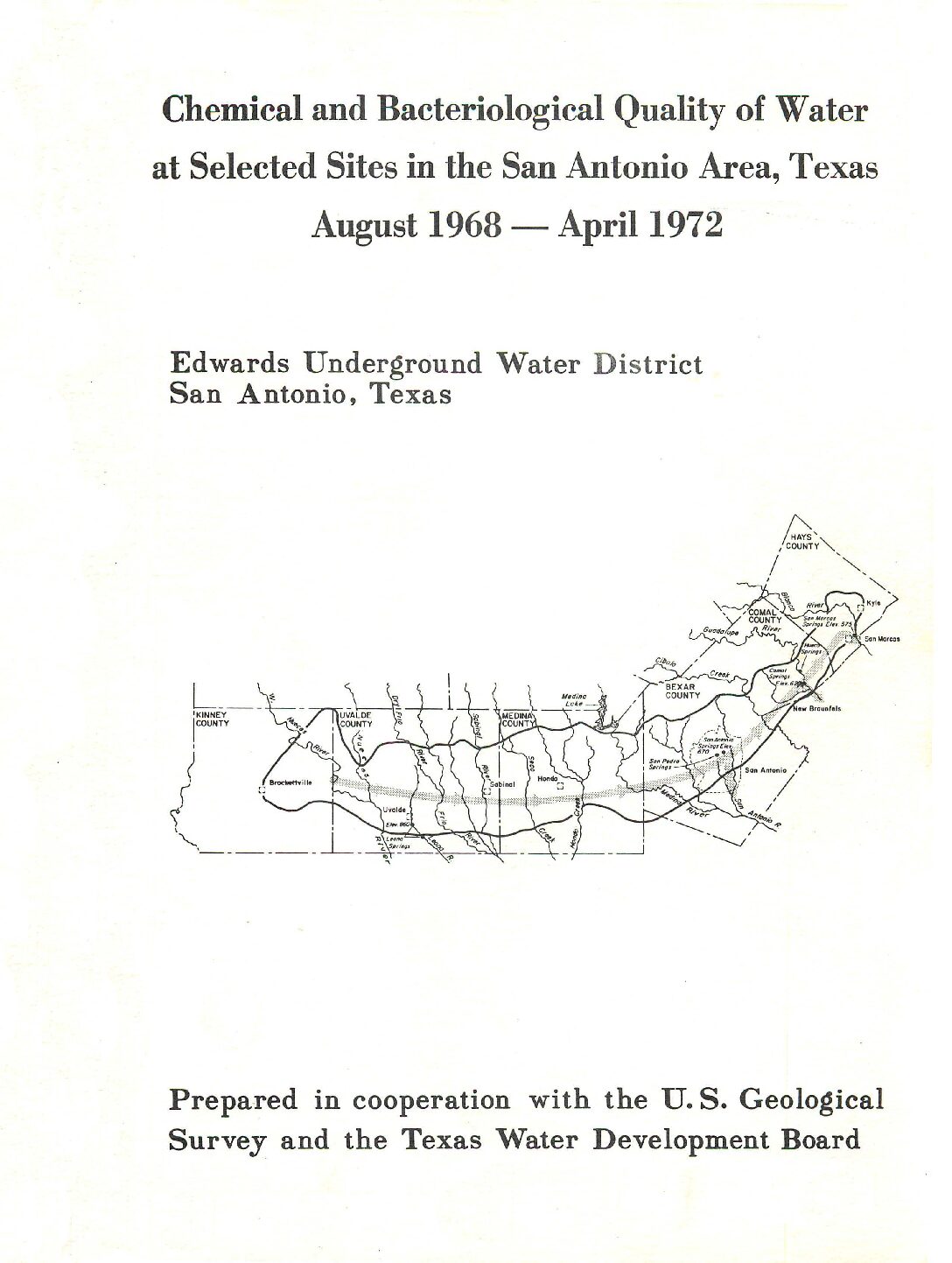
Description: Surface and groundwater quality monitoring in the San Antonio area, 1968-1972
Location: Edwards Aquifer, Balcones Fault Zone, San Antonio Segment, and associated surface water
Summary:Urban development on or adjacent to the recharge zone of the Edwards aquifer is causing concern about the possible pollution of ground water in the aquifer, which is the principal source of water supply for the San Antonio area. Water-quality data for many wells and springs and for selected sites on streams that cross the recharge zone of the aquifer are being collected to provide background information and to detect any current pollution of ground water in the area.
Water from the Edwards aquifer is very hard and of the calcium bicarbonate type. The concentrations of dissolved solids in samples from wells and springs ranged from about 200 to 470 mg/1 (milligrams per liter); the chloride and sulfate concentrations ranged from 6.5 to 62 mg/1 and from 0.0 to 65 mg/1, respectively. The nitrate and phosphate contents of the ground water ranged from 0.0 to 15 mg/1 and from 0.00 to 0. 37 mg/1.
The concentrations of these and other constituents show that the chemical quality of water in the Edwards aquifer has not been degraded significantly by domestic, industrial, or agricultural effluents.
However, variations in the number of coliforms, the concentrations of nitrate and phosphate, and the presence of fecal coliforms and fecal streptococci in samples from some wells show that fecal pollution is reaching the aquifer.
Most of these wells, which are located in or just downdip from the recharge zone, are poorly sealed or inadequately cased. The areal variation in the locations of these wells indicates that pollution of ground water in the aquifer is very localized. Pollution results principally from runoff from the land surface and from effluent from septic tanks which enters the aquifer through fractures in the recharge zone or which infiltrates through the thin soil into poorly sealed or inadequately cased wells in or adjacent to the recharge zone.
Trace amounts of several pesticides have been detected in samples from two wells in the San Antonio area. Field investigations showed the source of pesticides in these wells to be. surface drainage that entered the wellbores.
Water-quality data collected at sites on streams that cross the recharge zone of the Edwards aquifer show the chemical composition of surface water to be very similar to that of ground water in the area.
Water in most streams is very hard and of the calcium bicarbonate type. Limited data on the bacteriological quality show that coliforms were present at each of the sites sampled and that fecal coliforms and fecal streptococci were present at most sites. Although the number of these bacteria varied greatly in both time and place, their density in samples from most sites were low for untreated surface water.
Analysis of Water Quality Data for East Elm, West Elm and Lorence Creeks
Description: Water quality in three small watersheds in the Edwards Aquifer Recharge Zone in relation to storm water runoff and urbanization, 1976 - 1980
Location: Edwards Aquifer, Balcones Fault Zone, San Antonio Segment, Recharge Zone
Summary:Water quality data collected on East Elm, West Elm and Lorence Creeks were compiled and analyzed. The watersheds of the three streams are characterized by different levels of urbanization. The East Elm watershed is largely undeveloped, while the Lorence Creek basin is almost completely urbanized as a residential area. The West Elm watershed represents an intermediate level of development.
Statistical analysis of the water quality data indicated that mean concentration values of most of the constituents were higher at the Lorence Creek station than at either the East Elm or West Elm sites. Further, mean concentration values at the West Elm station were higher than corresponding values at the East Elm station.
The most apparent factor which may contribute to the observed differences in constituent concentrations is the level of urbanization in the test watersheds. However, additional factors could also contribute, such as physiographic variables and differences in the frequency and duration of stormwater runoff events. On the basis of flow-weighted average concentrations, West Elm Creek displayed the highest values, with no consistent difference evident between Lorence Creek and East Elm Creek.
Several mathematical relationships were examined to investigate correlations between constituent concentration and discharge rate for the three sampling stations. Only poor correlations were evident, indicating that concentrations are not a function of flow rate.


 CURRENT