

 Aquifer Conditions
Science & Data Document Library
Science and Data Resources
Assessment of Recharge Benefit from Enhanced Rainfall

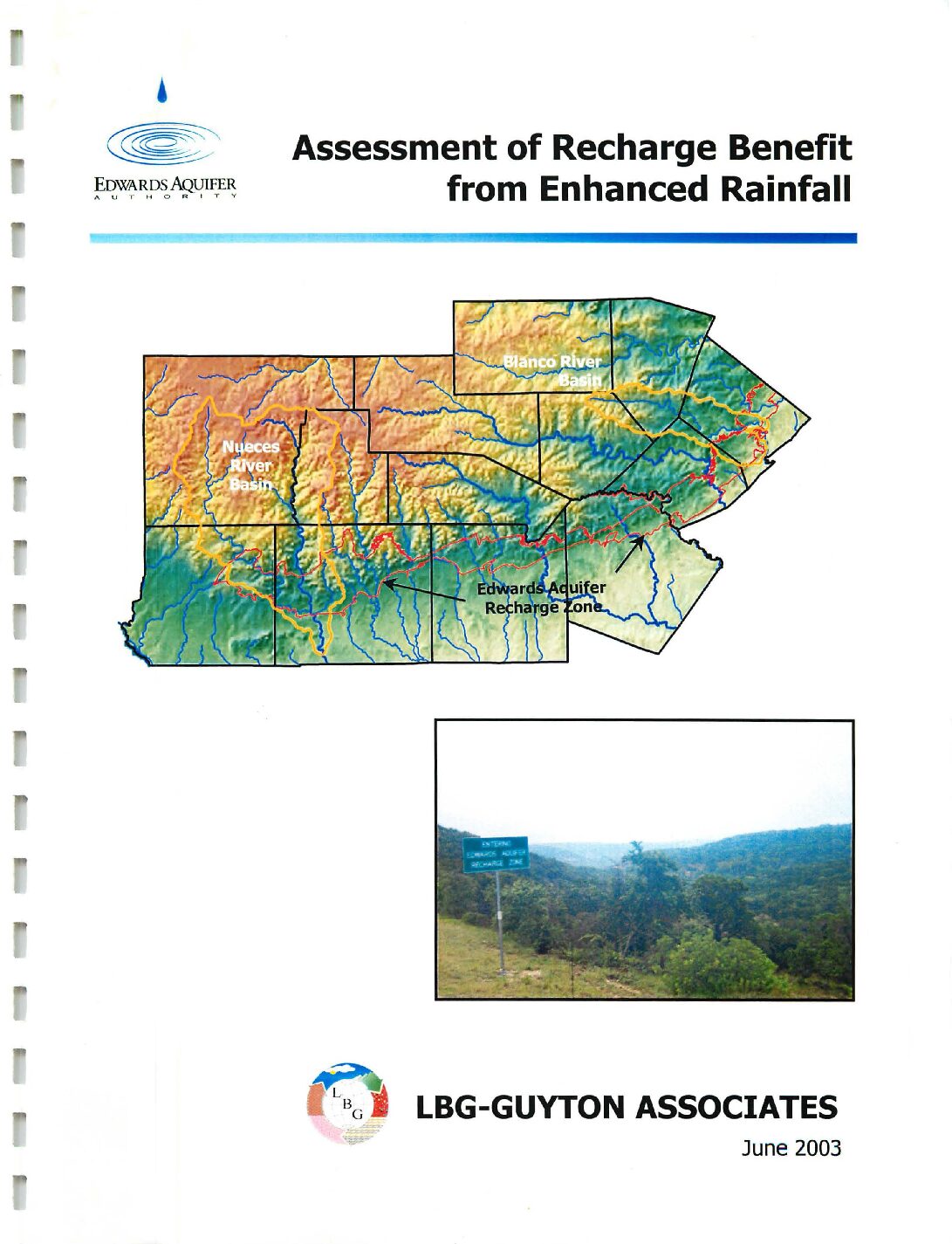
Description: Using the HSPF model to estimate recharge in the Blanco and Nueces River basins from the Edwards Aquifer Authority Precipitation Enhancement Program in 1999-2001
Location: Blanco River Basin, Nueces River Basin
Summary:LBG-Guyton Associates has used pilot recharge models (developed using HSPF (Hydrologic Simulation Package Fortran)) for the Nueces and Blanco River basins to estimate the total amount of increased recharge to the Edwards aquifer during the 1999, 2000, and 2001 Precipitation Enhancement Program (PEP) seasons. Woodley Weather Consultants (WWC)(2002) provided estimates of rainfall and seeding-induced rainfall increments for the Nueces and Blanco basins during the 1999, 2000, and 2001 seasons. These estimates of increased precipitation were used as a basis for simulating the impact of the PEP on aquifer recharge.
Modeling results indicate the total increased aquifer recharge during 1999, 2000, and 2001 in the Nueces basin was 663, 655 and 654 acre-feet per year respectively, which represents a 0.45, 0.34 and 0.19 percent per year increase respectively. The total increased recharge during the three-year period was 1,972 acre-feet, or 0.29 percent in the Nueces basin. In the Blanco basin, the increased aquifer recharge was 152, 179, and I ,00 I acre- feet per year respectively, which represents a 0.44, 0.56, and 1.92 percent per year increase respectively for the Blanco basin. The total increased aquifer recharge during the three-year period was I ,332 acre-feet, or 1.13 percent in the Blanco basin. About half of the Nueces basin is in the c loud seeding zone, which may have reduced the impact of the PEP with regard to aquifer recharge in that basin.
WWC (2002) indicates that the enhanced precipitation during the 1999, 2000, and 2001 seasons could have been increased if more cloud seeding had been performed. To simulate the effect of potentially greater enhanced precipitation, Scenario I was simulated. Scenario I assumed that the enhanced precipitation was equal to one inch on each of the days for which cloud seeding was considered successful (i.e., five days for Nueces basin and eight days for Blanco basin during the 3-year period). Scenario I modeling results indicate that the total increased aquifer recharge during 1999, 2000, and 2001 in the Nueces basin was 4, 123, 754, and 2,029 acre-feet per year respectively, which represents a 2.8, 0.4, and 0.6 percent per year increase respectively in the total recharge for the Nueces basin. The total increased recharge during the three-year period was 6,906 acre-feet, or 1.0 percent in the Nueces basin. In the Blanco basin, the increased aquifer recharge was I ,717, 550, 2,828 acre-feet per year respectively, which represents a 5.0, 1.7, 5.5 percent per year increase respectively in the total recharge for the Blanco basin. The total increased aquifer recharge during the three-year period was 5,095 acre-feet, or 4.2 percent in the Blanco basin.
Limitations and assumptions of the modeling methodology are discussed in this report. Important factors affecting the evaluation of the PEP are the spatial and temporal accuracy of the precipitation data and the inability of the pilot models to simulate hydrology in the contributing zones of the watersheds that recharge the aquifer. In order to evaluate the PEP in the future, it is recommended that appropriate resources be applied to collecting and evaluating precipitation data, especially during the PEP season. In addition, future models should simulate the hydrology of the entire watershed instead of j ust the recharge zone.
Edwards Aquifer Precipitation Enhancement Program Final Report 2001
Description: Summary of the Edwards Aquifer Precipitation Enhancement Program for 2001
Location: South Central Texas
Summary:This report summarizes the activities and data collected during the 2001 field operations of the Edwards Aquifer Precipitation Enhancement Program. This was the third year of a program conducted by Weather Modification Inc. (WMI) of Fargo, North Dakota, for the Edwards Aquifer Authority (the Authority) of San Antonio, Texas. The program was funded by the Edwards Aquifer Authority, the Texas Natural Resources Conservation Commission, and the Texas Department of Agriculture, with the sole intent being enhancement of precipitation through cloud seeding. The project area covered 6.37 million acres across south Texas, including all or parts of the following 12 counties: Bandera, Bexar, Blanco, Caldwell, Comal, Guadalupe, Hays, Kendall, Kerr, Medina, Real, and Uvalde. Seeding operations were conducted 24 hours-a-day, seven days a week from April 15 through September 15.
The facilities and procedures for this project were as follows: One C-band weather radar, computers, and a communications system were set up at the centrally located Hondo Regional Airport in Hondo, Texas, to monitor storms and control aircraft. The radar operated continuously throughout the five-month period. The storms, as detected by radar, were posted on the WMI Internet Home Page at 15-minute intervals, thus allowing remote near real-time viewing of operations. Two specially equipped cloud seeding aircraft were dedicated to the project; both were stationed in Hondo. On August 13, 2001, a hangar containing one of the aircraft caught fire and was destroyed, along with the aircraft. A replacement aircraft arrived at Hondo on August 14. Both aircraft were relocated to the Castroville Airport, 15 miles east of Hondo, on the morning of August 14.
High yield formulations of silver-iodide pyrotechnics and acetone solutions were used to generate high concentrations of very fast acting ice-nuclei. High performance aircraft crewed by experienced pilots and directed by experienced radar meteorologists treated developing regions of the storms by direct injection with the seeding agents.
The 2001 field program successfully achieved its objective, to seed those cells thought to have the potential to produce precipitation. During the five-month project, the two aircraft safely completed 58 flights totaling 152 hours 58 minutes. A total of 21.7 kg of seeding agent was dispensed in the form of 834 ejectable flares and approximately 82.8 gallons of silver iodide acetone solution, which was burned in wing-tip generators.
This final report for 2001 provides a general overview of the program and describes the methodology used. Pictures, tables, graphs, and references are used to summarize the operational activities. All of the project's radar data, meteorological data, and reports (weekly operations summaries and monthly reports) have been recorded onto CD-ROM and are available to the Authority.
South Texas Weather Modification Association Edwards Aquifer Authority Target Area 2008 Report
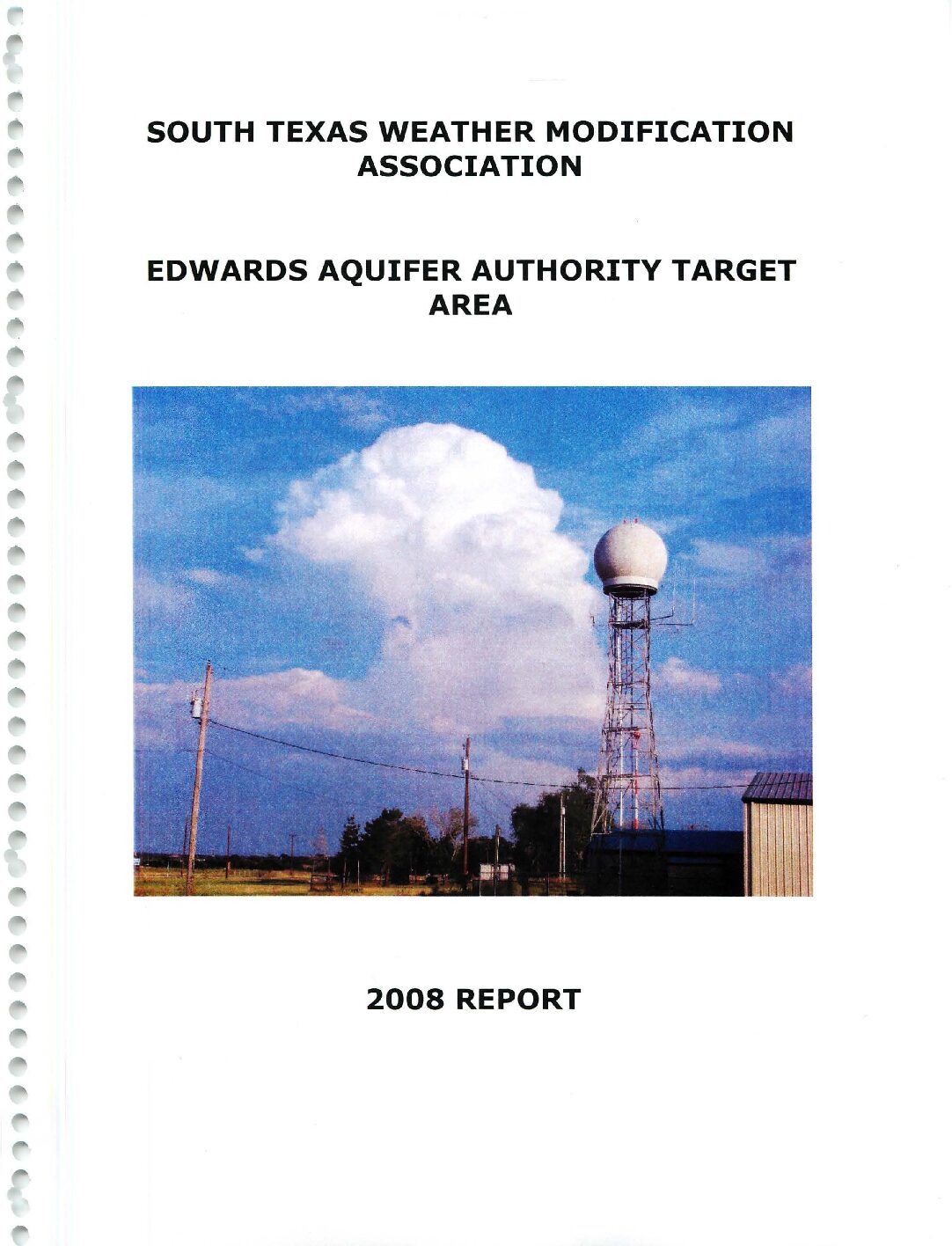
Description: Weather modification program by South Texas Weather Modification Association for the Edwards Aquifer Authority in 2008
Location: South Texas
Summary:2008 marked year number seven in terms of cloud seeding operations for the STWMA in the EAA's tri-county area of Bandera, Bexar and Medina. Cloud seeding operations took place on fourteen days during the season.
At the request of the EAA, the STWMA continued with year two of a three-year experiment within the EAA target area where randomized seeding would take place.Within the tri-county area of Bandera, Bexar and Medina, there were no candidates that presented themselves for randomization. Only one cloud in the 5 month season, in Uvalde County, satisfied the criteria for protocol enactment.
South Texas Weather Modification Association Edwards Aquifer Authority Target Area 2007 Report
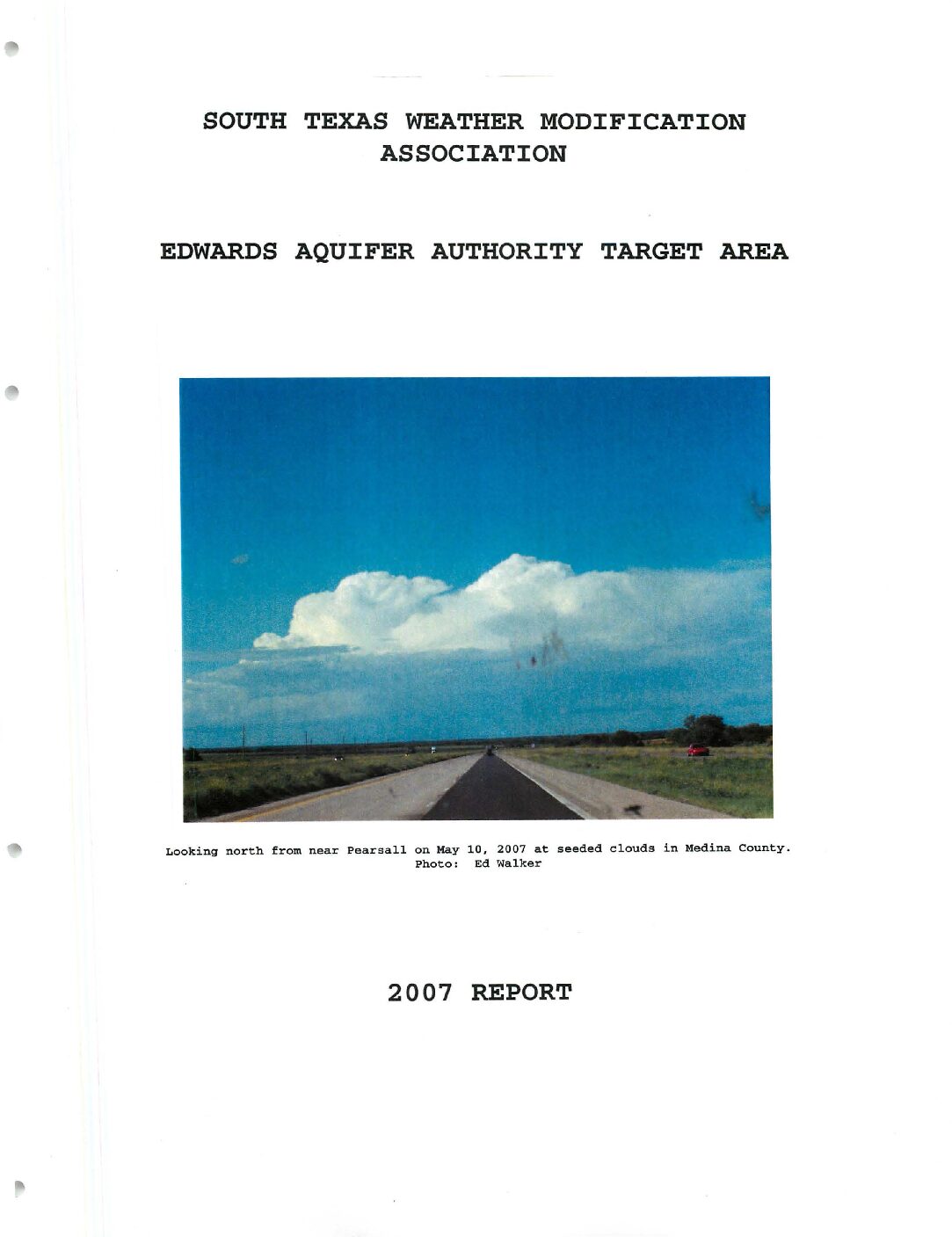
Description: Report of the Edwards Aquifer Authority weather modification program for 2007
Location: South Texas
Summary:STWMA continued to conduct cloud seeding operations over the tri-county EAA target area in 2007, marking year number six. The past year was rather wet, with several intense rainfall episodes occurring in south-central Texas primarily in the May through August period. On several occasions event totals topped ten inches. Because of the persistent heavy rains and subsequent flooding, seeding operations were conducted on fewer days than in years past. 2007 was comparable to 2002, the last time destructive flooding occurred within the target area.
Operations took place on eleven days, with cloud seeding occurring on eight of these days. This compares with 14 days of seeding in 2006, 25 days of seeding in 2005, 20 days of seeding in 2004, 22 days in 2003, and 8 days in 2002.
One of, if not the best day for cloud seeding this past year was on May 10 (photo on cover) when an upper low over north-central Texas helped ignite showers and thunderstorms across the target area. Aggressive seeding of developing showers and thunderstorms took place, with several cells merging into a line that traversed the central and southern EAA target area and continued all the way to Corpus Christi by late that evening. Another day of seeding took place on the 24th. It would be nearly two months before another day of seeding would occur; a reconnaissance flight took place on July 14th but convection would die before the plane arrived. Between June and mid-August, over 20 inches of rain fell over a good portion of south-central Texas. Suspensions took their toll on seeding, with over six weeks of down time. It was a bittersweet result: Although we did not seed as many clouds as years past, the drought had come to a temporary end. Seeding operations resumed in mid-August, with the bulk of the seeding missions for 2007 taking place between August 15th and September 1st. A recon flight on September 27th would be the final flight for the EAA target area for the year.
The annual evaluation conducted by Archie Ruiz at Active Influence is not available for this report.
At the request of the EAA, the STWMA began a three-year experiment within the EAA target area where randomized seeding would take place. With a bit of guidance from the National Center for Atmospheric Research (NCAR), a randomization protocol was developed that would guide both the pilot and the meteorologist in conducting a randomized seeding experiment. The flight to the area of developing convection would take place and the pilot would determine if the activity was seedable based on cloud appearance, inflow strength and location. Once a seedable candidate was found, the randomized decision procedure would take place. This involves both the meteorologist and pilot opening an envelope, inside of which would be a card with either SEED or NO SEED written on it. The meteorologist would convey his envelope content to the pilot, but the pilot would not tell the meteorologist what was in his envelope. If both envelopes matched, the pilot would seed the cloud. He would continue the mission as usual, burning flares as long as conditions warranted. If the envelopes did not match, the pilot would continue to fly in the favorable location, but only pretending to burn flares as long as conditions warranted. By doing the randomization in this manner, only the pilot truly knows if the cloud or clouds were seeded. The cards and notes for each day were to be placed into separate manila envelopes for future analysis, the purveyor of which has yet to be determined. Radar data from each day was also to be saved, again for future analysis. There were a few exceptions to the randomization enactment. If the activity was on the edge of the target area about to exit, if the clouds were too small, or if warnings were issued, the randomized protocol was not put into effect.
As it turns out, 2007 was not the best year for starting this experiment. The weather was not very cooperative, with only five of the eight days allowing for the randomized protocol to be enacted. In addition, it was not until late June before the protocol was developed.
It is the hope of the STWMA that the upcoming seasons will be more favorable for continuing the randomized experiment.
South Texas Weather Modification Association Edwards Aquifer Authority Target Area 2006 Report
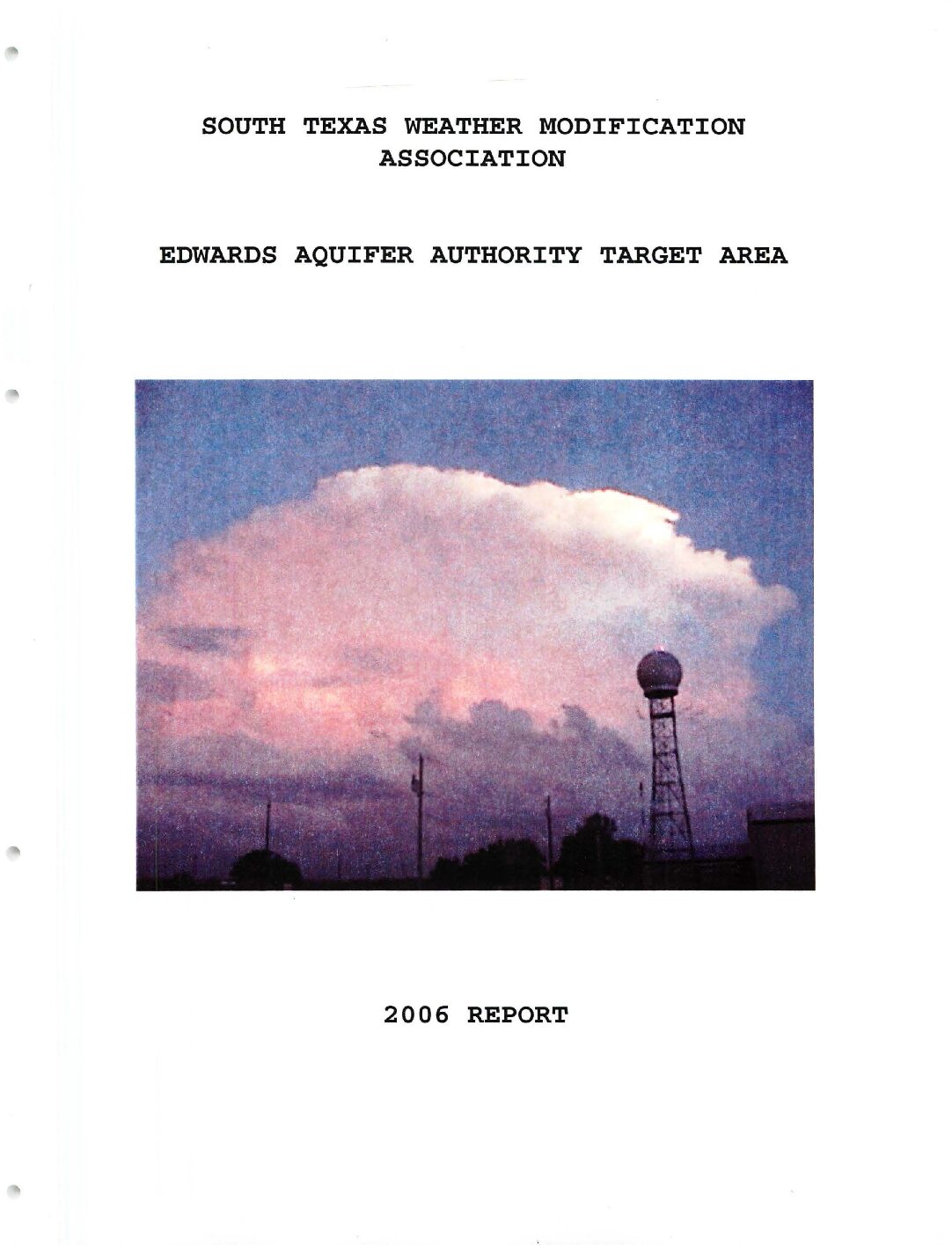
Description: Report of the Edwards Aquifer Authority weather modification program for 2006
Location: South Texas
Summary:2006 marked the fifth year of operations for the Edwards Aquifer Authority (EAA ) by the STWMA . Due to the dry weather experienced during much of the season, there were fewer opportunities for seeding compared to previous years. For the May-October period, there were 14 days on which cloud seeding operations took place within the target area. This compares with 25 days of seeding in 2005, 20 days of seeding in 2004, 22 days in 2003, and 8 days in 2002.
Cloud seeding missions did not take place in May due to convection occurring at night or warnings being issued. June fared a bit better, with two missions taking place during the second half of the month as a tropical airmass affected the area; however , high pressure domainated [sic] the area for a good part of the month, effectively capping the convective potential . The weather pattern became more conductive [sic] to favorable seeding conditions in July, with seeding taking place on six days . High pressure once again exerted its effects on the area during much of August:, although there were four days two near the beginning of the month and two near the end where clouds were seeded within the target area. September was quieter than usual, with only two days on which seeding operations took place. This turned out to be the end of the season, as no seeding took place during October.
Once the season concluded, Archie Ruiz, who works for Active Influence performing radar evaluations for the Texas weather modification projects, completed the radar evaluation of the program. Once again, the analysis shows that seeding may have produced favorable increases in rainfall, with apparent lifetime extensions in the seeded clouds along with other positive results. These numbers are presented and discussed towards the end of the report.
Unlike the past, the flight tracks are not included in the hard copy of the 2006 report; instead, they are on a CD attached to this report.
South Texas Weather Modification Association Edwards Aquifer Authority Target Area 2005 Report
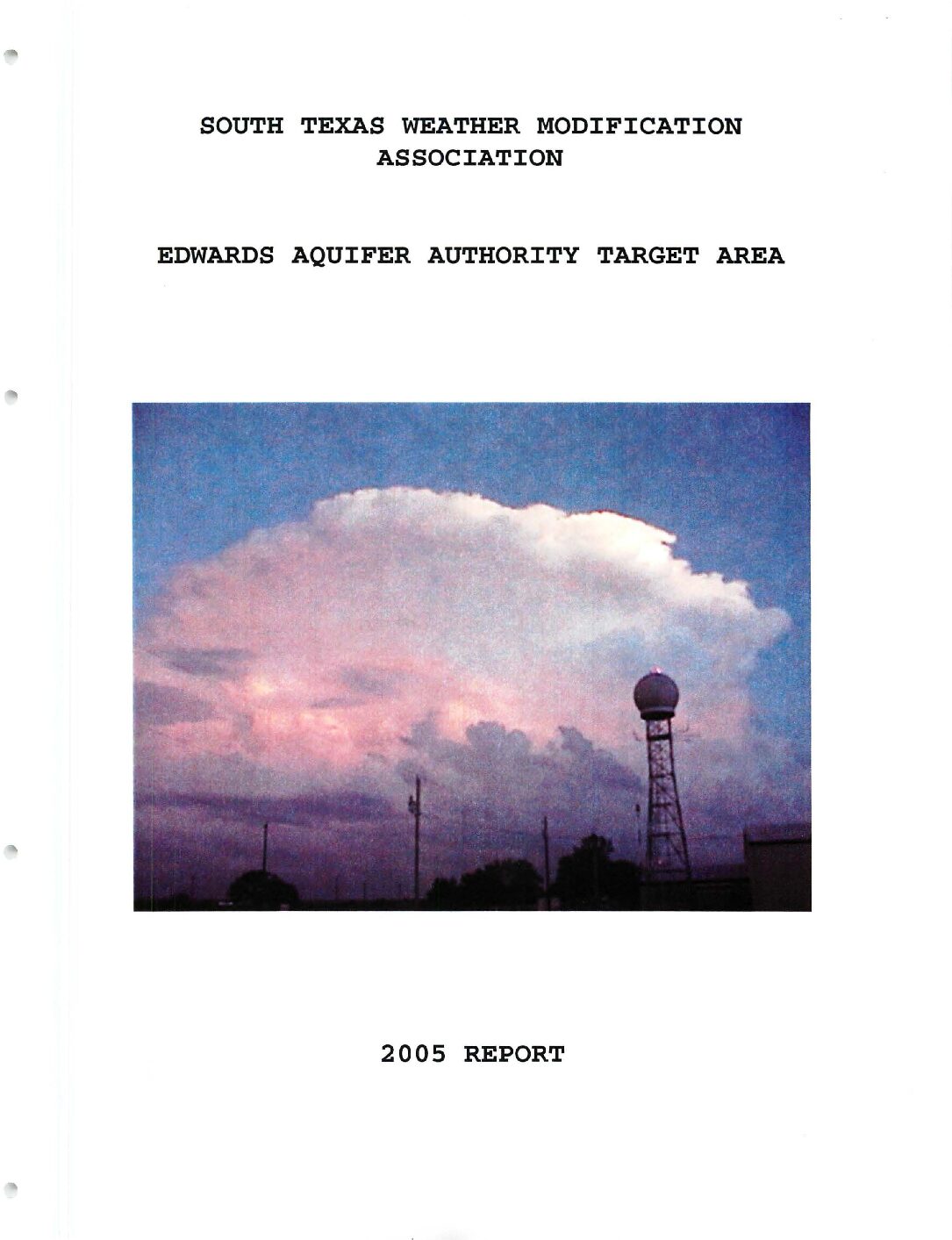
Description: Report of the Edwards Aquifer Authority weather modification program for 2005
Location: South Texas
Summary:2005 marked the fourth year of operations for the Edwards Aquifer Authority (EAA) by the STWMA. Once again, N57AA was stationed at Stinson Field (SSF) in south San Antonio. Two of our pilots, Ron Merks and Mickey Chadwell, were stationed there. They worked along with Jim Transue and Tim Pickens, stationed at Pleasanton, and Larry Dement, stationed at Kenedy. N57AA did not fly as much this season due to flare rack problems, but Jim Transue and N8847P were able to fly numerous seeding missions in the EAA target area, henceforth referred to as the target area.
2005 turned out to be a good year for seeding in the target area, with 25 days of seeding. This compares with 20 days of seeding in 2004, 22 days in 2003, and 8 days in 2002. May saw a few days with seedable clouds, but was quieter than usual. June was incredibly disappointing, with no seeding missions taking place due to high pressure sitting over the area, effectively capping the convective potential. July exhibited a dramatic swing from June, with seeding taking place on 11 days within the target area. The busier weather pattern continued into August, with seeding missions taking place on seven days. Things began to wind down as fall approached, with only three days of seeding in September, and two in October. Despite the increase in convective activity over last year, rainfall amounts were significantly less in 2005, with some areas reporting rainfall deficits by the end of the year in excess of ten inches; this was mainly over Bexar County. Areas a bit further west over Medina and Bandera counties saw rainfall amounts closer to normal, but still on the dry side. A brief discussion on the meteorological perspective of the weather in summer 2005, along with seeding events will be presented later in the report.
Once the season concluded, Archie Ruiz, who works for Active Influence performing radar evaluations for the Texas weather modification projects, completed the radar evaluation of the program. Once again, the analysis shows that seeding may have produced favorable increases in rainfall, with apparent lifetime extensions in the seeded clouds along with other positive results. These numbers are presented and discussed towards the end of the report.
South Texas Weather Modification Association Edwards Aquifer Authority Target Area 2004 Report
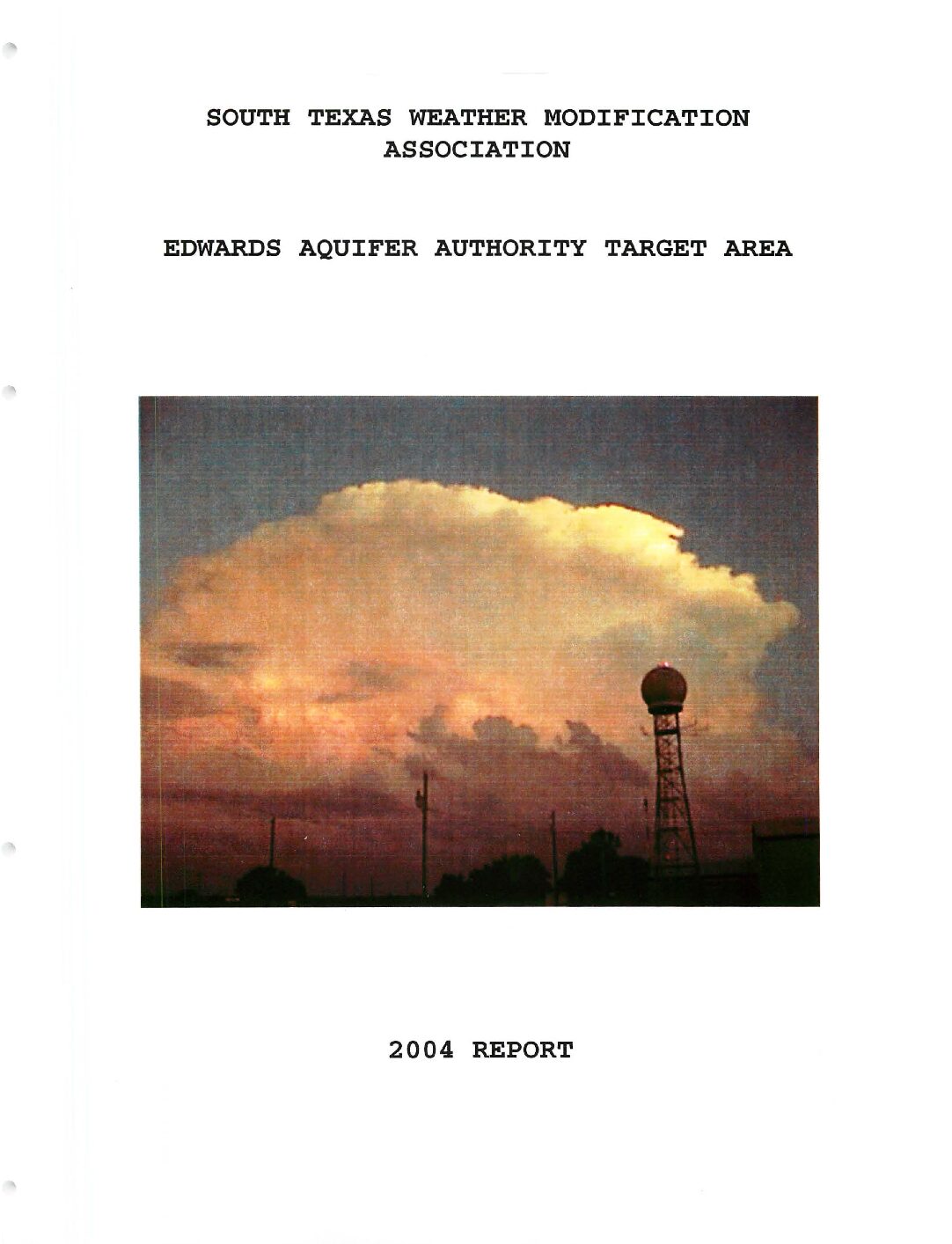
Description: Report of the Edwards Aquifer Authority weather modification program for 2004
Location: South Texas
Summary:2004 marked the third year of operations for the Edwards Aquifer Authority (EAA) by the STWMA. As was the case in 2002 and 2003, one plane, N57AA, was stationed at Stinson Field (SSF) in south San Antonio. Two of our pilots, Ron Merks and Mickey Chadwell, were stationed there. They worked along with Jim Transue and Tim Pickens, stationed at Pleasanton, and Larry Dement, stationed at Kenedy. Occasionally the other pilots helped out with seeding in the EAA target area, henceforth referred to as the target area.
2004 turned out to be a good year for seeding in the target area, with 20 days of seeding. This compares with 22 days of seeding in 2003, and only 8 in 2002. May turned out to have a few convective events, none of which were seeded due either to storms occurring at night or the location of the storms over the city of San Antonio. The first seeding mission of the year took place on June 7th, when a surge of tropical moisture brought waves of showers and thunderstorms northward across the area. June ended up being a very wet month, so wet in fact, that a temporary suspension was put in place for the last few days of June due to excessive rainfall and numerous Flash Flood Warnings being issued. The remainder of the year saw some good activity with October 27th being the final day of seeding within the target area. A brief discussion on the meteorological perspective of the seeding events will be presented later in the report.
Once the season concluded, Archie Ruiz, who works for Active Influence performing radar evaluations for the Texas weather modification projects, completed the radar evaluation of the program. Once again, it appears that seeding produced favorable increases in rainfall, with apparent lifetime extensions in the seeded clouds along with other positive results. These numbers are presented and discussed towards the end of the report.
As was mentioned in the 2003 annual report, the weather modification projects in Texas now have a contract with Weather Decision Technologies, Inc., based out of Norman, Oklahoma. The company provides the projects with live NEXRAD feeds from the various National Weather Service offices nearest to their respective target areas. For the target area, a feed from the WSR-88D radar at New Braunfels (KEWX) is used. The WSR-74C radar at the Pleasanton Municipal Airport is still used in conjunction with the NEXRAD data, and this secondary radar data may be analyzed in the near future to determine any possible differences.
Southwest Texas Rain Enhancement Association 2009 Edwards Aquifer Authority Final Report
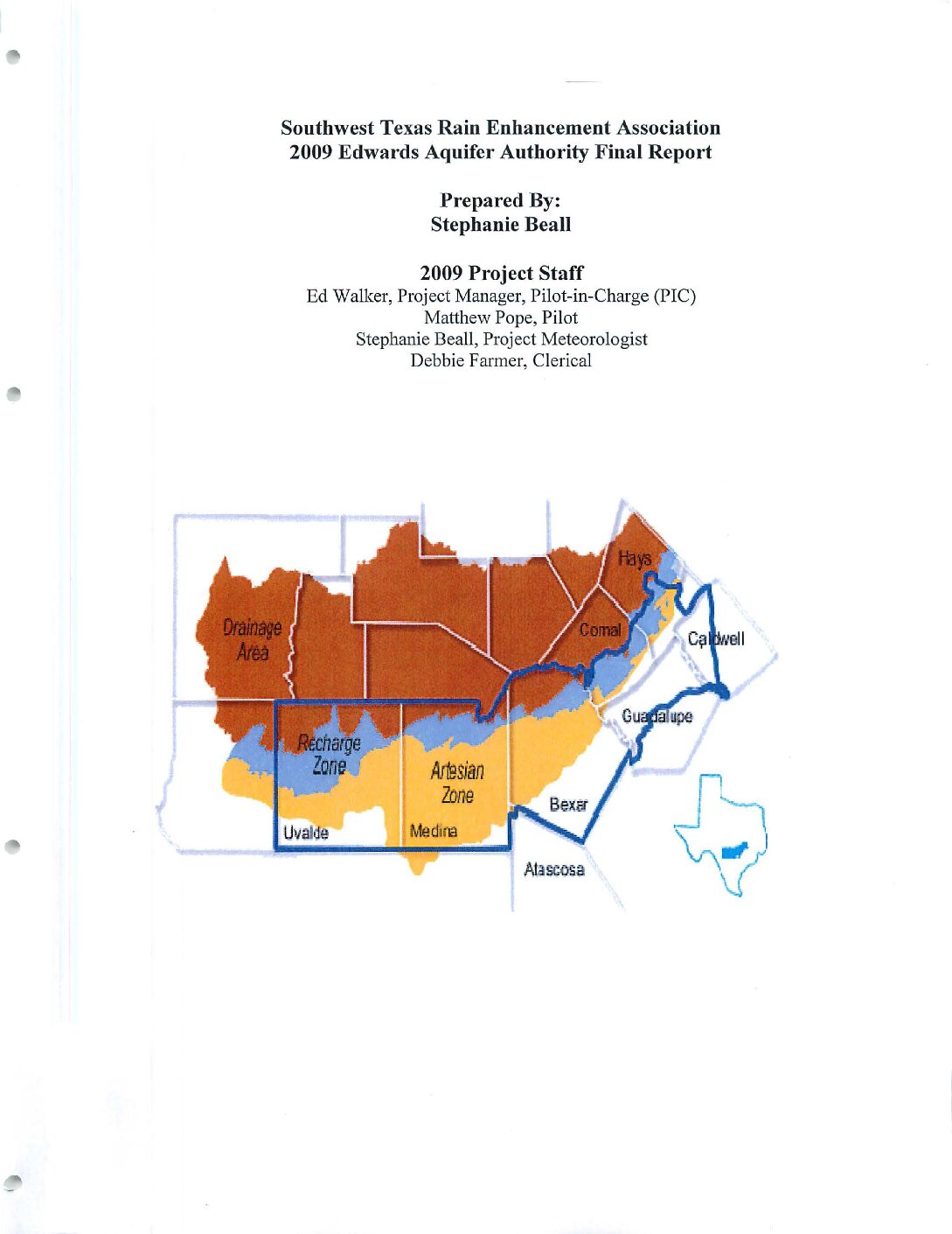
Description: Weather modification program by Southwest Texas Rain Enhancement Association for the Edwards Aquifer Authority in 2009
Location: San Antonio Region
Summary:2009 marked the eighth year of operations for the Edwards Aquifer Authority (EAA) by the Southwest Texas Rain Enhancement Association (SWTREA). The project duration was the same as it has been the past couple of years, with seeding taking place in Uvalde County from May until September. Drought conditions that originated in late 2008 continued into most of 2009, which in tum had an effect on seeding operations for most of the summer.. Seeding in the Authority target area of Uvalde County saw a total of twenty-four seeding flights for the 2009 operational season.
As was the case last year, in addition to normal weather modification activities in the Edwards Aquifer Authority (EAA) target area, 2009 was the third year for a randomized seeding experiment. The randomized seeding experiment was also conducted by the EAA's other weather modification contractor, the South Texas Weather Modification Association (STWMA). Due to bias that could occur the experin1ent was double blind so that ground operations staff would not know which clouds were seeded and which were not seeded.
No randomized seeding flights took place in Uvalde County during the 2009 season. The reason for no flights during the season was due to the fact that most ofthe convection in the EAA target area did not meet the randomized criteria.
At the September 30th conclusion of the 2008 operational season for the EAA target area, a radar evaluation was completed for the program. The findings are presented and discussed towards the end of this report. The flight logs for the 2009 seeding season are [shown].
South Texas Weather Modification Association EAA Target Area 2003 Report
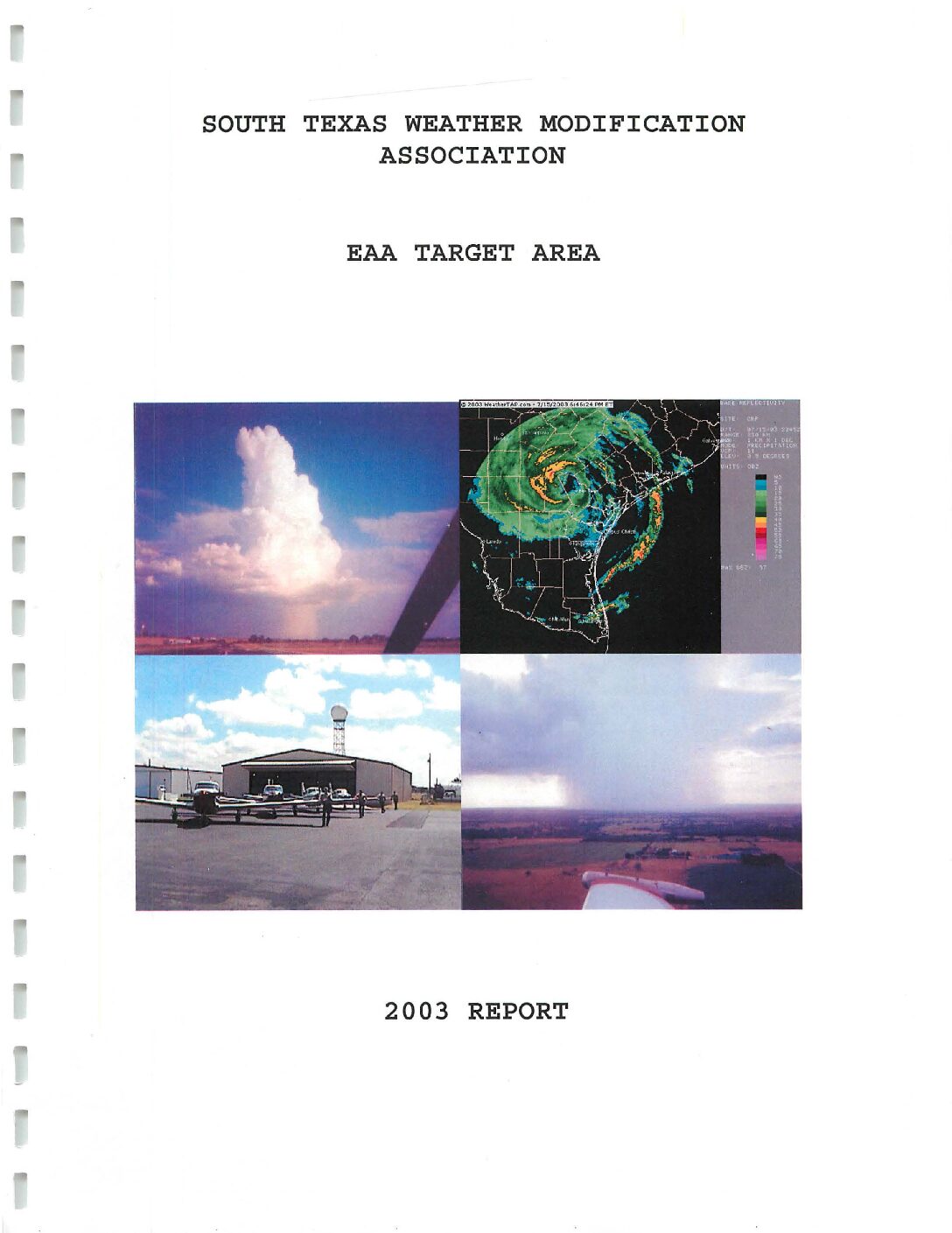
Description: Report of the Edwards Aquifer Authority weather modification program for 2003
Location: South Texas
Summary:2003 marked the second year of operations for the EAA by the STWMA. One change seen was the extension of the seeding season from September 30th to October 31st. This was done in 2002 as a result of the downtime we experienced due to flooding rains. For 2003, the extension really didn't make much of a difference, as no seeding was done after September 17th.
As was the case in 2002, one plane, N57AA, was stationed at Stinson Field (SSF) in south San Antonio. Two of our pilots, Ron Merks and Mickey Chadwell, were stationed there. They worked along with Jim Transue and Tim Pickens, stationed at Pleasanton, and Larry Dement, stationed at Kenedy. Occasionally the other pilots helped out with seeding in the EAA target area.
2003 turned out to be a much better year for seeding in the EAA target area, with 22 days of seeding, compared with only 8 in 2002. With a record-setting dry spell in May, our first seeding mission did not take place until May 27th. June saw 4 days with seeding, while July ended up being the busiest month, with 8 seeding days. Hurricane Claudette tracked across south Texas on July 15th, bringing heavy rain and high winds to much of the area. Due to a risk of flooding, operations were suspended from the 15th through the 20th to allow for any rains to soak in and flooded rivers to recede. A rare July cold front pushed down into Texas on July 23rd. The front itself stayed north of the area, but a pre-frontal trough did make it through the area, igniting showers and thunderstorms. The busy weather continued into August, with 7 days of seeding taking place. Things quieted down in September, with only two days of seeding. After the middle of the month, there were no more missions for the year.
Once the season concluded, Archie Ruiz completed the radar evaluation of the program, and again it appears that seeding produced favorable increases in rainfall. These numbers are presented and discussed on page 36 of this report.
For 2004, there will be a dramatic change in the radar data. We have acquired an agreement with WDT, a company based in Oklahoma City. They will be taking the TITAN software, which we currently use in conjunction with our C-band radar, and integrating it into the National Weather Service Doppler radars in New Braunfels, Corpus Christi, and Brackettville. Starting in 2004, our program will use WDT's software to peruse radar data from the NWS in order to conduct operations. It is an exciting change, since the meteorologist will now have access to many of the algorithms currently used by the NWS. Some of these include, but are not limited to, tornado detection, hail detection, lightning strike display, and future radar, which takes past reflectivities and extrapolates 30-60 minutes into the future to give you a predicted radar image. Radial velocity data will also be available, which lets the meteorologist look at the winds within a storm.
2003 saw more activity weatherwise compared to the previous year, and as such, we saw more cloud seeding missions take place in the EAA target area. Radar analysis showed that seeding effects this year were positive once again.
Overall, the main factor that is evident from comparing the 2002 and 2003 analyses deals with the cloud attributes. The clouds in 2002 were larger, on average, and appeared to contain more water than those in 2003. When looking at the parameter increases alone, 2003 was a more successful year in terms of the apparent effectiveness of seeding.
With further work in weather modification in the EAA target area and more analyses, we will get a better understanding of the effects of glaciogenic seeding in south Texas.
South Texas Weather Modification Association 2002 Report
Description: Report of the Edwards Aquifer Authority weather modification program for 2002
Location: South Texas
Summary:STWMA entered year number six in operations in 2002. With a fresh new radar office in place, we eagerly awaited the first day of seedable weather. It wasn't until mid-April before this took place, but what a start: intense thunderstorms developing right over the radar site, prompting warnings by the NWS. Some seeding of this activity took place, and with that, we were well on our way to what would hopefully be a busy year of rainfall enhancement.
We welcomed two pilots to the association in the spring. Ron Merks, who worked with the program back in 1997-98 when AI was running operations, joined us once again in 2002. In addition, Mickey Chadwell, a flight instructor at Stinson Field, trained with us this year to become STWMA's fifth and newest pilot. With the additional pilots, there came another Comanche. N57AA, also referred to as Strawberry Five or Lipstick Queen due to its iridescent pink paint, was purchased in the spring and became operational in June.
With the departure of WMI from the EAA Weather Modification project, seeding to our north was halted by the end of 2001. The EAA, however, was still interested in having a weather modification program in some of the counties. Working with the STWMA and the SWTREA (Cotulla) programs, they developed a contract whereupon the STWMA would annex the counties of Bandera, Bexar and Medina into the target area for the May-September period, and the SWTREA would acquire Uvalde County. This was to be a three-year contract, with one of the planes (N57AA) being located at Stinson Field in south San Antonio.
The idea to develop a mini-mesonet of weather stations across the target area became reality this past year, when several Davis Wireless Weather Stations were purchased . One station was allotted per county, except for Bexar and Medina, where observation sites already exist (San Antonio, Hondo). The stations were to be set up with each transmitting real-time conditions to the STWMA web page every 10 minutes. It took the rest of the year to set up the stations, with a few glitches occurring along the way. It will be a work in progress, but several of the stations are already in place and successfully sending information to the web page (http: //www.southtexasweathermodification.com), where a daily discussion and five-day forecast are also located.
Our hopes of having a busy year of seeding went down the river, so to speak, when an upper level low parked itself over the area from the end of June into the first part of July. Tapping into abundant tropical moisture, torrential rainfall began on June 30th and continued into the first week of July. Some parts of the target area, mainly the northern half, received over two feet of rain in a 10-day period. This caused extensive flooding across the area, with rivers unable to handle the deluge of water. As such, seeding was suspended from July 1st until the second week of August, when the soils were finally dry enough and rivers were down below bank-full levels. Another system in early September brought another one to two feet of rain to parts of the target area, so seeding was suspended once again. As a result of these two flooding events, the 2002 season saw the fewest number of seeding missions in its history. This outcome was bittersweet; we missed several convective events, but the long-term drought was broken with the extended period of heavy rainfall.
STWMA gained some recognition with the media in 2002. In mid-June, Wallpaper magazine, based out of London and distributed worldwide, came over to Pleasanton and learned more about weather modification in south Texas. We were featured in their September issue. In late June, the EAA set up a media day where the different TV/radio/newspaper networks in San Antonio and surrounding areas came down to see how cloud seeding operations were done and learn a bit more about the program. STWMA was featured on the local FOX, ABC and NBC stations as well as radio stations WOAI (San Antonio) and KBUC (Pleasanton).
Southwest Texas Rain Enhancement Association 2008 Edwards Aquifer Authority Final Report
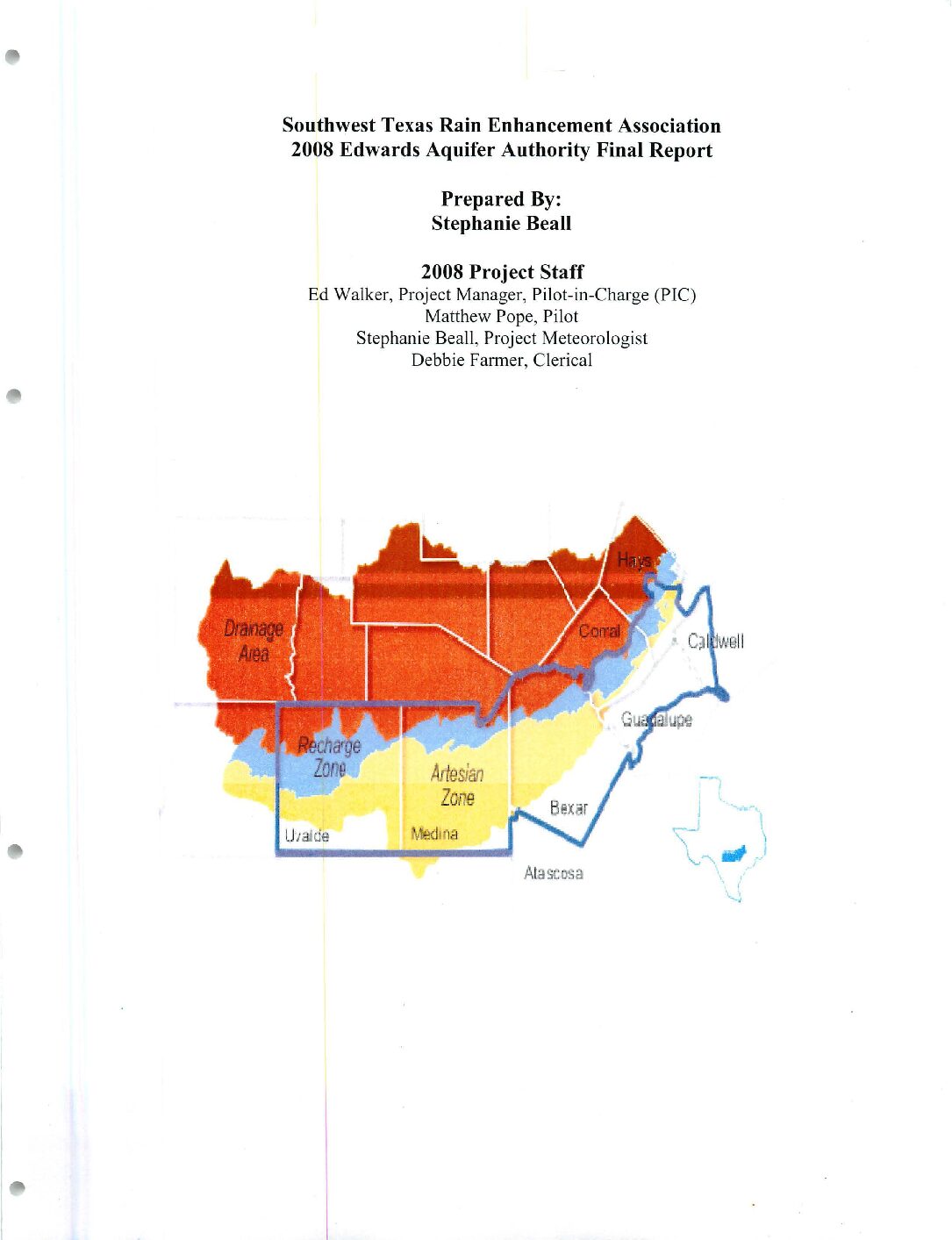
Description: Weather modification program by Southwest Texas Rain Enhancement Association for the Edwards Aquifer Authority in 2008
Location: South Central Texas
Summary:2008 marked the seventh year of operations for the Edwards Aquifer Authority (EAA) by the Southwest Texas Rain Enhancement Association (SWTREA). The project this year was business as usual, with seeding taking place in Uvalde County from May until September. Most of South Texas and the counties within the Aquifer saw a very dry year in 2008.
Seeding in the Authority target area of Uvalde County saw a total of five flights for the 2008 operational year, two of which were reconnaissance flights.
2008 was the second year of a three year randomized seeding experiment. The randomized seeding experiment was also conducted by the EAA's other weather modification contractor, the South Texas Weather Modification Associationi(STWMA). The objective of randomized seeding operations for the Edwards Aquifer Authority was to select clouds that met the criteria for suitable seeding candidates. This was seeding at random, and from that point, measurements and observations were taken to determine if seeding had an effect on the cloud. The experiment was double blind so that ground operations staff would not know which clouds were seeded and which were not seeded due to bias that could occur.
At the September 30th conclusion of the 2008 operational season for the EAA target area, a radar evaluation was completed for the program. The findings arc presented and discussed towards the end of this report. The flight logs for the 2008 seeding season are listed
Southwest Texas Rain Enhancement Association 2006 Edwards Aquifer Authority Final Report
Description: Report of the Edwards Aquifer Authority weather modification program for 2006 in Uvalde, Medina and Bandera Counties
Location: Uvalde County, Medina County, Bandera County
Summary:2006 marked the fifth year of operations for the Edwards Aquifer Authority (EAA) by the Southwest Texas Rain Enhancement Association (SWTREA). The project this year was business as usual, with seeding taking place in Uvalde County from May until October. There was caveat this year. Due to the continuing drought of most of South Texas, seeding missions were hard to come by throughout most of the year. A few months of the year did see increased activity, but the majority of it was hot and dry.
Drought conditions did tend to improve towards the latter part of the year with the development of a moderate El Nino episode in the South Pacific off the coast of South America. When El Nino's tend to develop, the southern half of the United States tend to benefit greatly from the increase intensity of the subtropical jet.
Seeding in the Authority target area of Uvalde County saw a total of twenty flights for the 2006 operational year compared to twenty flights in 2005. Also, with the continued cooperation between the two seeding projects, SWTREA flew a total of two missions in Medina County and one in Bandera County for the South Texas Weather Modification Association (STWMA). As seen above, there were more missions in 2005 than 2006, due to the lack of convection across the Aquifer area. Most of the systems seeded in the EAA target were classified as small clouds, or systems that were not large in area. 2006 was very dry for most parts of Texas as a whole. For the most part, a very aggressive seeding approach was taken over Uvalde County during the year due to the drought that was classified as severe to exceptional across the area.
At the conclusion of the 2006 operational season for the Authority EAA target area, October 31st a radar evaluation was completed for the program. The findings are presented and discussed towards the end of this report. The flight logs for the 2006 seeding season are on the following page.
Southwest Texas Rain Enhancement Association 2005 Edwards Aquifer Authority Final Report
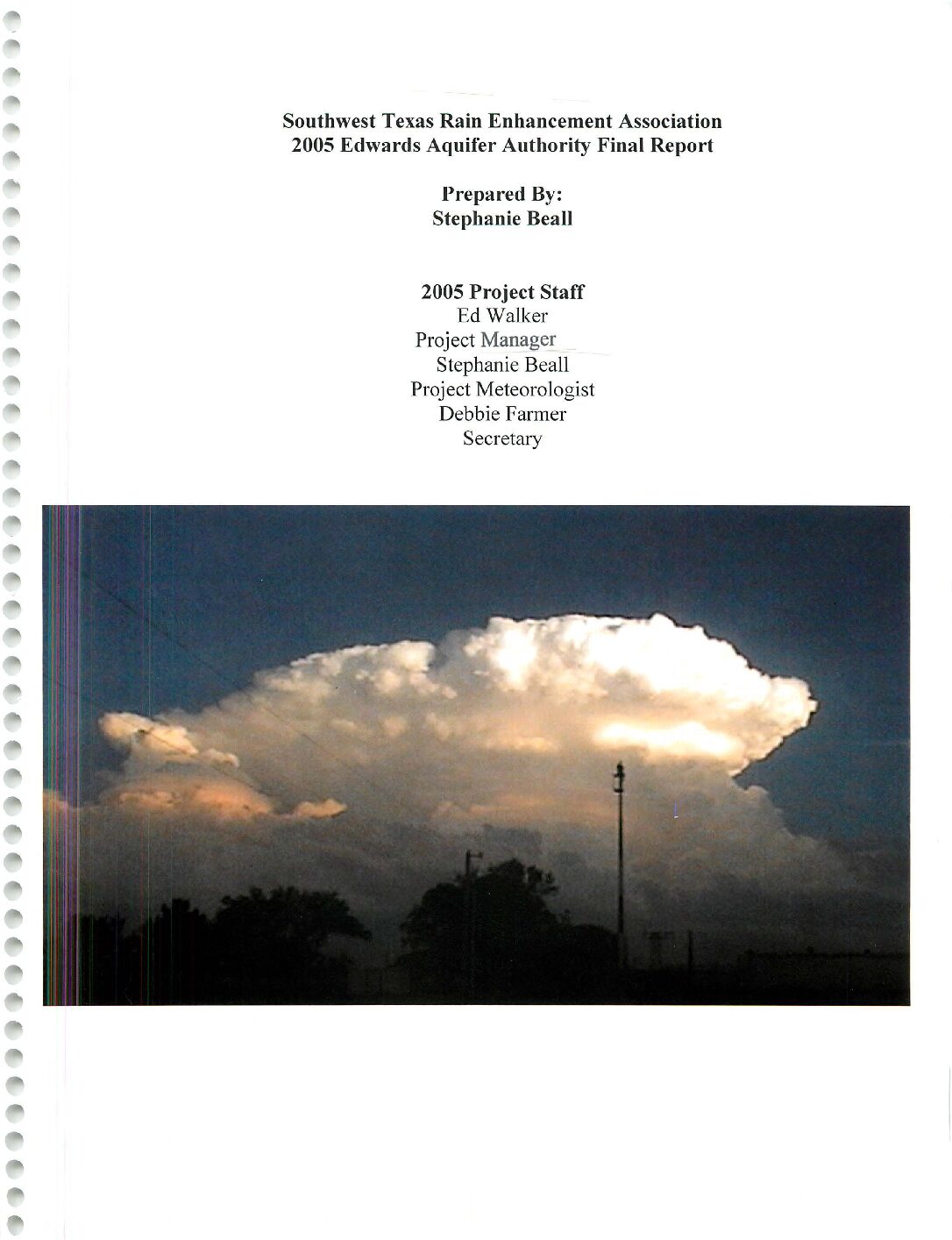
Description: Report of the Edwards Aquifer Authority weather modification program for 2005 in Uvalde and Medina Counties
Location: Uvalde County, Medina County
Summary:2005 marked the fourth year of operations for the Edwards Aquifer Authority (EAA) by Southwest Texas Rain Enhancement Association (SWTREA). The 2005 seeding season was an interesting one in terms of staff. The project under went [sic] some changes in terms of where planes and pilots were. The pilot and plane that was [sic] stationed in Uvalde County were moved to San Antonio at Stinson airport. A pilot from the South Texas Weather Modification Association (STWMA) project was used mainly for seeding in Uvalde County. The other two planes were stationed in Carrizo Springs. This pilot occasionally was used for seeding in Uvalde County. During the 2005 season, the cooperation between SWTREA and STWMA continued as SWTREA used pilots stationed in San Antonio for seeding operations. The working relationship between the two projects has allowed both projects to benefit.
Seeding in the Authority target area of Uvalde County saw a total of 21 flights for the 2005 operational year compared to 15 flights in 2004. Also, with the continued cooperation between the two seeding projects, SWTREA flew a total of 6 missions in Medina County.
Five of these missions were flown in addition to another mission that was already taking place. One mission was launched specifically for Medina County due to technical difficulties with the SWTMA project on this particular day. As seen above, there were more missions in 2005 than 2004. 2005 was very dry for most parts of south Texas. As written in last year's report, seeding operations in 2004 were suspended for most of June due to excessive flooding across the area. However, when making a comparison with 2003, things seem more normal with a total of 20 flights in 2003.
At the conclusion of the 2005 operational season for the Authority EAA target area, October 31st, a radar evaluation was completed for the program. The findings were presented and discussed towards the end of this report.
The flight logs for the 2005 seeding season are below. This is just for Uvalde County. A separate table will be included for the seeding done in Medina County.
Southwest Texas Rain Enhancement Association 2004 Edwards Aquifer Authority Final Report
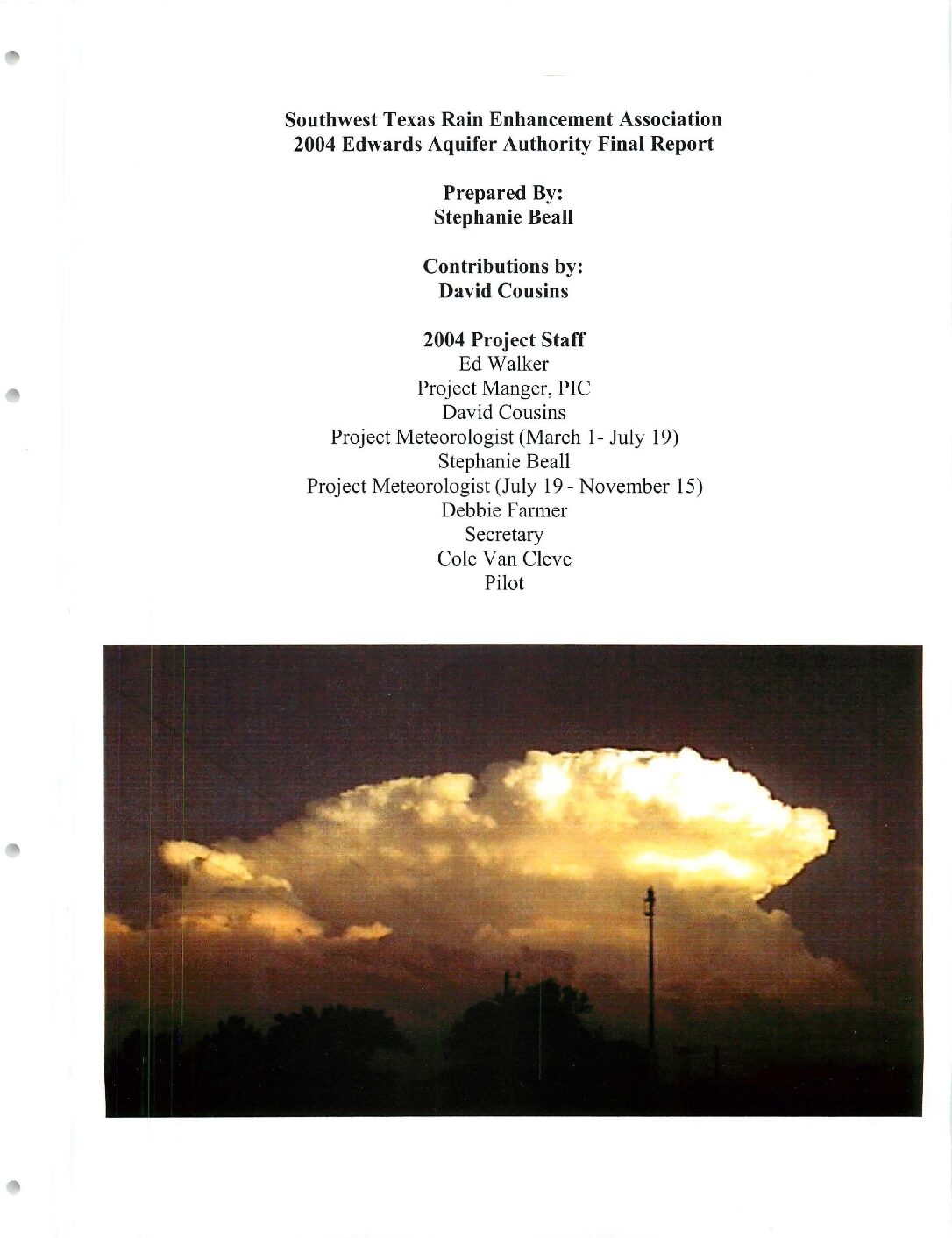
Description: Report of the Edwards Aquifer Authority weather modification program for 2004 in Uvalde County
Location: Uvalde County
Southwest Texas Rain Enhancement Association 2003 EAA Final Report
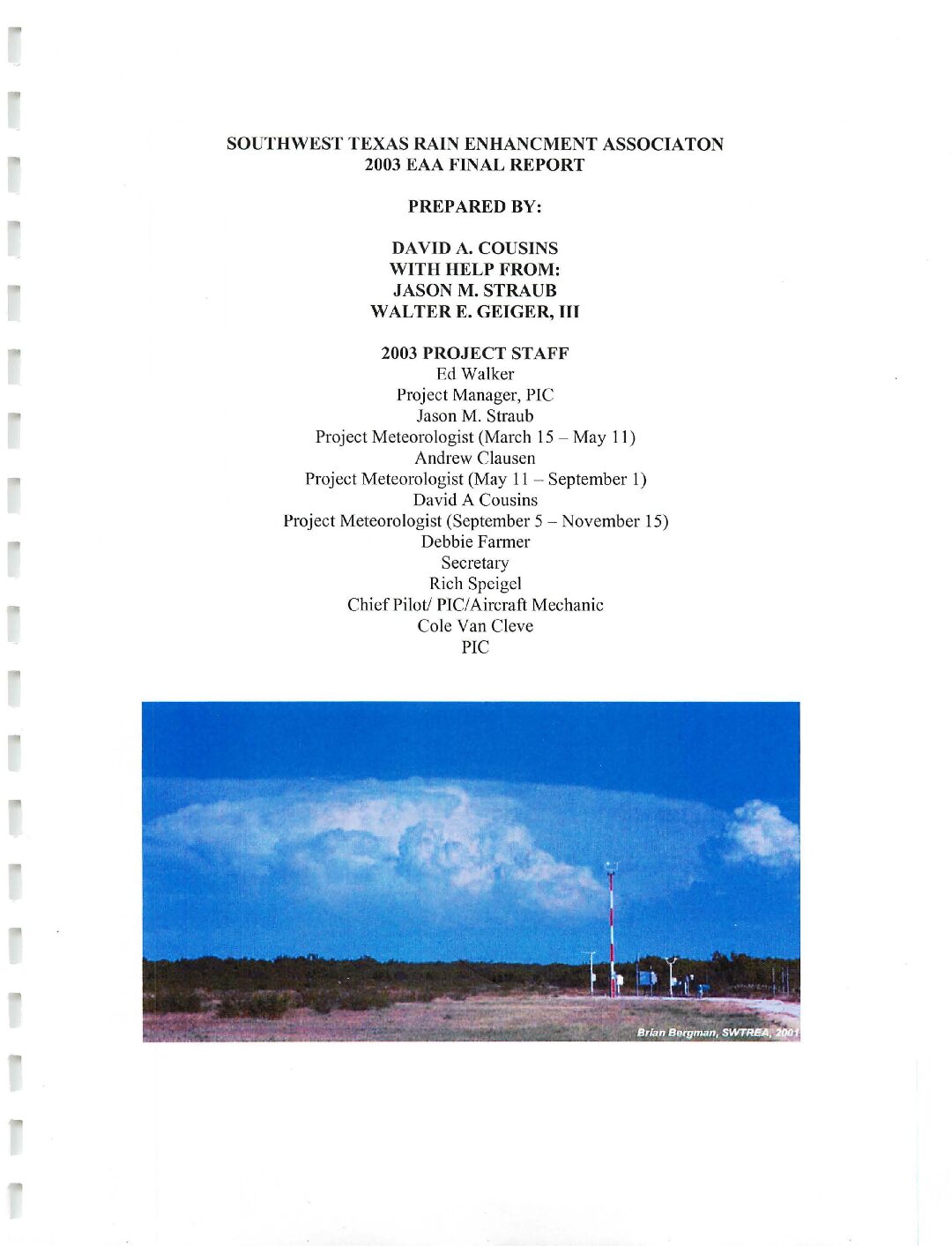
Description: Report of the Edwards Aquifer Authority weather modification program for 2003 in Uvalde County
Location: Uvalde County
Summary:The Southwest Texas Rain Enhancement Association has just now completed its fifth year of operations and the third full year of 24-hour 7-day per week cloud seeding. This was a very active year weather wise. There were 100 flights during this year's 8-month season. Of the 100 flights, 28 (20 during the contracted season with the Edwards Aquifer Authority) took place over Uvalde County. The SWTREA continued to serve as a demonstration program to many of the other weather modification programs in Texas demonstrating effective rain enhancement and hail suppression techniques on many different types of storms at any time of the day or night.
As per table 7 on page 30, one can see that the 2003 was more active in terms of the number of flights taking place over Uvalde County than the 2003 season. Again the total number of flights in 2003 were [sic] 20 as compared to 17 in 2002. One can [sic] Also when you compare the 2003 total season rainfall for May through October with the same total for the 30 year average precipitation one will find that the rainfall for 2003 was slightly above normal for Uvalde County. One can also [sic] This is supported by the Ruiz Assessment in Appendix A, which shows that an additional 36.733-acre feet of rainfall was created for Uvalde County from cloud seeding activities.
Further more [sic], by looking at the Ruiz Assessment in Appendix A, one can see that the SWTREA aircraft were on time for 87% of the small clouds and 100% on time for large clouds, which formed inside the target area. Timing for type B clouds, clouds that formed outside the target area and are at least 1-hour old, was 48%. The reader may ask why is there such a large on time difference in timing for clouds that form inside the target area and Type B clouds. This is due to the fact that the project must wait for the cloud to enter the operational area to be legally seeded. Therefore one can quickly see that the proper procedure for delivering the agent in the first half-life of the cloud is often not possible. The reader can then infer that the poor timing on type B clouds is often beyond our control.


 CURRENT