

 Aquifer Conditions
Science & Data Document Library
Science and Data Resources
Final Report-2002/A Weather Resources Management Program/A Summary of Cloud Seeding Activities Conducted over Six Counties in South Texas During the Period 15 March-15 November 2002

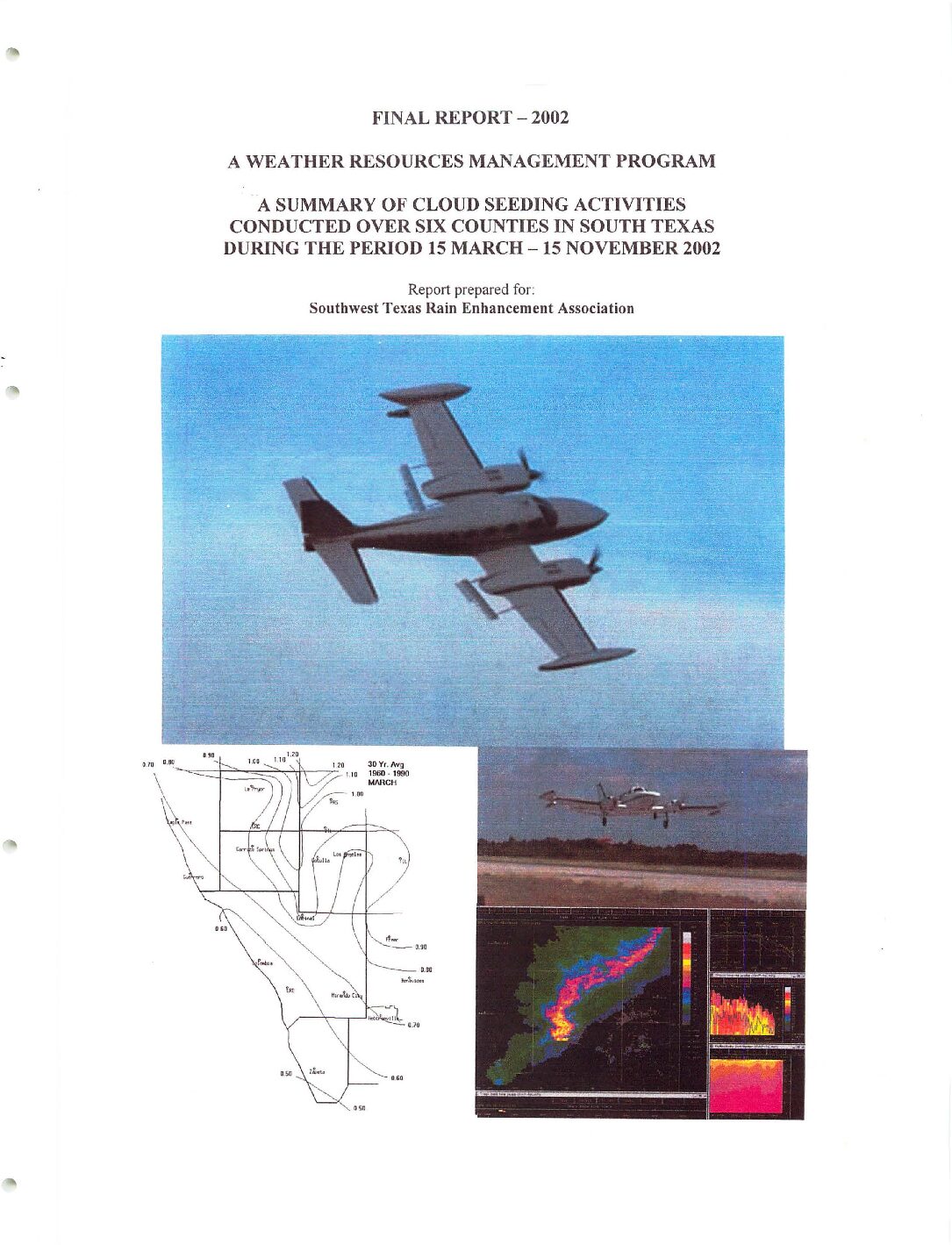
Description: Report on rain enhancement by the Southwest Texas Rain Enhancement Association for 2002
Location: Southwest Texas
Summary:The Southwest Texas Rain Enhancement Association has now completed its fourth year of operations and the second full year of 24-hours a day 7-day per week seeding. This year was a year of ups and downs, with the season starting slowly, then becoming very active. The program performed almost 100 flights during the eight month season. The program has now focused on establishing a long-term weather modification program for the participating counties for many years to come. This year, the SWTREA in many respects again served as a demonstration program to many of the other weather modification projects in Texas by demonstrating effective rain enhancement and hail suppression seeding on any type of storm at any given hour of the day. We look forward to another aggressive seeding season in 2003.
Operations Report on a Cloud Seeding Program for the Edwards Underground Water District NAWC WM-86-6
Description: Summary of the weather modification program by North American Weather Consultants for the Edwards Underground Water District in 1986
Report Number: NAWC WM-86-6
Location: South Central Texas
Summary:North American Weather Consultants completed its second weather modification program for the Edwards Underground Water District. The program ran from April 1, 1986 to September 30, 1986. The program was based in Uvalde, Texas where the weather radar, aircraft, and program director resided.
Seeding operations were performed on days and used a total of 19,368 grams of silver iodide. A total of 85.4 aircraft hours and 981 weather radar hours were logged during the program.
The project experienced dry conditions during July and the first half of August. Operational potential was further reduced by seeding suspensions due to excessive soil moisture content, as June was a wet month.
No evaluation of seeding effectiveness has been attempted in this operations report. A target-control type evaluation is possible, although the precipitation data for such an evaluation is delayed several months until it becomes available from the National Oceanic and Atmospheric Administration. Even if the data were available, the determination of a seeding effort for a one or two year project is difficult due to the large natural variability in precipitation coupled with the expectation of a relatively small seeding signature (10 -20 percent). Normally, several years are required to document such a seeding effect with any degree of statistical significance.
NAWC nonetheless believes, however, that this seeding program was effective. This belief comes from experience on similar projects in other areas such as one long term program that has been conducted by the Colorado River Municipal Water bistrict near Big Spring, Texas. Even though there were a number of seeding suspensions on the Edwards program during the summer of 1986, considerably more seeding was accomplished on the project than the first year of operations in 1985.
Edwards Aquifer Precipitation Enhancement Program Final Report 2000
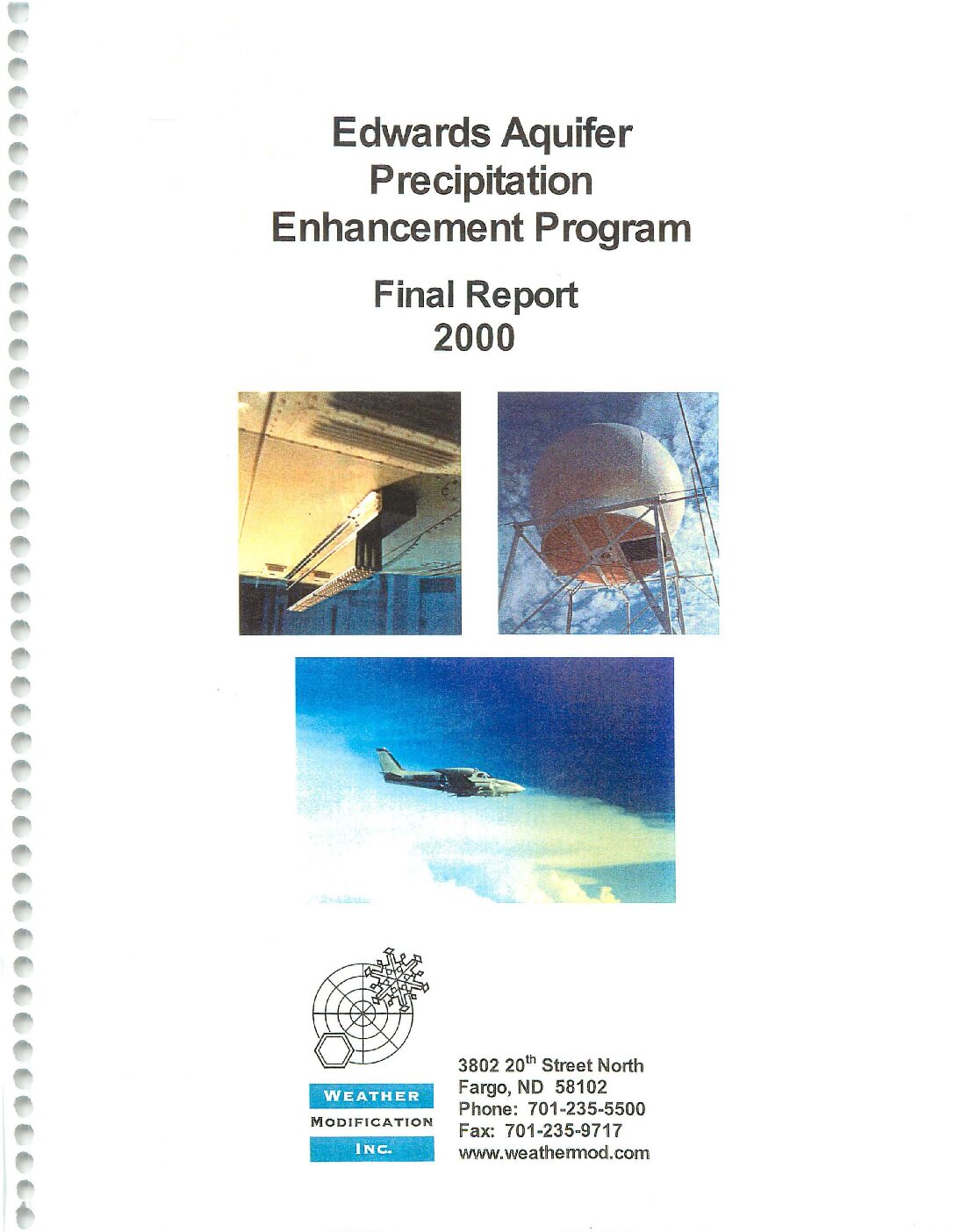
Description: Summary of the Edwards Aquifer Precipitation Enhancement Program for 2000
Location: South Central Texas
Summary:This report summarizes the activities and data collected during the 2000 field operations of the Edwards Aquifer Precipitation Enhancement Program. This was the second year of a program conducted by Weather Modification Inc. {WMI) of Fargo, North Dakota, for the Edwards Aquifer Authority (the Authority) of San Antonio, Texas. The program was funded by the Texas Natural Resource Conservation Commission and the Authority, with the sole intent being enhancement of precipitation through cloud seeding. The project area was 6.37 million acres across south Texas, covering all or parts of 12 counties including Real, Uvalde, Kerr, Bandera, Medina, Kendall, Bexar, Blanco, Comal, Hays, Guadalupe, and Caldwell. Seeding operations were conducted 24 hours-a-day, seven days-a-week from March 1st through November 30th.
The facilities and procedures for this project were as follows. One C-band weather radar, computers, and a communications system were set up in Hondo, Texas, to monitor storms and control aircraft. The radar operated continuously throughout the nine-month period. The storms, as detected by radar, were posted on the WMIIntemet Home Page at 3D-minute intervals, thus allowing remote near real-time viewing of operations. Two specially equipped cloud seeding aircraft were dedicated to the project; both were stationed at the centrally located Hondo Regional Airport in Hondo, Texas. This maximized coverage of the target area and minimized response times.
New and improved formulations of silver-iodide pyrotechnics and acetone solutions were used to generate high concentrations of very fast acting ice-nuclei. High performance aircraft crewed by experienced pilots and directed by experienced radar meteorologists treated developing regions of the storms by direct injection of the seeding agents.
The 2000 field program successfully achieved its objective, to seed those cells thought to have the potential to produce precipitation. During the nine-month project, the two aircraft safely completed 82 flights totaling 218.80 hours. A total of 29.3 kg of seeding agent was dispensed in the form of 1,144 ejectable flares and 1 06 gallons of silver iodide acetone solution, which was burned in wing-tip generators.
This final report for 2000 provides a general overview of the program and describes the methodology used. Pictures, tables, graphs, and references are used to summarize the operational activities. All of the project's radar data, meteorological data, and reports (weekly operations summaries and monthly reports) have been recorded onto CD-ROM and are available to the Authority.
Edwards Aquifer Precipitation Enhancement Program Final Report 1999
Description: Summary of the Edwards Aquifer Precipitation Enhancement Program for 1999
Location: South Central Texas
Summary:This report summarizes the activities and data collected during the 1999 field operations of the Edwards Aquifer Precipitation Enhancement Program. This was the first year of a projected long-range program conducted by Weather Modification Inc. (WMI) of Fargo, North Dakota, for the Edwards Aquifer Authority (the Authority) of San Antonio, Texas. The program is funded partially by money from the Texas Natural Resource Conservation Commission, with the sole intent to enhance precipitation through cloud seeding. The project area was 5.44 million acres across south Texas, covering all or parts of 12 counties including Real, Uvalde, Kerr, Bandera, Medina, Kendall, Bexar, Blanco, Comal, Hays, Guadalupe, and Caldwell. A 24 hours per day, seven days per week cloud seeding service was provided from April 15th through September 15th.
The facilities and procedures for facilitating this project were as follows. One Cband weather radar, computers, and a communications system were set up in Hondo, Texas, for storm monitoring and aircraft control purposes. The radar operated continuously throughout the five-month period. Radar pictures were available and posted on the WMI Internet Home Page at 30-minute intervals, thus allowing remote viewing of operations. Two specially equipped cloud seeding aircraft were dedicated to the project. Both aircraft were stationed at the Hondo Regional Airport in Hondo, Texas, to provide adequate coverage of the target area and minimum response time to potential seeding candidates.
New and improved formulations of silver-iodide pyrotechnics and acetone solutions were used to generate high concentrations of very fast acting ice nuclei. High performance aircraft with experienced pilots and radar meteorologists provided fast response and the direct injection of the seeding material into the developing regions of the storms.
The 1999 field program successfully achieved its objective, to seed cell with the potential to produce precipitation. During the 5-month project, the two aircraft completed 65 missions totaling 174.9 flight hours and dispersed 37.5 kg of silver iodide. The 37.5 kg of silver iodide comes from a total of 1,826 ejectable flares and 15 gallons of silver iodide- acetone solution from wing-tip generators used during the project.
The year can best be characterized as one with many low intensity thunderstorms and a few of days with very severe, long-lived, high intensity storms. Concerns voiced during the project period were that there were clouds overhead and the planes were not. During much of the summer a strong high-pressure cell was located over the southern High Plains. Although there were numerous cumulus type clouds on most days, they were of the fair weather variety and had no potential to produce precipitation. Cloud modification cannot initiate the convective process but can aid it once convection begins. During each occasion with the potential for rainfall enhancement, seeding aircraft were dispatched to those areas within the target area.
This final report for 1999 provides a general overview of the program describing the methodology used. Pictures, tables, graphs, and references are used to summarize the operational activities. All of the project's radar data, meteorological data, and reports have been recorded onto CD-ROM and are available to the Authority.
Assessment of the Effect of Cloud Seeding in the Edwards Aquifer Target During the 1999, 2000 and 2001 Seasons
Description: Assessment of the weather modification program by the Edwards Aquifer Authority for the 1999 2001 seasons
Report Number: EAA Contract No. 01-68-PC
Location: South Central Texas
Summary:This is the Final Report from Woodley Weather Consultants (WWC) to the Edwards Aquifer Authority (EAA) under Contract 01-68-PC between WWC and the EAA. The [sic] has entailed a comprehensive evaluation of project operations for the 1999, 2000 and 2001 seasons, including the seeding flights, record-keeping and data management procedures. WWC has also made an assessment of the effect of seeding in and downwind of the EAA target using a new, objective, comprehensive, computer-based method of evaluating operational cloud seeding programs. Finally, daily gauge vs. radar rainfall comparisons were made for the new EAA gauge network for the 2001 season.
The operational review determined that project documentation and data handling were good during the 1999, 2000 and 2001 seasons.WWC made a major breakthrough under the contract in its efforts to develop an objective and comprehensive method of evaluating the operational cloud seeding programs on an area basis in Texas. The new procedures have been applied to the Edwards Aquifer project for the 1999, 2000 and 2001 seasons and the results are documented in considerable detail herein.
Further analysis provided additional insights into the effects of seeding. Although the response diminished with time, it seemed to persist in many cases for up to 8 hours. If the units are moving, this means that the effect of seeding is not limited to the boundaries of the target but rather extends outside the target downwind. Thus, those living outside a seeding target in a region that is normally downwind of the seeding activity are benefiting from the enhanced rainfall without having to pay for it.
The results of the Edwards project to date warrant its continuation, although there is considerable room for improvement, particularly in initiating seeding at the time and place it will be most effective. The Edwards target seems too large for two seeding aircraft. Either the target size should be reduced or the number of seeding aircraft increased for maximum seeding effectiveness. If picking the former option, the seeding should be focused on the portion of the target where it will do the most good. With respect to the Edwards target this would appear to be in the recharge zone for the Edwards Aquifer in the western and northwestern portions of the target. More seeding should be done over longer time periods. Night seeding should be done, if it can be done safely and efficiently.
Since then, the EAA governing board decided to continue its seeding program for the 2002 season by providing financial support to the South Texas and Southwest Texas operational seeding programs to seed the western portion of the EAA target, constituting the major recharge zone for the Edwards Aquifer. The benefit to cost ratio after three seasons of cloud seeding of nearly 12 to 1, supports this action. Upon considering this apparent benefit, the obvious recommendation is that the seeding program should continue, and the action for the 2002 season is consistent with this recommendation.
The installation and activation in 2001 of the EAA recording rain gauge network was a major milestone for the seeding project and for the EAA overall, permitting documentation of systematic radar underestimation of the aquifer rainfalls by about 56%. Adjustment upward of the Edwards Aquifer radar rainfall estimates by 56% brought them into better agreement with rainfall estimates elsewhere in Texas. In addition, this adjustment facilitated a more realistic estimate of project benefits relative to its costs. This rain gauge network is now a major asset to the EAA and the resources needed to keep it in good working order should be expended. Finally, it is recommended that the data generated by the EAA cloud seeding effort be used to relate radar-estimated, gauge-adjusted, target rainfalls to recharge of the Edwards Aquifer. This can be done in any time frame for areas of any size in the Edwards Aquifer. Knowing how the Aquifer responds to rainfall as a function of its intensity, duration, total amount, and location will make it possible to focus cloud seeding activities on the portions of the Aquifer that will be most beneficial. The development of rainfall vs. recharge relationships based on years of observations also will be valuable to the development of realistic hydrological models for the Edwards Aquifer.
Structural Controls on the Edwards Aquifer/Trinity Aquifer Interface in the Helotes Quadrangle, Texas
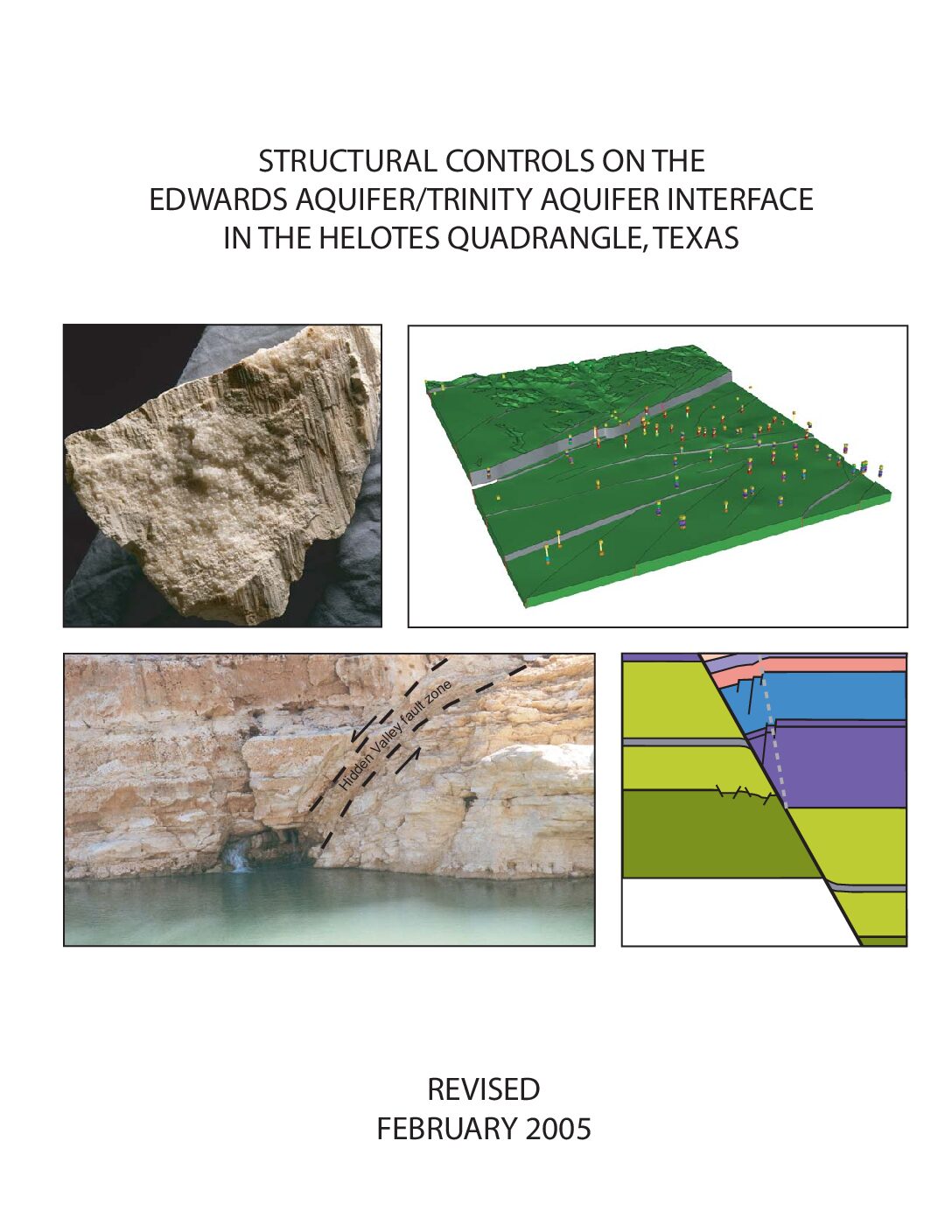
Description: Structural analyses for geologic framework model of the Helotes Quadrangle around the intersection of the Edwards and Trinity Aquifers
Location: Edwards Aquifer, Balcones Fault Zone, San Antonio Segment, Trinity Aquifer, Bexar County
Summary:The purpose of this study was to generate a three-dimensional geologic model of the Edwards Aquifer and Trinity Aquifer in the area of the Helotes Quadrangle and to assess the potential for hydraulic communication across the interface between the two aquifers. the study was completed in February 2005 by Southwest research Institute, San Antonio, Texas.
[Executive Summary]
The purpose of the project reported here is to characterize the structural architecture of the Edwards and Trinity Aquifers in the area of the Helotes 7 ½ minute quadrangle. Included in this analysis are tasks to generate a three-dimensional computer model (geologic framework model) of the Edwards and Trinity Aquifers, and perform field investigations to characterize the mechanisms and products of localized fault-related deformation in the Edwards and Trinity Aquifers in and near the study area. An important objective is to analyze the potential for groundwater flow from the Trinity Aquifer to the Edwards Aquifer, taking into account fault-related deformation and juxtaposition of the aquifers across key faults.
Results of the project show the aquifer architecture throughout the study area, the location and interpreted geometry of the most important mapped faults in the study area, and the deformation mechanisms and deformation style in fault zones in the rocks of both the Edwards and Trinity Aquifers. The three-dimensional geologic framework model of the Helotes area reveals: (i) juxtaposition of permeable and relatively impermeable hydrogeologic units, (ii) structural thinning of the Edwards and Trinity Aquifers, (iii) potential for cross-fault communication between the Edwards and Trinity Aquifers, (iv) faults expressed on the surface as potential infiltration pathways, and (v) maximum offset concentrated along a small number (two or three) faults. This information, along with an understanding of fault zone deformation mechanisms and the role of fault zones as barriers or conduits, can assist in locating environmentally sensitive areas. It is useful for aquifer water flow path studies and contributes to the identification of areas where communication between the Trinity and Edwards Aquifers is suspected. In this geologic framework model, the Edwards and Trinity Aquifers and associated confining layers are subdivided into 12 stratigraphic units which are offset by a network of 30 faults. Vertical offset (fault throw) ranges from near zero to an approximate maximum of 178 meters (584 ft). Displacement sense is normal, commonly down to the southeast, and lateral throw gradients are generally small (0.002 to 0.015), although locally may be as high as 0.03. In map view, fault blocks are elongate, with the long axis commonly oriented NE-SW. Maximum offset is concentrated along two major fault systems; one fault, the Haby Crossing fault, has a maximum throw of about 178 m (584 ft) and juxtaposes virtually the entire Edwards Group stratigraphic section with rocks of the Glen Rose Formation beneath the City of Helotes. The Diversion Lake fault cuts across the NW corner of the Helotes Quadrangle, and has amaximum throw of 68 m (223 ft) within the quadrangle area.
In general, normal faults of all displacements decrease the effective aquifer thickness. This structural thinning of aquifer layers can cause flow constrictions, which in turn may divert flow and cause fluctuations in the local water table from fault block to fault block. Areas of such flow constrictions can be identified using a map of fault throw distribution; constriction is likely greatest where fault throw is greatest.
The large displacement on the Haby Crossing fault within the Helotes quadrangle may be significant for direct communication between the Edwards Group and Glen Rose Formation in this area. Also important, this large displacement on a single fault is responsible for dropping the Edwards Aquifer from hilltop exposures north of the Haby Crossing fault, to mostly buried (confined) on the south side.
Consequently, this large-displacement fault results in a local narrowing of the area designated as Edwards Aquifer recharge zone. 3DStress„¢ analyses of measured faults and regional stratigraphic thicknesses based on published maps yield a stress system during faulting of: vertical effective stress = 15 MPa; minimum horizontal effective stress (F3²) = 4 MPa with an azimuth of 150°; and an intermediate principal effective stress = 9.5 MPa.
When applied to the fault surfaces exported from the three-dimensional geologic framework model, this stress tensor indicates that the dominant, NE-SW striking faults experience high slip tendencies and are well oriented to have accommodated regional strains developed within the inferred stress system. In addition to experiencing high slip tendencies in the inferred stress system, the predominant faults are also subject to high dilation tendencies; this is especially true within the Edwards Aquifer section because these faults tend to have steeper dips than those within the Glen Rose Formation, and hence experience greater dilation tendencies. This combination of high slip and dilation tendencies implies that the major faults could have been effective fluid transmission pathways at the time of faulting. If a similar stress system were extant today, the faults would be in favorable orientations for enhanced fluid transmissivity.
Fault block deformation calculated using cutoff lines generated from the three-dimensional geologic framework model results in cutoff line elongations that rarely exceed 2 percent (positive or negative). Although these small cutoff elongations reflect generally low displacement gradients, faults within the Helotes area exhibit higher cutoff strains along more fault length than either the Castle Hills or Camp Bullis areas. At the scale of the three-dimensional model, competent units exhibit gentle dips, which is consistent with relatively rapid lateral and vertical fault propagation, until intersection with other faults occurs (laterally) or intersection with a weaker mechanical layer occurs. The overall lack of steep lateral displacement gradients suggests rapid fault propagation with respect to the rate of displacementaccumulation on the faults, although there are locations in which steeper lateral gradients have developed.
Field work reveals interesting contrasts between faults in the Edwards and Trinity Aquifers. Faults with displacements of 5 m (16 ft) to tens of meters in the Glen Rose Formation (Trinity Aquifer) commonly have wide damage zones, on the order of meters, within which small faults, rotated fault blocks, and smear of clay shale beds (if present) are common. By contrast fault zones with displacements of 5 m (16 ft) to tens of meters in the Edwards Group limestones typically have numerous associated small faults, but associated block rotation and bed tilting are rare. This characteristic difference in structural style between the Edwards Group limestones and the Glen Rose Formation appears to be related to lithologic differences and the resulting differences in mechanical behavior of the two stratigraphic sections. The Glen Rose Formation contains both competent massive limestone beds and incompetent argillaceous limestone and shale beds. Incompetent beds tend to arrest fault propagation during fault growth.
Consequently, with increasing fault displacement, fault tips (terminations) episodically propagate. Continued displacement on a fault with an arrested fault tipline will produce fault tipline folding and associated local deformation such as complex small-scale faulting. Resulting fault damage zones are quite complex and variable along a fault, and the complexity of faulting is related to the structural position (including displacement magnitude) and the associated mechanical stratigraphy. Permeability in fault zones and fault blocks is strongly influenced by deformation styles in different mechanical layers as well as the deformation progression with increasing fault displacement.
The large fault surfaces that cut multiple layers depicted in the Helotes geologic framework model provide potential pathways for both vertical and lateral movement of water and hydraulic communicationbetween aquifers. These fault surfaces along with localized zones of relatively intense small-scale faulting and extension fracturing, and limestone solution (karst conduit formation) provide likelycommunication pathways between the Edwards and Trinity Aquifers. The structural analyses presented in this report provide the basis for more detailed investigations of groundwater levels, multiwell pumping (drawdown) tests, tracer studies, and geochemical investigations to further investigate potential groundwater communication between the Edwards and Trinity Aquifers in the Helotes Quadrangle.
Helicopter Electromagnetic and Magnetic Survey Data and Maps, Seco Creek Area, Medina and Uvalde Counties, Texas Plate
Description: Full-size plate for "Helicopter Electromagnetic and Magnetic Survey Data and Maps, Seco Creek Area, Medina and Uvalde Counties, Texas". Note: Original size plate - need large-format printer.
Report Number: USGS O-FR 2003-226
Location: Medina County, Uvalde County
Summary:Full-size plate for Helicopter Electromagnetic and Magnetic Survey Data and Maps, Seco Creek Area, Medina and Uvalde Counties, Texas. Note: Original size plate need large-format printer.
Regional Distribution of Permeability in the Edwards Aquifer Plates
Description: Large-format versions of the plates for Regional Distribution of Permeability in the Edwards Aquifer. See companion document.
Report Number: 95-02
Location: Edwards Aquifer
Summary:Large-format versions of the plates for Regional Distribution of Permeability in the Edwards Aquifer. See companion document.
Geologic Framework and Hydrogeologic Characteristics of the Edwards Aquifer Outcrop, Medina County, Texas
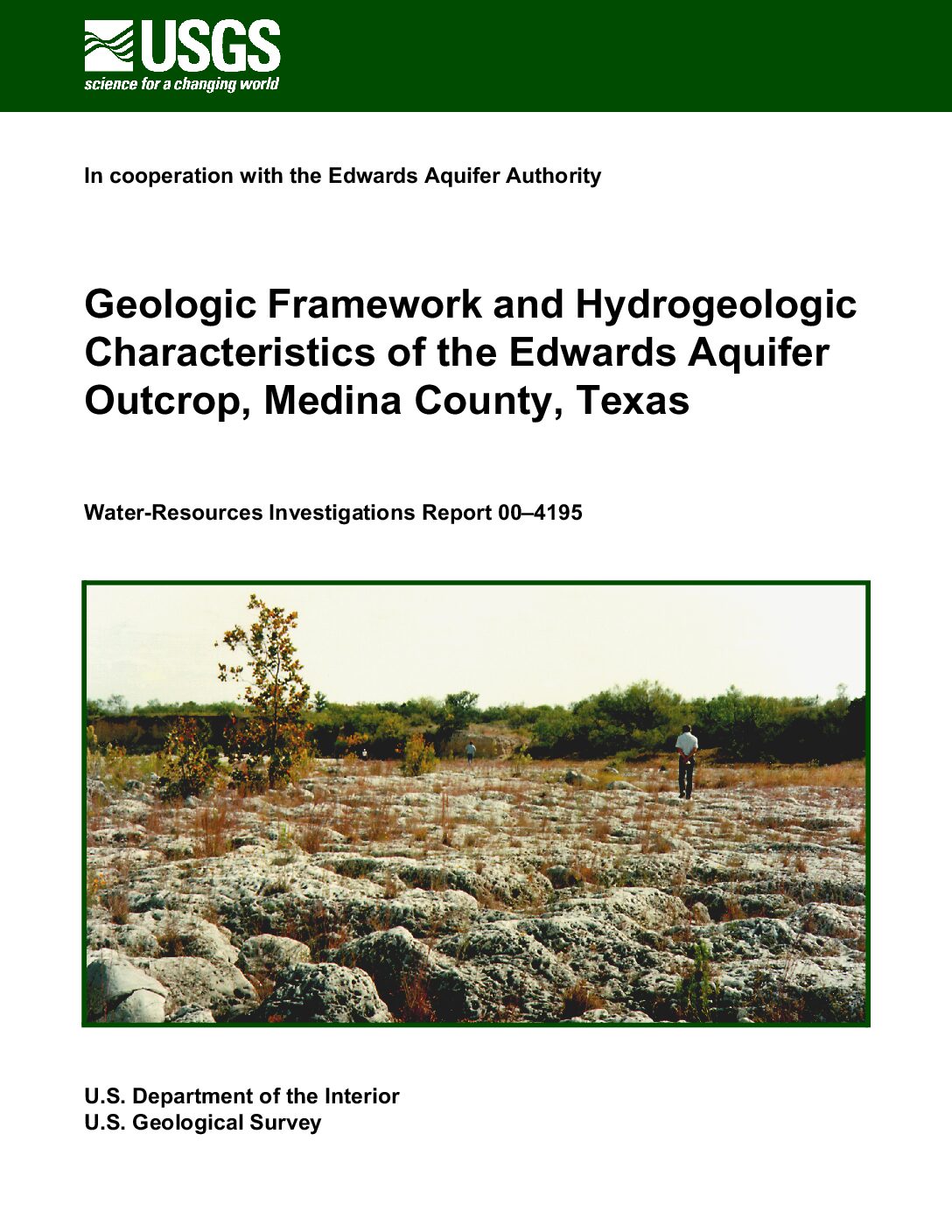
Description: Geologic and hydrogeologic description of the karstic limestone outcrops of the Edwards Aquifer Recharge Zone in Medina County, TX
Report Number: USGS WRIR 00-4195
Location: Medina County
Summary:The hydrogeologic subdivisions of the Edwards aquifer outcrop in Medina County generally are porous and permeable. The most porous and permeable appear to be hydrogeologic subdivision VI, the Kirschberg evaporite member of the Kainer Formation; and hydrogeologic subdivision III, the leached and collapsed members, undivided, of the Person Formation. The most porous and permeable rocks of the Devils River Formation in Medina County appear to be in the top layer. The upper member of the Glen Rose Limestone, the lower confining unit, has much less porosity and permeability than that observed in the Edwards aquifer.
The Edwards aquifer has relatively large porosity and permeability resulting, in part, from the development or redistribution of secondary porosity. Lithology, stratigraphy, diagenesis, and karstification account for the effective porosity and permeability in the Edwards aquifer outcrop. Karst features that can greatly enhance effective porosity and permeability in the Edwards aquifer outcrop include sinkholes, dolines, and caves. The Edwards aquifer rocks in Medina County change from the eight-member Edwards Group to the essentially indivisible Devils River Formation. The facies change occurs along a line extending northwestward from just south of Medina Lake.
Geologic Framework and Hydrogeologic Characteristics of the Edwards Aquifer, Uvalde County, Texas
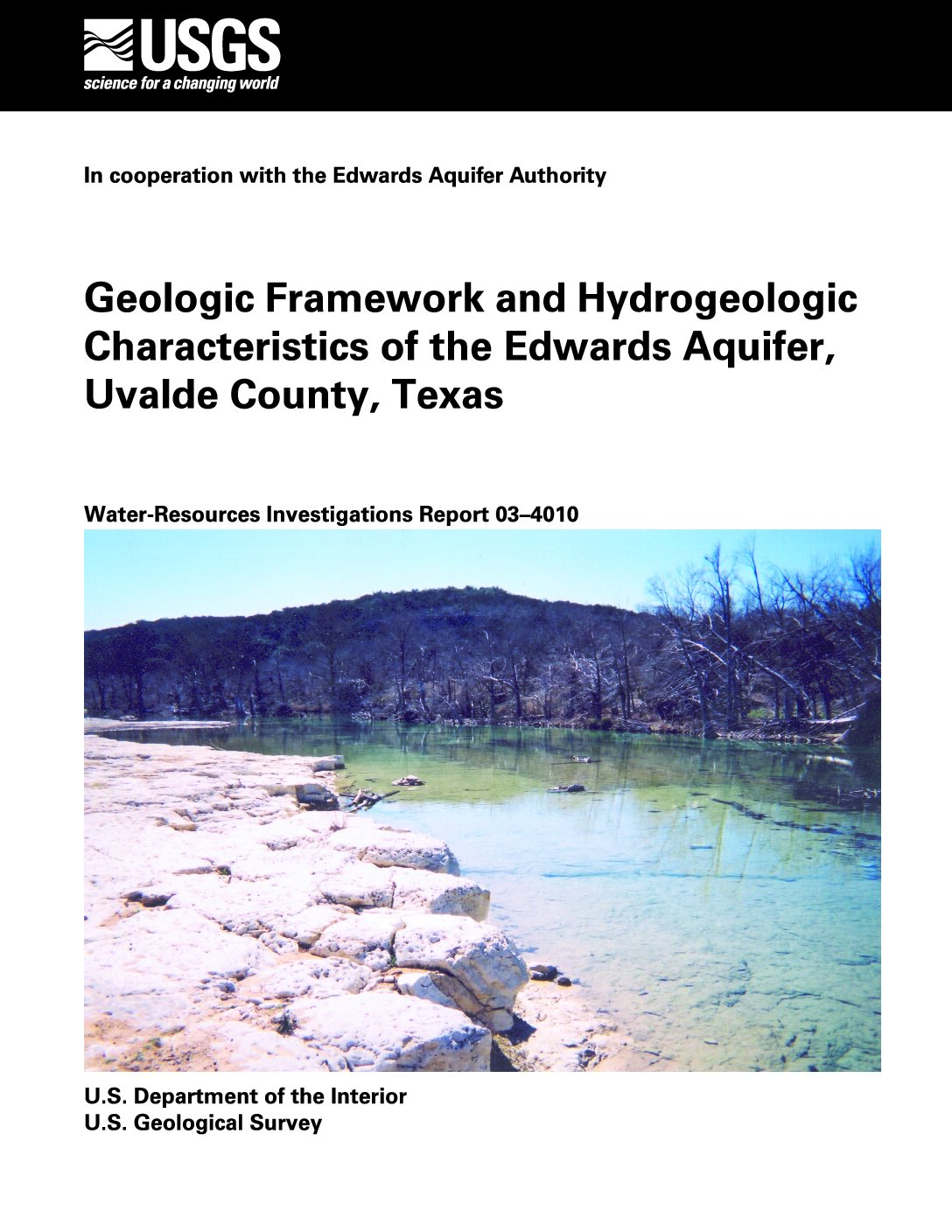
Description: Geology and hydrogeology of the Edwards Aquifer in Uvalde County, TX
Report Number: USGS WRIR 03-4010
Location: Uvalde County
Summary:The Edwards aquifer in Uvalde County is composed of Lower Cretaceous carbonate (mostly dolomitic limestone) strata of the Devils River Formation in the Devils River trend and of the West Nueces, McKnight, and Salmon Peak Formations in the Maverick basin. Rocks in the Devils River trend are divided at the bottom of the Devils River Formation into the (informal) basal nodular unit.
Maverick basin rocks are divided (informally) into the basal nodular unit of the West Nueces Formation; into lower, middle, and upper units of the McKnight Formation; and into lower and upper units of the Salmon Peak Formation. The Edwards aquifer overlies the (Lower Cretaceous) Glen Rose Limestone, which composes the lower confining unit of the Edwards aquifer. The Edwards aquifer is overlain by the (Upper Cretaceous) Del Rio Clay, the basal formation of the upper confining unit.
Upper Cretaceous and (or) Lower Tertiary igneous rocks intrude all stratigraphic units that compose the Edwards aquifer, particularly in the southern part of the study area. The Balcones fault zone and the Uvalde salient are the principal structural features in the study area. The fault zone comprises mostly en echelon, high-angle, and down-to-the-southeast normal faults that trend mostly from southwest to northeast. The Uvalde salient”resulting apparently from a combination of crustal uplift, diverse faulting, and igneous activity”elevates the Edwards aquifer to the surface across the central part of Uvalde County. Downfaulted blocks associated with six primary faults”Cooks, Black Mountain, Blue Mountain, Uvalde, Agape, and Connor”juxtapose the Salmon Peak Formation (Lower Cretaceous) in central parts of the study area against Upper Cretaceous strata in the southeastern part.
The carbonate rocks of the Devils River trend and the Maverick basin are products of assorted tectonic and depositional conditions that affected the depth and circulation of the Cretaceous seas. The Devils River Formation formed in a fringing carbonate bank”the Devils River trend”in mostly open shallow marine environments of relatively high wave and current energy. The West Nueces, McKnight, and Salmon Peak Formations resulted mostly from partly restricted to open marine, tidal-flat, and restricted deep-basinal environments in the Maverick basin.
The porosity of the Edwards aquifer results from depositional and diagenetic effects along specific lithostratigraphic horizons (fabric selective) and from structural and solutional features that can occur in any lithostratigraphic horizon (non-fabric selective). In addition to porosity depending upon the effects of fracturing and the dissolution of chemically unstable (soluble) minerals and fossils, the resultant permeability depends on the size, shape, and distribution of the porosity as well as the interconnection among the pores. Upper parts of the Devils River Formation and the upper unit of the Salmon Peak Formation compose some of the most porous and permeable rocks in Uvalde County.
Carbonate Geology and Hydrology of the Edwards Aquifer in the San Antonio Area, Texas
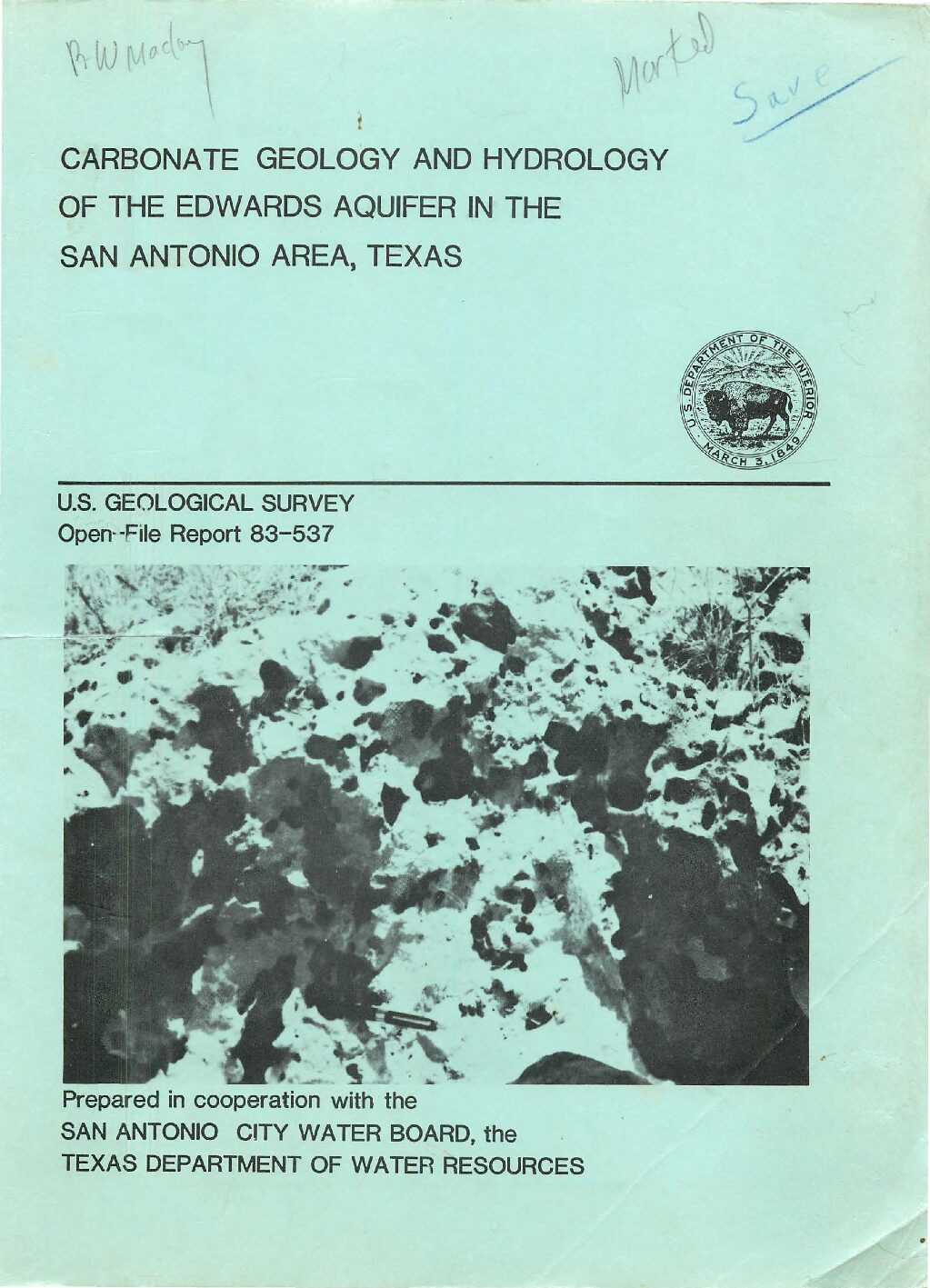
Description: Hydrostratigraphic subdivisions, types of rock, permeability and groundwater movement in the Edwards Aquifer in the San Antonio region
Report Number: USGS O-FR 83-537
Location: Edwards Aquifer, Balcones Fault Zone, San Antonio Segment
Summary:Regional differences in the porosity and permeability of the Edwards aquifer are related to three major depositional areas, the Maverick basin the Devils River trend, and the San Marcos platform, that existed during Early Cretaceous time. The rocks of the Maverick basin are predominantly deep basinal deposits of dense, homogeneous mudstones of low primary porosity. Permeability is principally associated with cavernous voids in the upper part of the Salmon Peak Formation in the Maverick basin. The rocks of the Devils River trend are a complex of marine and supratidal deposits in the lower part and reefal or inter-reefal deposits in the upper part. Permeable zones, which occur in the upper part of the trend, are associated with collapse breccias and rudist reefs. The rocks of the San Marcos platform predominantly are micrites that locally contain collapse breccias, honeycombed, burrowed mudstones, and rudist reef deposits that are well leached and very permeable. The rocks of the San Marcos platform form the most transmissive part of the Edwards aquifer in the San Antonio area. Karstification of the rocks on the San Marcos platform during Cretaceous time enhanced the permeability of the aquifer.
Permeability of the Edwards aquifer is greatest in particular strata (lithofacies) which have been leached in the freshwater zone. Ground water moves along vertical or steeply inclined fractures that are passageways by which water can enter permeable strata. Water moves from the fractures into beds formed by collapse breccias, burrowed wackestones, and rudist grainstones that have significant secondary porosity and permeability. Water has selectively dissolved sedimentary features within those rocks to increase the size of the openings and the degree of interconnection between pore voids.
Recognition of the hydrostratigraphic subdivisions provides a basis for defining the nonhomogeneity of the aquifer and determining its storage characteristics. The aquifer is considered to be a faulted and multilayered aquifer in which lateral circulation is mainly through very permeable, hydrostratigraphic subdivisions that are hydraulically connected at places by openings associated with steep-angle, normal faults. The Edwards aquifer is vertically displaced for its entire thickness at places along major northeastward trending faults. At these places, ground-water circulation is diverted either southwest or northeast.
Helicopter Electromagnetic and Magnetic Survey Data and Maps, Northern Bexar County, Texas
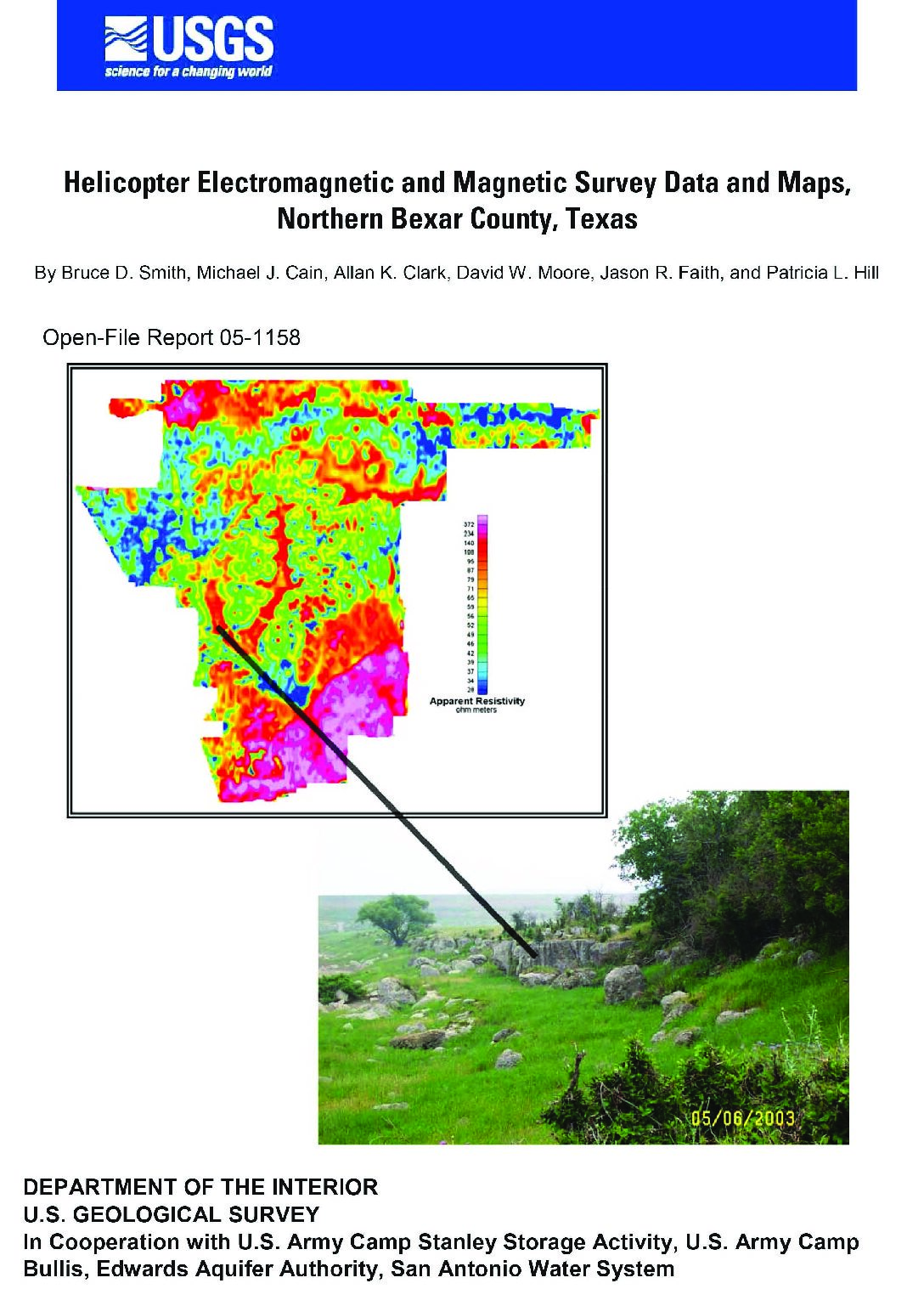
Description: Helicopter survey of electromagnetic and magnetic properties with hydrologic application around Northern Bexar County, TX
Report Number: USGS O-FR 2005-1158
Location: Bexar County
Summary:This open-file report is a data release for a helicopter electromagnetic (HEM) and magnetic geophysical survey flown in early December 2003, in Northern Bexar County, Texas (fig. 1). The U.S. Geological Survey (USGS) contracted the survey to Fugro Airborne of Toronto, Canada. Fugro flew a similar survey under contract to the USGS in the Seco Creek area (fig. 1) of the Edwards aquifer (Smith and others, 2003). The objective of these surveys was to collect geophysical data to map and image subsurface features important in understanding ground-water resources in the area (Smith and others, 2003). In particular, the survey has refined the location of mapped faults in the survey area and suggested many unmapped faults exist. These faults can control ground-water flow and storage. New lithologic variations in the Edwards Recharge were mapped in both the shallow and deep subsurface. Images of the subsurface in the confined zone demonstrated a structural complexity not previously appreciated. Geophysical mapping in the Trinity aquifer also showed previously unmapped structures and lithologic variations.
The success of the airborne geophysical work at Seco Creek (Smith, Irvine, and others, 2003) led to a meeting of USGS and Camp Stanley Storage Activity (CSSA, Brian Murphy) personnel organized by Parsons Technology (Gary Cobb) to evaluate the possible use of airborne geophysical methods at that site. The area of the CSSA, about 10 square miles, is considerably smaller than the Seco Creek survey area of 80 square miles. Consequently, the general cost per line mile for this small area was estimated to be a factor of 4 to 5 times higher than for the larger area of the Seco Creek survey. A proposal was submitted to the Camp Bullis environmental group to expand the survey area to include the military training site adjacent to CSSA. The USGS also submitted a funding proposal to the San Antonio Water System (SAWS) to fly the Cibolo Creek area north of the military sites and a proposal to the Edwards Aquifer Authority to fly the Edwards recharge area to the south. All of the proposals, in addition to the CSSA proposal, were at least partly funded. The resulting survey consisted of about 800 line miles (1,280 line kilometers) of HEM flying with a major portion of the area being Camp Bullis. A major constraint in flying the areas adjacent to the military sites and northern Bexar County is that urbanization of the city of San Antonio is rapidly expanding to the north, thus restricting low-level flying. An important reason for the project to map and to understand the subsurface Edwards aquifer is that it is the sole-source water supply for the city. As the city development expands northward in Bexar County, less area will be available for low-level aerial surveying including geophysics. A detailed map of survey boundaries is shown in figure 2.
Geophysical Survey Summary
The HEM survey used the RESOLVE© system flown by Fugro Airborne Surveys, which uses five horizontal coplanar coils and one vertical coaxial coil for electromagnetic field measurements. Appendix I, the contractor's report, gives details of the instrumentation and data processing procedures. The specific frequencies for the electromagnetic system are given in table 1. These frequencies are similar to those used in the Seco Creek survey except for the highest frequency that was nominally 100,000 Hz. The geophysical sensor housing (bird) includes the electromagnetic (EM) system, a total field magnetometer, differential kinematic Global Positioning System (GPS) and laser altimeter. The helicopter carries another differential GPS system, barometric and radar altimeters, and a video camera. Electromagnetic noise from power lines and natural sources (lightning) also are measured. The survey was flown with east-west flight lines and a nominal line spacing of 200 m with a sensor elevation of 30 m except as required for safety considerations and FAA regulations. In-fill lines were flown in the central part of the survey area to yield an effective flight line spacing of 100 m. Lines were also flown down Salado and Lewis Creeks (see cover photo) for additional resolution along drainages. North-south tie lines were flown to level the total field magnetic data.
Data-Release Summary
The digital data are described in detail in the following sections and in the contractor report (Appendix I). The data are organized into separate subdirectories in this data release. The subdirectories contain readme files describing the files in that directory. Table 2 is a summary of these directories with active links. The geographic data are referenced to NAD27, UTM14N unless otherwise specified. The line data in the LINEDATA directory are given in a Geosoft OASIS MONTAJ© database. A free data viewer is available from Geosoft (www.geosoft.com accessed 2/04/05) that can be used to convert the files to ASCII. Files given in the GRIDS subdirectory for the digital magnetic data, apparent resistivity data, and digital terrain model data (derived from the laser altimeter and GPS systems) can be read in the free viewer. Also included is a plug-in (SOFTWARE subdirectory) provided by Geosoft for ESRI programs such as ARCGIS (8.2 and higher) that reads Geosoft grids. The digital maps are all referenced to NAD27, UTM14N.
The airborne geophysical project for northern Bexar County includes an interpretational component. A report on results of this part of the study is in progress. Preliminary comparison of the new geophysical maps with the published geologic maps (A.K. Clark; 2003, 2004) show that the airborne survey provides new information about the location of structures and near surface lithologic variations.The apparent resistivity maps at the 6 survey frequencies provide a rough estimate of conductivity variations as a function of depth. The geophysical data suggest that 1) northwest trending structures that cross the northeast trend of the Balcones fault system are more extensive than currently mapped (A.K. Clark, 2003), 2) apparent resistivity trends in the Edwards recharge zone suggest possible lithologic or structural variations that have not been mapped, 3) the apparent resistivity data from the highest frequency (115,000 Hz) has trends that closely follow the mapped geology and suggest lithologic variations not previously mapped, and 4) differences in the lithologies of the Trinity and Edwards aquifers imply possible constraints in location of subsurface ground water flow paths. All of these preliminary interpretational observations suggest that further processing of the electromagnetic data will be useful in refinement of subsurface geologic and hydrologic features. Processing which is under way includes screening of areas affected by power line noise, and construction of resistivity depth sections (cross sections of resistivity variations) along each flight line.
Regional Distribution of Permeability in the Edwards Aquifer
Description: Quantitative distribution of various factors controlling permeability and analysis of geographic and geologic relationships in the Edwards aquifer. Note: Large-format versions of the plates for this report are available in a companion document.
Report Number: 95-02
Location: Edwards Aquifer
Summary:Note: Large-format versions of the plates for this report are available in a companion document.
The Edwards aquifer of South Texas is a dual-porosity/dual-permeability system. To describe the permeability structure of the aquifer quantitatively, the distribution of various factors controlling permeability was quantified, and geographic and geologic relationships were analyzed. The major contributors to permeability are (1) structurally controlled fractures and faults, (2) highly porous carbonate matrix, and (3) vertically and horizontally extensive cave systems.
Structural mapping of the Edwards Formation in outcrop and in the subsurface was used to define the location and amount of offset along faults and to define areas of potentially higher fracture intensity. Composite displacements of 1,400 to 1,850 ft (430 to 560 m) across the aquifer occur along a series of en echelon normal faults with throws of 100 to 850 ft (30 to 260 m). The areas between the en echelon faults, known as relay ramps, create and maintain the connection of the aquifer unit through faulted regions. Smaller faults and smaller relay ramps within the large fault-bounded blocks impact the permeability distribution primarily because of associated fractures.
Specific capacity test results from throughout the aquifer were used to calculate transmissivity using a relationship between specific capacity and transmissivity developed for the Edwards aquifer. Transmissivities vary eight orders of magnitude from 0.1 to 10,000,000 ft2/day (0.01 to 1,000,000 m2/day). Statistical analysis shows that transmissivity systematically varies In different areas of the aquifer but that variability within any area Is high, reflecting the heterogeneous contribution of fractures, matrix, and karst to transmissivity.
The distribution of caves and their relationship to stratigraphy and structure was examined using photomosaics of outcrops. Karst processes enlarge fractures by solution and increase their aperture and roughness. Preferential dissolution of dolomitic tidal flat and dolomitized subtidal facies creates stratigraphically controlled conduits and high, touching-vug permeability.
Intense diagenesis of the Edwards rocks is the principle control on the relationships between porosity and matrix permeability. Matrix porosity-permeability transforms were developed for (1) particle-dominated aquifer units, (2) the fine-grained Salmon Peak Formation, (3) particle-dominated units In outcrop, and (4) the saline portion of the Edwards, south and east of the aquifer.
Geologic Framework and Hydrogeologic Characteristics of the Edwards Aquifer Outcrop, Hays County, Texas
Description: Geologic and hydrogeologic description of the karstic limestone outcrops of the Edwards Aquifer Recharge Zone in Comal County, TX
Report Number: USGS WRIP 95-4265
Location: Hays County
Summary:All of the hydrogeologic subdivisions within the Edwards aquifer outcrop in Hays County have some porosity and permeability. The most porous and permeable appear to be hydrogeologic subdivision VI, the Kirschberg evaporite member of the Kainer Formation; hydrogeologic subdivision III, the leached and collapsed members, undivided; and hydrogeologic subdivision II, the cyclic and marine members, undivided, of the Person Formation.
The two types of porosity in the Edwards aquifer outcrop are fabric selective, which is related to depositional or diagenetic elements and typically exists in specific stratigraphic horizons; and not fabric selective, which can exist in any lithostratigraphic horizon. Permeability, the capacity of porous rock to transmit water, depends on the physical properties of the rock such as size, shape, and distribution of pores, and fissuring and dissolution.
Two faults, San Marcos Springs and Mustang Branch, completely, or almost completely, offset the Edwards aquifer by juxtaposing Edwards aquifer limestone against nearly impermeable upper confining units along parts of their traces across Hays County. These faults are thought to be barriers, or partial barriers, to groundwater flow where the beds are juxtaposed.
In Hays County, the Edwards aquifer probably is most vulnerable to surface contamination in the rapidly urbanizing areas on the Edwards aquifer outcrop. Contamination can result from spills or leakage of hazardous materials; or runoff on the intensely faulted and fractured, karstic limestone outcrops characteristic of the recharge zone.
Helicopter Electromagnetic and Magnetic Survey Data and Maps, Seco Creek Area, Medina and Uvalde Counties, Texas
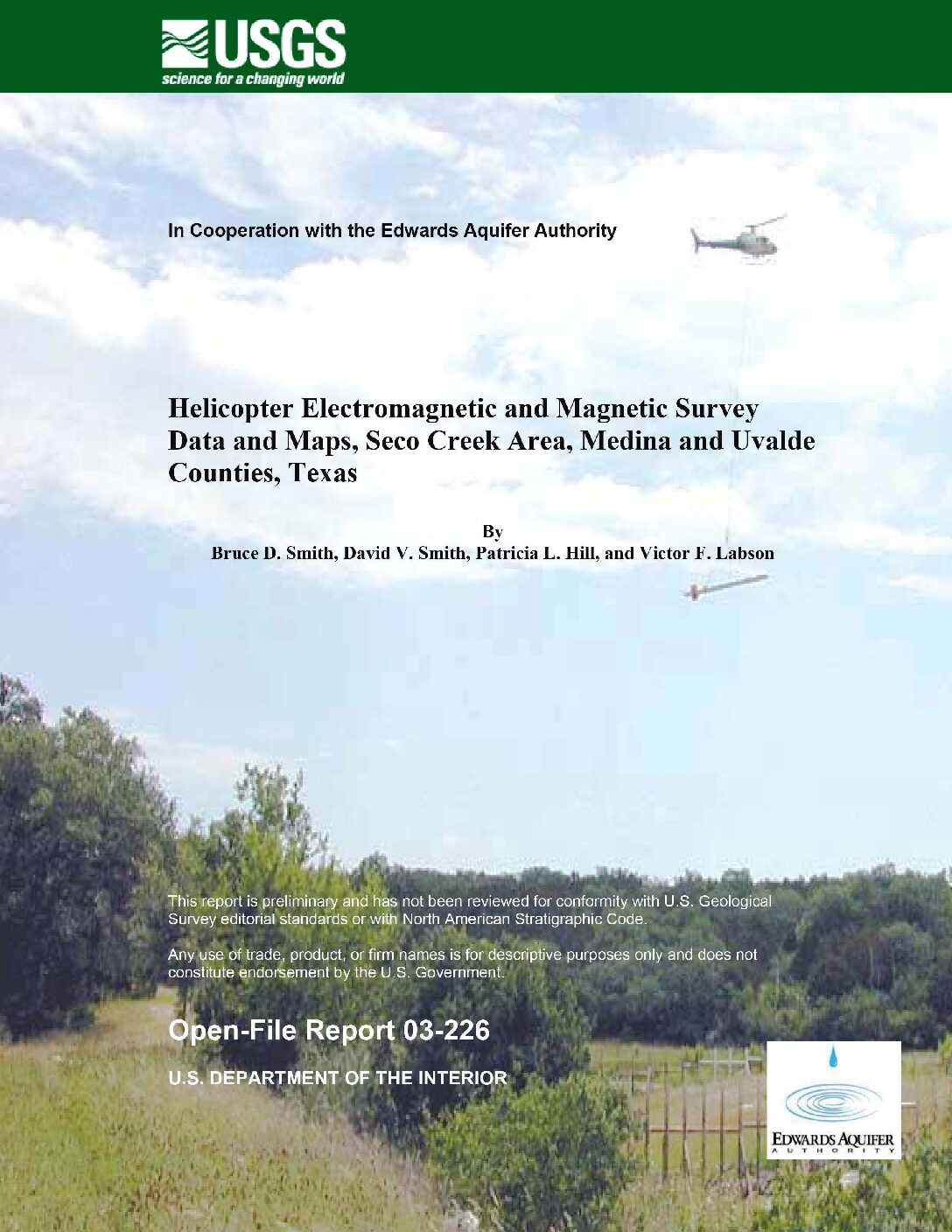
Description: Helicopter survey of electromagnetic and magnetic properties with hydrologic application around the Valdina Farms sinkhole in Medina County, Texas
Report Number: USGS O-FR 2003-226
Location: Medina County, Uvalde County
Summary:The purpose of this study was to obtain an airborne electromagnetic survey of northern Medina County in the vicinity of the Seco Creek Sinkhole. The data indicated that the survey is effective to a depth of approximately 100 meters below grade and that the data shows more detailed geologic structure than previously prepared geologic maps. Geologic structure and their effects on groundwater flow can be interpreted from the data. The study was completed in July 2003 by the United States Geological Survey, Denver, Colorado.
A helicopter electromagnetic and magnetic (HEM) survey was completed of a 209 square kilometer (81 square miles) area of the central Edwards aquifer. This openfile report is a release of the airborne geophysical data and a summary of the hydrologic application. The survey area was centered on the Valdina Farms sinkhole along the Seco Creek drainage in western Medina County, Texas. Flight lines were flown north south with three east west tie lines to aid in leveling the magnetic data.
Additional lines were flown on each side of the Seco and Little Seco Creek drainages. A five kilometer (4 mile) extension of 15 lines was flown north of the main survey block centered on Seco Creek. This digital data release contains the flight line data, grids, and maps of the HEM survey data.
The Edwards aquifer in this area consists of three hydrologic zones: catchment, recharge, and confined. The Glen Rose Formation is exposed in the catchment area. The recharge zone is situated in the Balcones fault zone where the Devils River Group of the Edwards aquifer has been exposed by normal faults. The magnetic data is not discussed in depth here, but does have high amplitude closed anomalies caused by shallow igneous intrusives. The Woodard Cave Fault that separates the recharge and catchment zones is in places associated with a weak linear magnetic low.
The HEM data has been processed to produce apparent resistivities for each of the six EM coil pairs and frequencies. Maps of the apparent resistivity for the five horizontal coil pairs show that the catchment, recharge, and confined zones all have numerous linear features that are likely caused by structures, many of which have not been mapped. The distribution of high resistivity areas reflects the lithologic differences within the Trinity and Edwards aquifers.


 CURRENT