

 Aquifer Conditions
Science & Data Document Library
Science and Data Resources
Geologic Framework and Hydrogeologic Characteristics of the Edwards Aquifer Outcrop, Comal County, Texas

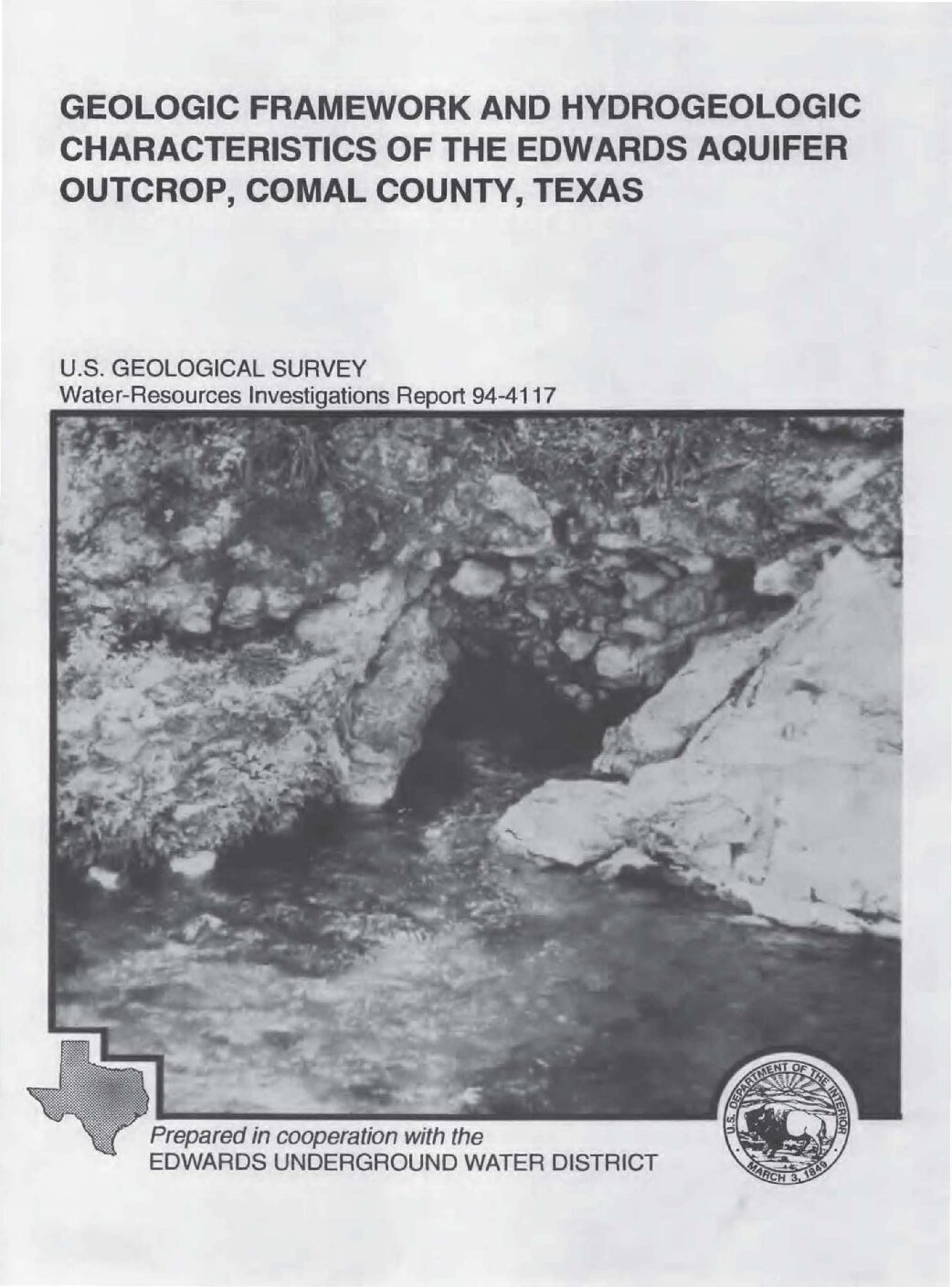
Description: Geologic and hydrogeologic description of the karstic limestone outcrops of the Edwards Aquifer Recharge Zone in Comal County, TX
Report Number: USGS WRIP 94-4117
Location: Comal County
Summary:All of the hydrogeologic subdivisions within the Edwards aquifer outcrop in Comal County have some porosity and permeability. The most porous and permeable appear to be Hydrogeologic subdivision VI, the Kirschberg evaporate member of the Kainer Formation; Hydrogeologic subdivision III, the leached and collapsed members, undivided; and hydrogeologic subdivision II, the cyclic and marine members, undivided, of the Person Formation. The two types of porosity in the Edwards aquifer outcrop are fabric selective, which is related to depositional or diagenetic elements and typically exists in specific stratigraphic horizons; and not fabric selective, which can exist in any lithostratigraphic horizon. Permeability, the capacity of porous rock to transmit water, depends on the physical properties of the rock such as pore size, shape, distribution, fissuring, and dissolution.
Two faults, Comal Springs and Hueco Springs, completely, or almost completely, offset the Edwards aquifer along much of their respective traces across Comal County. Porous and permeable Edwards aquifer limestone is juxtaposed against impermeable upper confining units in these areas. These faults completely, or almost completely, offset the Edwards aquifer and are thought to be barriers or partial barriers to groundwater flow where the beds are juxtaposed.
In Comal County, the Edwards aquifer is probably most vulnerable to surface contamination in the rapidly urbanizing areas on the Edwards aquifer outcrop. Possible contamination can result from spills, leakage of hazardous materials, or runoff onto the intensely faulted and fractured, karstic limestone outcrops characteristic of the recharge zone.
Structural Controls on the Edwards Aquifer/Trinity Aquifer Interface in the Camp Bullis Quadrangle, Texas
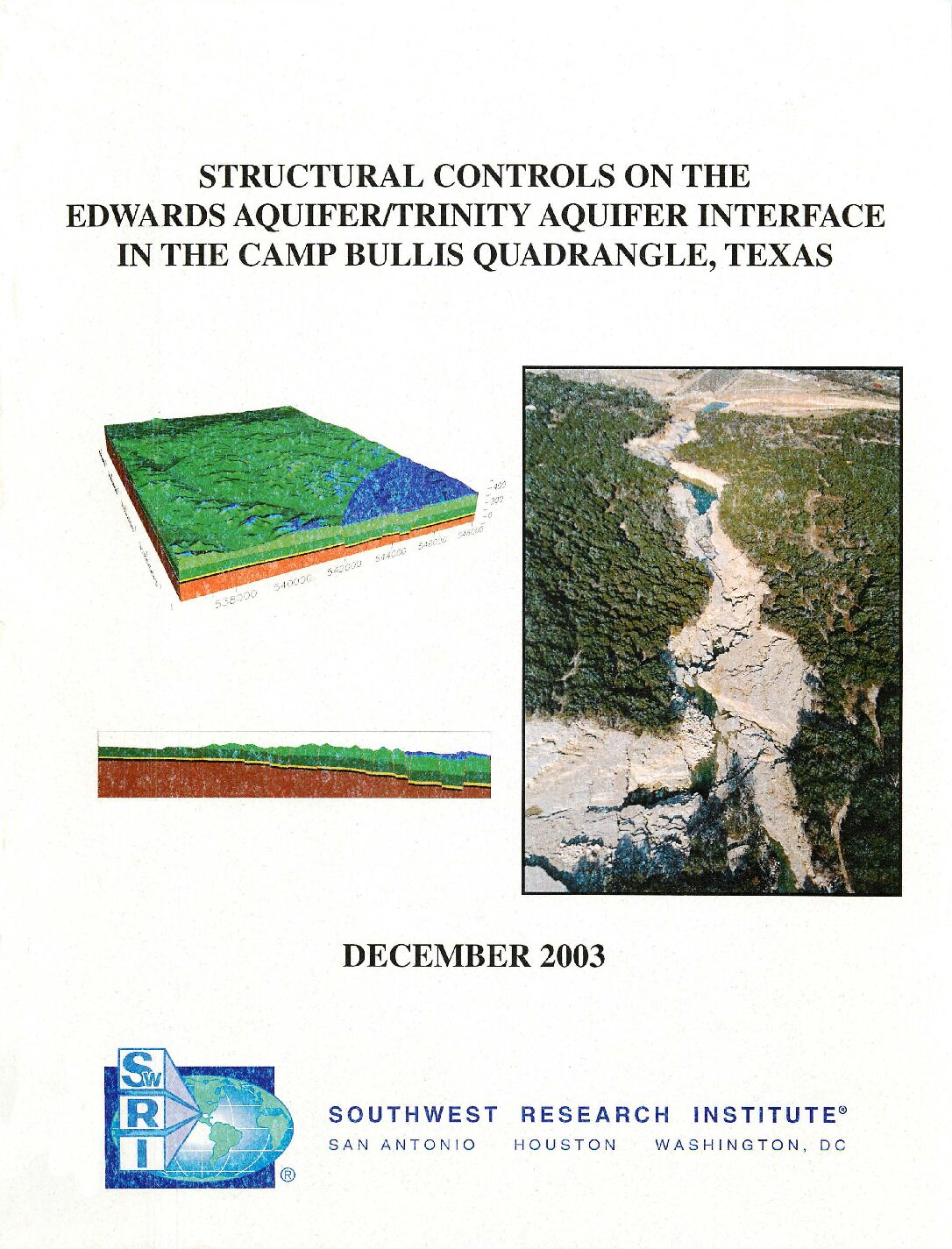
Description: Structural analyses for geologic framework model of the area around the intersection of the Edwards and Trinity Aquifers
Location: Edwards Aquifer, Balcones Fault Zone, San Antonio Segment, Trinity Aquifer, Bexar County
Summary:The purpose of this study was to generate a three-dimensional computer model and predictions of localized fault related deformation in the Edwards Aquifer and the Trinity Aquifer in the study area. The study also provided an analysis of the potential for hydraulic communication across the interface between the two aquifers, taking into account fault-related deformation and juxtaposition of the aquifers across key faults. The study was completed in December 2003 by Southwest Research Institute, San Antonio, Texas.
[From the Summary]
The purpose of the project reported here is to characterize the structural architecture of the Edwards and Trinity Aquifers for the area of the Camp Bullis 7 ½ minute quadrangle, and extending north to include Cibolo Creek in the southern part of the Bergheim 7 ½ minute quadrangle. Included in this analysis are tasks to generate a three-dimensional computer model of the Trinity and Edwards Aquifer, and perform field investigations to characterize the
mechanisms and products of localized fault-related deformation in the Edwards and Trinity Aquifers in and near the study area. An important objective is to analyze the potential for communication between the Edwards Aquifer and the Trinity Aquifers, taking into account fault-related deformation and juxtaposition of the aquifers across key faults.
Results of the project show the aquifer architecture throughout the study area, the location and interpreted geometry of the most important mapped faults in the study area, and the deformation
mechanisms and deformation style in fault zones in the rocks of both the Edwards and Trinity Aquifers. The three-dimensional geologic framework model of the Camp Bullis area reveals
(i) juxtaposition of permeable and relatively impermeable hydrogeologic units, (ii) structural thinning of the Edwards Aquifer and Trinity Aquifers, (iii) potential for cross-fault communication between the Trinity and Edwards Aquifers, (iv) faults expressed on the surface as potential infiltration pathways, and (v) maximum offset concentrated along a small number (two or three) fault systems. This information, along with an understanding of fault zone
deformation mechanisms and the role of fault zones as barriers or conduits, can assist in locating environmentally sensitive areas. It is useful for aquifer water flow path studies and contributes to
the identification of areas where communication between the Trinity and the Edwards Aquifers is suspected.
In this geologic framework model, the Edwards and Trinity Aquifers are subdivided into seven stratigraphic horizons which are offset by a network of 40 faults. Vertical offset (fault throw) ranges from near zero to an approximate maximum of 110 meters (361 ft). Displacement sense is normal, commonly down to the southeast, and lateral displacement gradients are small. In map view, fault blocks are elongate, with the long axis oriented NE-SW. Maximum offset is concentrated along three fault systems, the southernmost of which forms the northern boundary of the aquifer recharge zone, where rocks of the Edwards Group are in faulted juxtaposition with
rocks of the Glen Rose Formation.
Fault displacements within the Camp Bullis study area are too small to place the base of the Edwards Aquifer (Basal Nodular layer) against the permeable Lower Glen Rose layer. However, each fault decreases the effective aquifer thickness. This structural thinning of aquifer layers can cause flow constrictions, which in turn diverts flow and causes fluctuations in the local water table from fault block to fault block. Areas of such flow constrictions can be identified using a
map of fault throw distribution; constriction is greatest where fault throw is greatest.
In the Castle Hills quadrangle, immediately south of the Camp Bullis quadrangle, several faults offset the Edwards Aquifer by distances equal to or greater than its full thickness. Smaller fault displacements in the Camp Bullis area and the northern part of the Castle Hills quadrangle reduce the amount of direct juxtaposition of Kainer against Lower Glen Rose in these areas to a minimum. The lack of fault juxtaposition of the recognized highly permeable units of the Edwards Group and Glen Rose Formation in the Camp Bullis and Castle Hills areas suggests that simple juxtaposition is not likely to be a major source of aquifer communication in this area.
3DStress„¢ analysis of measured faults, and regional stratigraphic thicknesses based on published maps yield a stress system during faulting of: vertical effective stress = 15 MPa; minimum horizontal effective stress (F3²) = 4 MPa with an azimuth of 150°; and an intermediate principal effective stress = 9.5 MPa. When applied to the fault surfaces exported from the three-dimensional
geologic framework model, this stress tensor indicates that the dominant, NE-SW striking faults experience high slip tendencies and are well oriented to have accommodated regional strains developed within the inferred stress system. A few NW-SE trending faults
experience low slip tendencies and probably formed in response to local stress perturbations, indicating that local perturbations resulting from such effects as displacement-gradient-driven fault block deformation were not widely developed in this area. In addition to experiencing high slip tendencies in the inferred stress system, the predominant faults are also subject to high dilation tendencies. This combination of high slip and dilation tendencies implies that the major faults could have been effective fluid transmission pathways at the time of faulting. If a similar stress system were extant today, the faults would be in favorable orientations for fluid transmissivity.
Fault block deformation calculated using cutoff lines generated from the three-dimensional geologic framework model results in cutoff line elongations that rarely exceed 2% (positive or negative). These small cutoff elongations reflect the low displacement gradients on faults within the Camp Bullis study area. At the scale of the three-dimensional model, competent units exhibit gentle dips, which is consistent with relatively rapid lateral and vertical fault propagation, until intersection with other faults occurs (laterally) or intersection with a weaker mechanical layer occurs. This lack of steep lateral displacement gradients suggests rapid fault propagation with
respect to the rate of displacement accumulation on the faults.
Field work reveals interesting contrasts between faults in the Edwards and Trinity Aquifers. Faults with displacements of 5 m (16 ft) to tens of meters in the Glen Rose Formation (Trinity Aquifer) commonly have damage zones with widths on the order of meters, within which small faults and rotated fault blocks are common. Although faults with displacements of 5 m (16 ft) to tens of meters in the Edwards Group limestones typically have numerous associated small faults,
block rotation and bed tilting is not common. This characteristic difference in structural style between the Edwards Group limestones and the Glen Rose Formation appears to be related to lithologic differences and the resulting differences in mechanical behavior of the two stratigraphic sections. The Glen Rose Formation contains both competent massive limestone beds and incompetent argillaceous limestone and shale beds. Incompetent beds tend to arrest fault propagation during fault growth. Consequently, with increasing fault displacement, fault tips (terminations) episodically propagate then arrest. Continued displacement on a fault with an
arrested fault tipline will produce fault tipline folding and associated local deformation such as intense small scale faulting. Resulting fault damage zones can be quite complex and variable along a fault, related to the structural position (including displacement magnitude) and the associated mechanical stratigraphy. Permeability in fault zones and fault blocks is likely to be strongly influenced by the different deformation styles in mechanical layers, and the deformation progression with increasing fault displacement.
The large fault surfaces that cut multiple layers depicted in the Camp Bullis geologic framework model provide potential pathways for both vertical and lateral movement of water and hydraulic
communication between aquifers. These fault surfaces along with localized zones of relatively intense small scale faulting and extension fracturing, and limestone solution (karst conduit formation) provide likely communication pathways between the Trinity and Edwards Aquifers.
The structural analyses presented in this report provide the framework for more detailed investigations of groundwater levels, multiwell pumping (drawdown) tests, tracer studies, and geochemical investigations to further investigate potential groundwater communication between the Trinity and Edwards Aquifers in the Camp Bullis and Castle Hills Quadrangles.
Geologic framework and hydrostratigraphy of the Edwards and Trinity aquifers within northern Bexar and Comal Counties, Texas
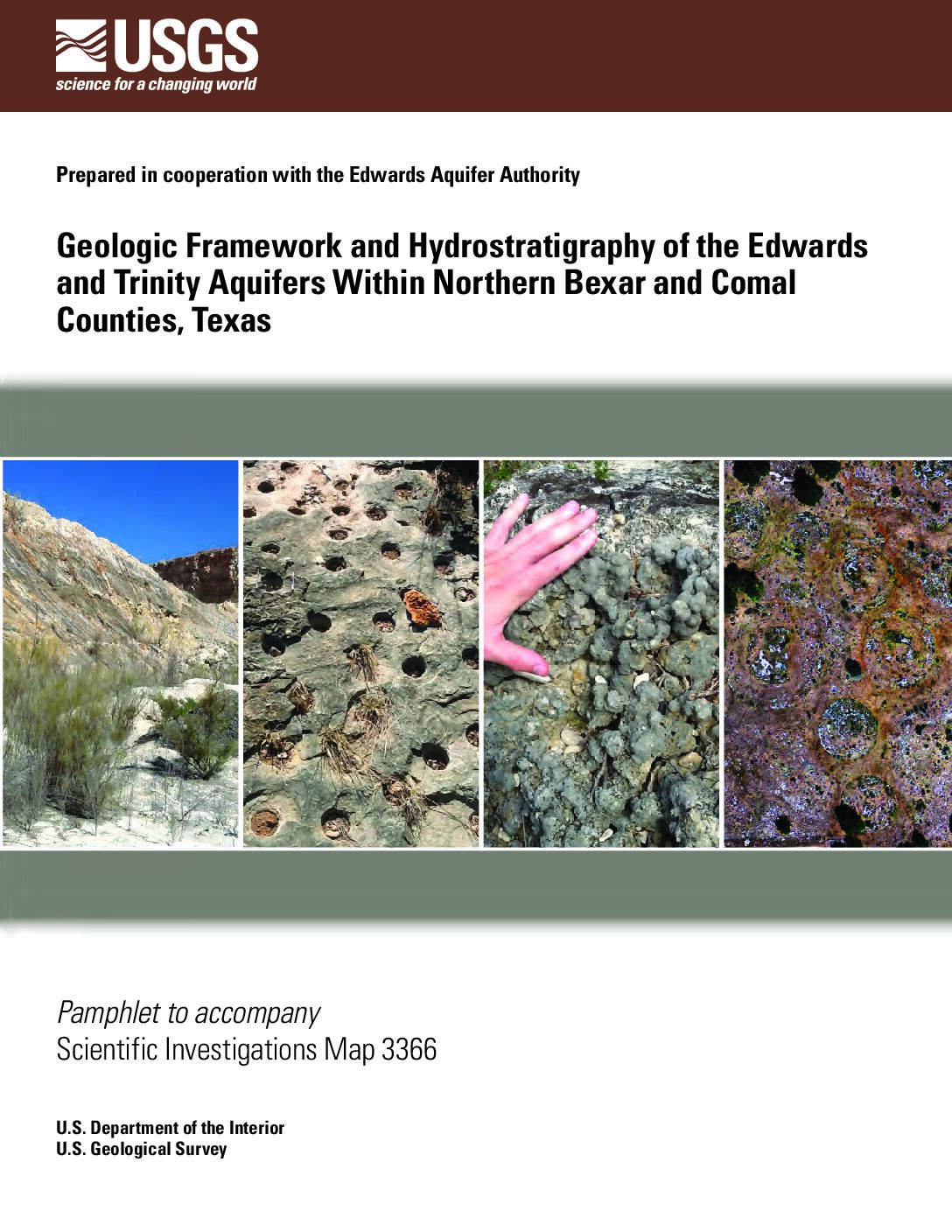
Description: Geologic framework and hydrostratigraphy of the outcrops and hydrostratigraphy of the Edwards and Trinity aquifers within northern Bexar and Comal Counties, Tex.
Report Number: 3366
Location: Comal County, Bexar County
Summary:During 2014“16, the U.S. Geological Survey, in cooperation with the Edwards Aquifer Authority, documented the geologic framework and hydrostratigraphy of the Edwards and Trinity aquifers within northern Bexar and Comal Counties, Texas. The Edwards and Trinity aquifers are major sources of water for agriculture, industry, and urban and rural communities in south-central Texas. Both the Edwards and Trinity are classified as major aquifers by the State of Texas.
The purpose of this report is to present the geologic framework and hydrostratigraphy of the Edwards and Trinity aquifers within northern Bexar and Comal Counties, Tex. The report includes a detailed 1:24,000-scale hydrostratigraphic map, names, and descriptions of the geology and hydrostratigraphic units (HSUs) in the study area.
The scope of the report is focused on geologic framework and hydrostratigraphy of the outcrops and hydrostratigraphy of the Edwards and Trinity aquifers within northern Bexar and Comal Counties, Tex. In addition, parts of the adjacent upper confining unit to the Edwards aquifer are included.
Read more at the USGS website.
Structural mapping of the Edwards Aquifer in eastern and central Uvalde County, Texas, using seismic, well and outcrop data
Description: Structural mapping of the Edwards Aquifer in eastern and central Uvalde County, Texas, using seismic, well and outcrop data. Work performed under contract with the EAA by Thomas E. Ewing, Frontera Exploration Consultants; May 24, 2005
Location: Edwards Aquifer in eastern and central Uvalde County
Summary:In October, 2003, the Edwards Aquifer Authority engaged Frontera Exploration
Consultants, in particular Dr. Thomas E. Ewing its senior geoscientist, to interpret
licensed seismic data, integrate the data with available well control, and prepare a
structure map of the Edwards Aquifer in the Knippa Gap area of eastern and central
Uvalde County (Figure 1).
Better understanding of the Knippa Gap' constriction in the Edwards Aquifer,
and of flowpaths from western Uvalde County eastward towards Medina County, are a
high priority for Aquifer research. An important part of the constriction, lying south of
Old Sabinal Road near and east of the Frio River, has little well control. This area contains the apparent downdip limit of fresh water through the constriction, and is key to understanding flowpaths. Fortunately, a sparse network of 2D seismic reflection data was acquired by the oil and gas industry in and near this key area. Interpretation of this data, integrated with all available well and outcrop control, can yield a much more complete and more reliable intepretation of fault patterns and depths to the Edwards Group in the area.
The seismic reflection lines were acquired for deep exploration targets within the
Paleozoic Ouachita thrust belt. However, modern acquisition techniques provide enough
fold and coverage at shallow depths that the structural configuration of the aquifer can be
mapped.
Geologic framework and hydrostratigraphy of the Edwards and Trinity aquifers within Hays County, Texas
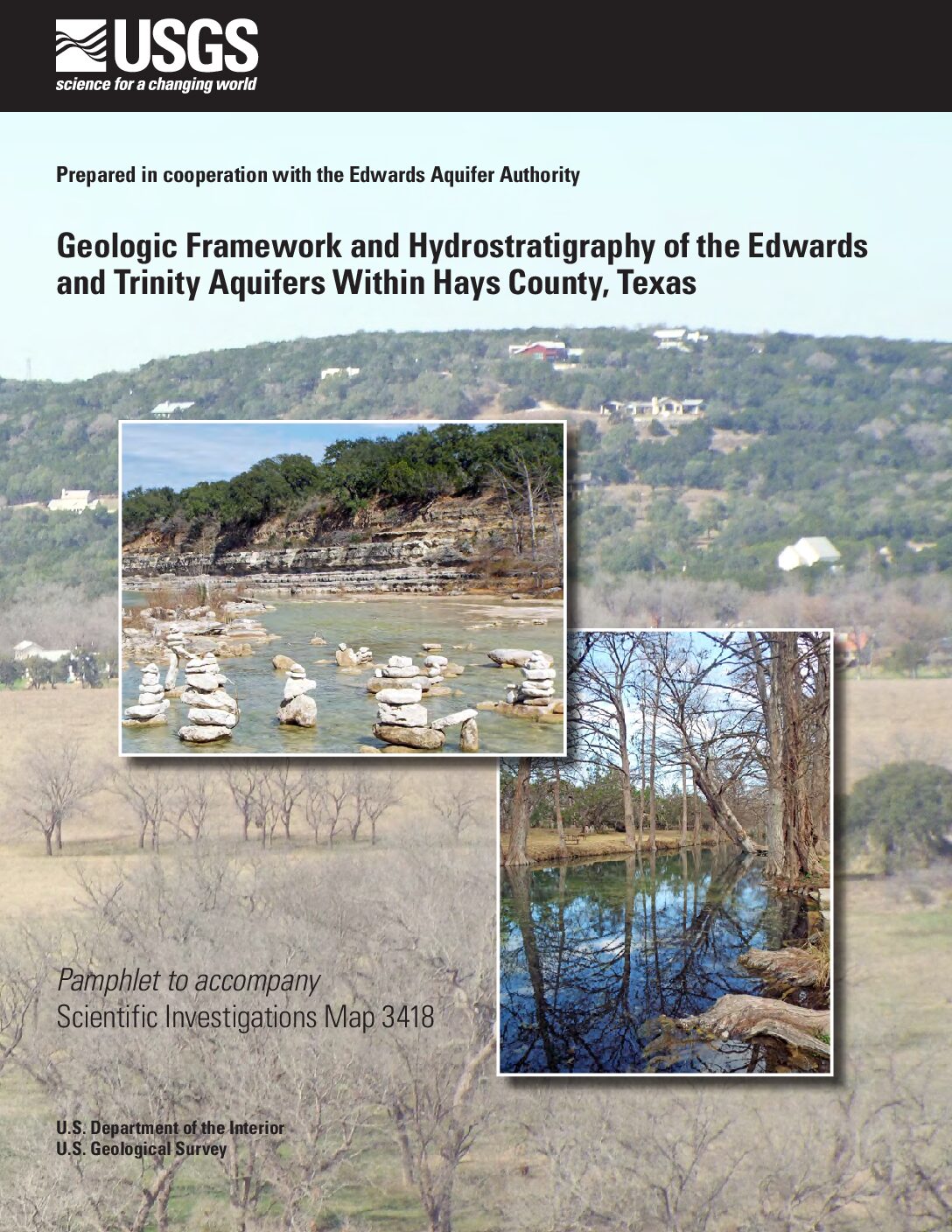
Description: Geologic framework and hydrostratigraphy of the Edwards and Trinity aquifers within Hays County, Texas
Report Number: 3418
Location: Hays County
Summary:The Edwards and Trinity aquifers are classified as major aquifers by the Texas Water Development Board and are major sources of water in south-central Texas, where Hays County is located. Detailed maps and descriptions of the geologic framework and hydrostratigraphic units (HSUs) of these karstic aquifers in Hays County are needed for water managers to effectively manage groundwater resources in the area. During 2016“18, the U.S. Geological Survey, in cooperation with the Edwards Aquifer Authority, documented the geologic framework and hydrostratigraphy of the Edwards and Trinity aquifers for a large part of Hays County, characterizing approximately 560 square miles of the county. The report includes a 1:24,000-scale hydrostratigraphic map and descriptions of the geology and HSUs in the study area. In addition, parts of the adjacent upper confining unit to the Edwards aquifer are described.
Read more at the USGS website.
Geologic Framework and Hydrostratigraphy of the Edwards and Trinity Aquifers Within Northern Medina County, Texas
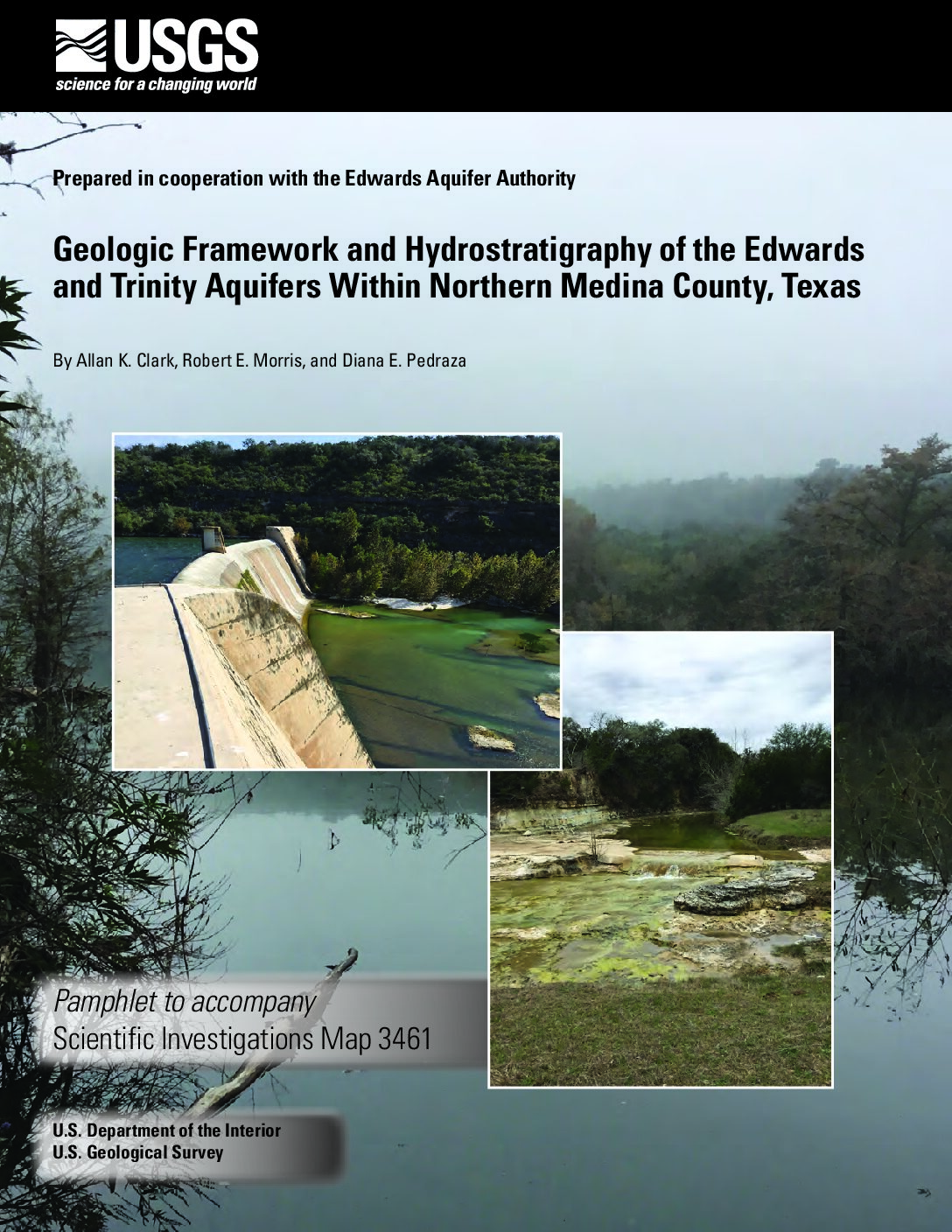
Description: Geologic framework and hydrostratigraphy of the Edwards and Trinity aquifers within northern Medina County, Texas
Report Number: 3461
Location: Medina County
Summary:The karstic Edwards and Trinity aquifers are classified as major sources of water in south-central Texas by the Texas Water Development Board. During 2018“20 the U.S. Geological Survey, in cooperation with the Edwards Aquifer Authority, mapped and described the geologic framework and hydrostratigraphy of the rocks composing the Edwards and Trinity aquifers in northern Medina County from field observations of the surficial expressions of the rocks. The thicknesses of the mapped lithostratigraphic members and hydrostratigraphic units were also estimated from field observations.
Descriptions of the geologic framework and hydrostratigraphy of the Edwards and Trinity aquifers within northern Medina County are provided, as well as a detailed map of the hydrostratigraphy. In addition to the rocks that compose the Edwards and Trinity aquifers, parts of the adjacent upper confining unit to the Edwards aquifer are described. Compared to the level of detail available in existing geologic maps, the geologic map in this report was prepared at a scale of 1:24,000 to aid water managers as they work to anticipate and mitigate issues related to changing land use and increasing groundwater demands.
Read more at the USGS website.
Maps Showing Outcrops of the Edwards and Associated Limestones in the Principal Recharge Area of the Edwards Aquifer in Bexar County, Texas [6 maps]
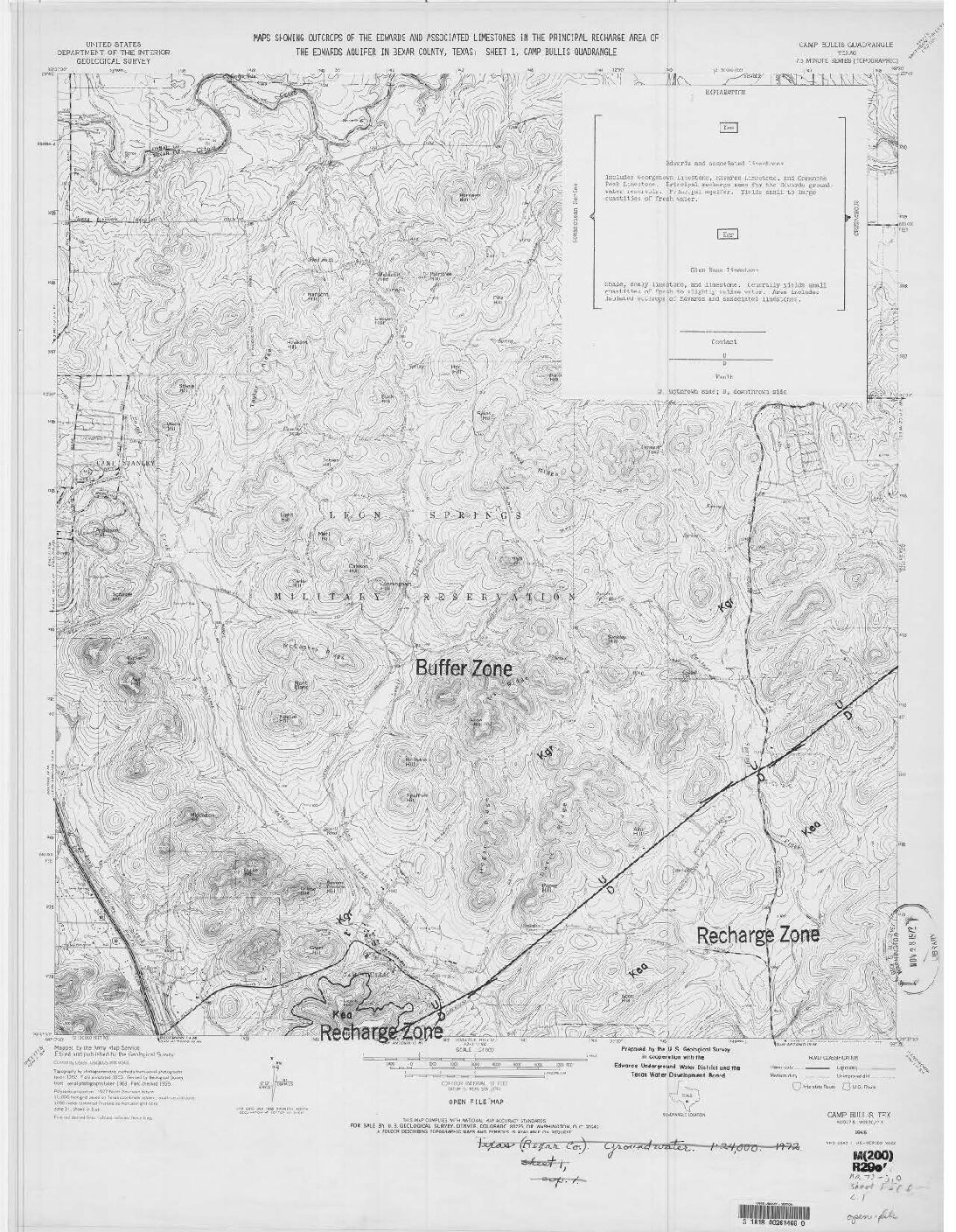
Description: Six topographic maps of the Edwards Aquifer Recharge Zone, scale 1:24,000. Camp Bullis Quadrangle, Bulverde Quadrangle, Helotes Quadrangle, Longhorn Quadrangle, Castle Hills Quadrangle, San Geronimo Quadrangle. Note: Both letter-size and full-size maps are included.
Report Number: USGS Open File Maps AMS 6243 11 NE-SERIES V882 1965, AMS 6343 Ill NW - SERIES V882 1967, AMS 6243 II SW-SERIES V882 1966, N 2930
Location: Edwards Aquifer Balcones Fault Zone San Antonio Segment, Recharge Zone, Bexar County
Summary:Six topographic maps of the Edwards Aquifer San Antonio region, scale 1:24,000.
Camp Bullis Quadrangle, Bulverde Quadrangle, Helotes Quadrangle, Longhorn Quadrangle, Castle Hills Quadrangle, San Geronimo Quadrangle. Note: Both letter-size and full-size maps are included.
Leak Detection Survey Report for the City of Uvalde, Texas, January 11, 1993-April 26, 1993
Description: Leak detection and location survey report for City of Uvalde, 1993. Note: this function was taken over by the San Antonio Water System in 2006.
Report Number: 93-02
Location: City of Uvalde
Summary:On October 5, 1992, the Edwards Underground Water District (EUWD) received a completed application form from the City of Uvalde requesting a leak detection/location survey on its water distribution system. A pre-survey conference was held October 22, 1992 at the City of Uvalde City Hall to discuss the work to be performed. It was agreed that EUWD would perform sonic leak detection on all available access points, computerized leak location as needed, record any unusual system conditions found, and submit to the City a revised master water plat with the final report.
Mark L. McGinnis of EUWD began the survey on January 11, 1993, and the survey was concluded on April 26, 1993. Over the course of the survey, EUWD surveyed a total of 6,345 access points including 5,091 customer service connections, 361 fire hydrants, 884 main line valves, and 9 other access points covering 89.89 miles of distribution mains.
Computer leak sound correlation was performed on 2 locations. EUWD technicians detected a total of 362 leaks. This total included 30 meter box leaks, 9 fire hydrant leaks, 9 service line leaks, 3 main leaks, 2 valve leaks, and 309 customer side leaks. EUWD estimates 17,525 gallons of water per day has been saved by the repair of 45 detected leaks as of April 26, 1993. The leaks discovered during the survey range from 2,160 gallons per day to numerous small meter box leaks.
As part of the survey, EUWD located 173 main line valves, 33 fire hydrants, and 20.2 miles of distribution main not shown on the master water plats. EUWD staff was unable to locate 97 main line valves and 17 customer service connections. An additional 112 valve stacks need cleaning and/or repair. EUWD noted 100 water meters that were not registering accurately.
Leak Detection Survey Report for Bexar Metropolitan Water District: San Antonio, Texas, February 10, 1992-January 8, 1993
Description: Leak detection and location survey report for Bexar Metropolitan Water District, San Antonio, 1993. Note: this function was taken over by the San Antonio Water System in 2006.
Report Number: 93-01
Location: San Antonio
Summary:On September 3, 1991, the Edwards Underground Water District (EUWD) received a completed application form from the Bexar Metropolitan Water District (BMWD) requesting a leak detection/location survey on its water distribution system. A pre-survey conference was held January 9, 1991 at the BMWD main office to discuss the work to be performed. It was agreed that EUWD would perform sonic leak detection on all available access points, computerized leak location as needed, record any unusual system conditions found, and submit to the utility an updated master water plat with the final report.
Mark L. McGinnis and John E. Gapinski of EUWD began the survey on February 10, 1992, and the survey was concluded on January 8, 1993. Over the course of the survey, EUWD surveyed a total of 37,716 access points including 30,270 customer service connections, 2,066 fire hydrants, 5,257 valves, and 123 other access points covering 421.37 miles of distribution mains. Computer leak sound correlation was performed on 17 locations by EUWD and numerous other locations by BMWD personnel.
EUWD technicians detected a total of 1,907 leaks. This total included 354 meter box leaks, 143 fire hydrant leaks, 44 service leaks, 21 main line leaks, 19 main valve leaks, and 1,326 customer side leaks. EUWD estimates 547,596 gallons of water per day has been saved by the repair of 375 detected leaks as of January 8, 1993. Additionally, 165 leaks were repaired without leakage estimates. The leaks discovered during the survey range from 129,600 gallons per day to numerous small meter box leaks.
As part of the survey, EUWD located 417 service connections, 60 service valves, 19 main valves, 17 fire hydrants, and 5 blow offs with valves not shown on the master water plats. EUWD staff were unable to locate 1,251 service connections and 799 valves shown on the master water plats. An additional 1,404 valve stacks need cleaning and/or repair and 90 valve and meter box lids were discovered missing.
History of Water in the San Antonio River Valley
Description: Colorful narrative history of the San Antonio River basin and the role of water in the location and development of San Antonio
Location: San Antonio River Basin
Summary:Colorful narrative history of the San Antonio River basin and the role of water in the location and development of San Antonio
Leak Detection/Location Survey Report for the City of Kirby, Bexar County, Texas: May 1, 1995-May 16, 1995, June 6, 1995-June 30, 1995, October 25, 1995-December 12, 1995
Description: Leak detection/location survey report for City of Kirby, May 1, 1995-May 16, 1995, June 6, 1995-June 30, 1995, October 25, 1995-December 12, 1995. Note: this function was taken over by the San Antonio Water System in 2006.
Report Number: 96-02
Location: Bexar County, City of Kirby
Summary:On August 25, 1993, the Edwards Underground Water District (EUWD) received a request from the City of Kirby to perform a leak detection I location survey on its water distribution system. A pre-survey conference was held April 20, 1995. at the City of Kirby Public Works Center to discuss the work to be performed. It was agreed that EUWD staff would perform sonic leak detection on all available access points and computerized leak location as needed. A final report, including any unusual system condition found and an updated master water plat would be submitted to the City at the conclusion of the survey.
John E Gapinski of EUWD began the survey on May I, 1995. With the approval of Mr. Sidney Lankford, Sr., Public Works Director for the City of Kirby the survey was halted and restarted on three occasions. The survey was performed May 1, 1995 May 16, 1995. June 6, 1995 June 30, 1995, and October 25, 1995 -December 12, 1995. Over the course of the survey, EUWD staff surveyed a total of 3,080 access points including 2.64 7 customer service connections, 122 fire hydrants, 292 main valves, and 19 other access points covering 28.18 miles of distribution main. Computer leak sound correlation was performed at one location by EUWD staff.
EUWD staff detected 104 utility side leaks and 39 customer side leaks for a total of 144 leaks. The utility side leaks included 68 service leaks, 31 meter box leaks, 1 main valve leak, 1 main leak and 3 fire hydrant leaks. EUWD staff estimates 30,661 gallons of water per day has been saved by the repair of 54 utility side leaks as of February 14, 1996. The leaks discovered during the survey range from 5,328 gallons per day to numerous small meter box leaks.
As part of the survey, EUWD staff located 57 valves of various types. 15 fire hydrants and 3,250 feet of main not shown on the master water plats. EUWD staff were unable to locate 52 valves of various types and 6 fire hydrants shown on the master water plats. An additional 22 items were discovered to need some type of repair, cleaning, or adjustment.
Leak Detection/Location Survey Report for Bexar Metropolitan Water District, northeast/northwest San Antonio, Texas: March 21, 1994-February 24, 1995
Description: Leak detection/location survey report for Bexar Metropolitan Water District, March 21, 1994-February 24, 1995. Note: this function was taken over by the San Antonio Water System in 2006.
Report Number: 95-04
Location: Bexar County, Bexar Metropolitan Water District
Summary:On March 15, 1994, the Edwards Underground Water District (EUWD) received a request from the Bexar Metropolitan Water District (BMWD) to perform a leak detection I location survey on their two newly acquired water systems. These systems were formerly owned and operated by the Lackland City Water Company. A pre-survey conference was held March 15, 1994 at the BMWD Service Center to discuss the work to be performed. It was agreed that EUWD would perform sonic leak detection on all available access points and computerized leak location as needed. A final report, including any unusual system condition found and an updated master water plat would be submitted to BMWD at the conclusion of the survey.
Mark L. McGinnis of EUWD began the survey of the Northwest system on March 23, 1994. The Northeast system survey was started on April 11, 1994 by John E. Gapinski of EUWD. The Northeast survey was concluded on February 3, 1995 followed by the Northwest survey that was concluded on February 24, 1995. Over the course of the survey, EUWD surveyed a total of 22,319 access points including 18,239 customer service connections, 898 fire hydrants, 1,855 valves, and 207 other access points covering 175.93 miles of distribution main. Computers leak sound correlation was performed on 17 locations by EUWD and numerous other locations by UMWD personnel.
EUWD surveyors detected a total of 741 leaks. This total included 194 service leaks, 137 meter box leaks, 27 main line leaks, 22 fire hydrant leaks, 10 main valve leaks, and 351 customer side leaks. EUWD estimates 559,797 gallons of water per day has been saved by the repair of 387 detected leaks as of March 17, 1995. The leaks discovered during the survey range from 54,864 gallons per day to numerous small meter box leaks.
As part of the survey, EUWD located 340 valves of various types, 90 fire hydrants, and 59,385 feet of main not shown on the master water plats. EUWU surveyors were unable to locate 287 service connections, 171 valves of various types, and 2 fire hydrants shown on the master water plats. An additional 196 items were discovered to need some type of repair or adjustment.
Leak Detection/Location Survey Report for Springs Hill Water Supply Corporation, January 31, 1994-March 28, 1994
Description: Leak detection/location survey report for Springs Hill Water Supply Corp, Seguin, Guadalupe County, January 31, 1994-March 28, 1994. Note: this function was taken over by the San Antonio Water System in 2006.
Report Number: 94-02
Location: Guadalupe County, Seguin, Springs Hill Water Supply Corp.
Summary:On August 12, 1993, the Edwards Underground Water District (EUWD) received a completed application form from Springs Hill Water Supply Corporation requesting a leak detection/location survey on its water distribution system. A pre-survey conference was held January 28, 1994 at Springs Hill office to discuss the work to be performed. It was agreed that EUWD would perform sonic leak detection on all available access points, computerized leak location as needed, record any unusual system conditions found, and submit to Springs Hill a revised master water plat with the final report.
Mr. John Gapinski of EUWD began the survey on January 31, 1994, and the survey was concluded on March 28, 1994. Over the course of the survey, EUWD surveyed a total of 1,278 access points including 938 customer service connections, 60 fire hydrants, 232 main line valves, and 48 other access points covering 72.05 miles of distribution mains.
EUWD technicians detected a total of 42 leaks. This total included 3 meter box leaks, 7 service line leaks, 3 main leaks, 4 valve leaks, and 25 customer side leaks. EUWD estimates 36,914 gallons of water per day has been saved by the repair of 8 detected leaks as of March 28, 1994. The leaks discovered during the survey range from 15,840 gallons per day to numerous small customer side leaks.
As part of the survey, EUWD located 29 main line valves, 202 customer service connections, 23 fire hydrants, and .96 miles of distribution main not shown on the master water plats. EUWD staff was unable to locate 60 main line valves, 16 fire hydrants, and 77 customer service connections. An additional 13 valve stacks need cleaning and/or repair. EUWD noted 7 valve boxes missing lids and one fire hydrant missing a cap.
Leak Detection/Location Survey Report for Fort Sam Houston, Bexar County, Texas, July 22, 1993-February 4, 1994
Description: Leak detection/location survey report for Fort Sam Houston, July 22, 1993 - February 4, 1994. Note: this function was taken over by the San Antonio Water System in 2006.
Report Number: 94-01
Location: Bexar County, Fort Sam Houston
Summary:On April 23, 1993, the Edwards Underground Water District (EUWD) received a completed application form from Fort Sam Houston requesting a leak detection/location survey on its water distribution system.
Pre-survey conferences were held June 14, 1993 and June 21, 1993 at the Environmental and Natural Resources Division to discuss the work to be performed. It was agreed that EUWD would perform sonic leak detection on all available access points, computerized leak location as needed, record any unusual system conditions found, and submit to the Post a revised master water plat with the final report. It was further agreed that Fort Sam Houston would provide EUWD with one experienced utility service person and would repair all leaks detected in a timely manner.
Mark L. McGinnis of EUWD began the survey on July 22, 1993, and the survey was concluded on February 4, 1994. Over the course of the survey, Mr. McGinnis surveyed a total of 2,751 access points including 1,133 customer service connections, 447 fire hydrants, 1,064 main valves, and 107 other access points covering 68.3 miles of distribution and transmission mains. Computer leak sound correlation was performed on one location.
Mr. McGinnis detected a total of 177 leaks. This total included 42 service valve leaks, 42 main valve leaks, 42 fire hydrant leaks, 29 customer side leaks, and 22 main leaks. Additional leaks are suspected at many of these locations, but cannot be located until repairs are completed on all known leaks . As of February 4 , 1994, 39 of the 177 leaks detected over the length of the survey have been repaired. EUWD estimates 170,580 gallons of water per day has been saved by the repairs to date. The leaks detected during this survey range from 144,000 gallons per day to numerous small service valve leaks.
As part of the survey, Mr. McGinnis located 249 service valves, 97 main valves of various types, 31 fire hydrants, and .89 miles of distribution main not shown on the master plats . EUWD staff was unable to locate 109 main line valves, 91 service valves, 24 fire hydrants and 24 assorted valves. An additional 194 valve stacks need cleaning and/or repair.
Leak Detection/Location Survey Report for the City of Cibolo, Texas, November 2, 1993-December 2, 1993
Description: Leak detection and location survey report for City of Cibolo,Texas, November 2, 1993-December 2, 1993. Note: this function was taken over by the San Antonio Water System in 2006.
Report Number: 93-13
Location: Guadalupe County
Summary:On August 29, 1991, the Edwards Underground Water District (EUWD) received a completed application form from the City of Cibolo requesting a leak detection/location survey on its water distribution system. A pre-survey conference was held October 19, 1993 at the City of Cibolo City Hall to discuss the work to be performed. It was agreed that EUWD would perform sonic leak detection on all available access points, computerized leak location as needed, record any unusual system conditions found, and submit to the City a revised master water plat with the final report.
John E. Gapinski of EUWD began the survey on November 2, 1993, and the survey was concluded on December 2, 1993. Over the course of the survey, EUWD staff surveyed a total of 985 access points including 639 customer service connections, 88 fire hydrants, 241 main line valves, and 17 other access points covering 15.52 miles of distribution mains. Computer leak sound correlation was performed on two locations.
EUWD technicians detected a total of 22 leaks. This total included 1 meter box leak, 2 fire hydrant leaks, 3 service line leaks, 3 valve leaks, and 13 customer side leaks. EUWD staff estimates 38,483 gallons of water per day has been saved by the repair of 6 detected leaks as of December 17, 1993. The leaks discovered during the survey range from 36,720 gallons per day to numerous small customer side leaks.
As part of the survey, EUWD staff located 72 main line valves, 14 blow-off valves, 27 fire hydrants, 225 services, and 3.66 miles of distribution main not shown on the master water plats. EUWD staff was unable to locate 14 main line valves, 2 services, and 2 fire hydrants. An additional 22 valve stacks need cleaning and/or repair. EUWD noted 3 meter boxes and 3 valve boxes needing lid replacement.
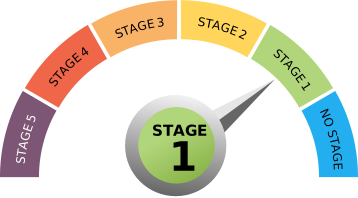


 CURRENT