

 Aquifer Conditions
Science & Data Document Library
Science and Data Resources
Edwards Aquifer Hydrogeologic Status Report for 1992

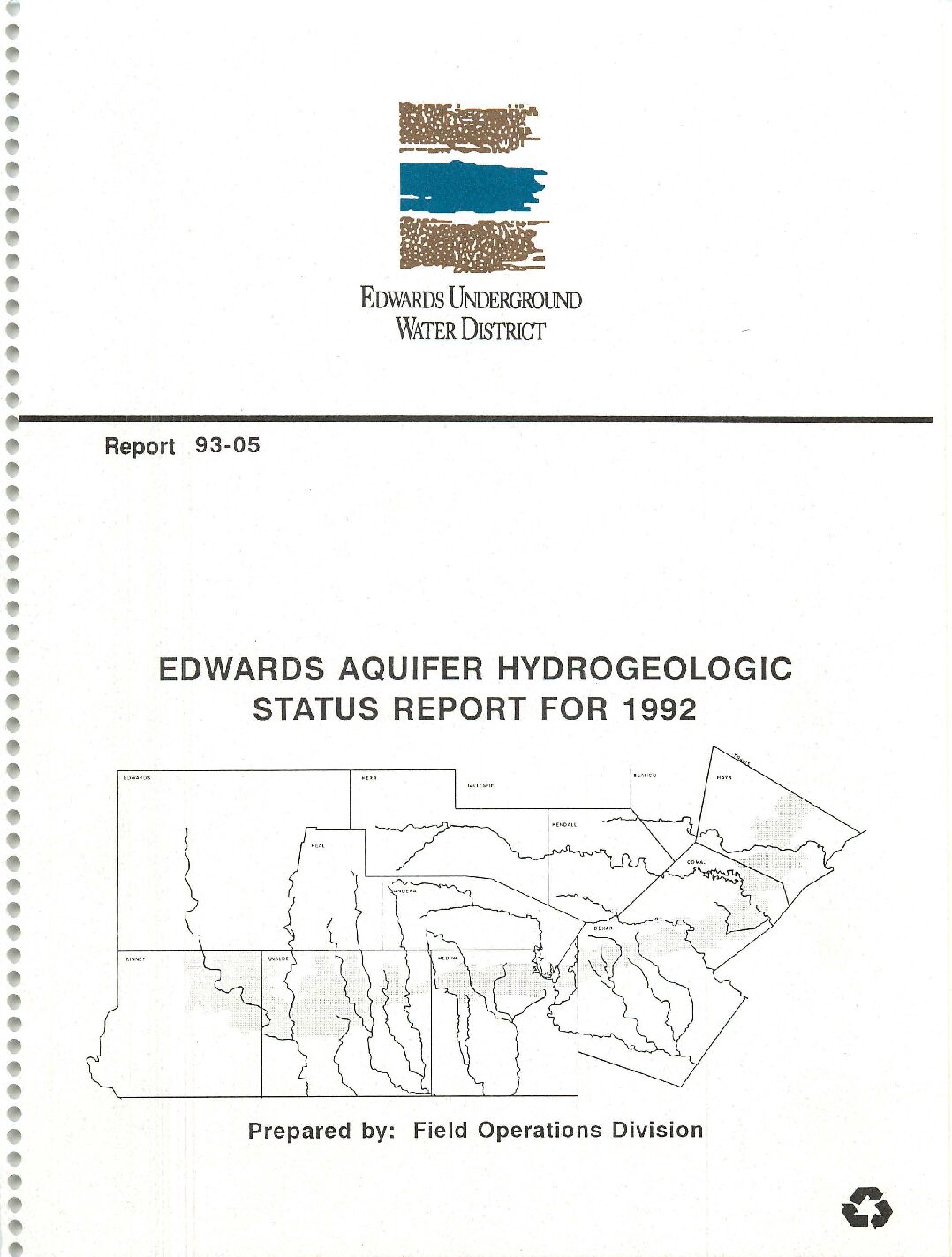
Description: Annual report for 1992 on recharge, discharge, water levels and water quality in the Edwards Aquifer San Antonio Region
Report Number: 93-05
Location: Edwards Aquifer - San Antonio Area
Summary:Surface-water data for the San Antonio area used to calculate annual recharge and discharge of the Edwards aquifer, consist of flow data for streams and discharge data for springs, and quantity data for reservoirs. The data is stored in the National Water Information system, a computerized data base operated by the U. S. Geological Survey.
The average estimated annual groundwater recharge to the Edwards aquifer in the San Antonio area, Texas, from 1934 through 1992 was 682,860 acre-feet. Recharge in 1992 was 2,486,000 acre-feet, which is the largest estimated annual recharge. The lowest annual recharge of 43,700 acre-feet occurred in 1956.
The estimated annual discharge from the Edwards aquifer by wells and springs in 1992 was 1,130,000 acre-feet, which is the largest calculated annual discharge for the period of record which began in 1934. The lowest annual discharge by wells and springs for the same time period was 388,800 acre-feet in 1955.
Water level data for wells during 1992 reflected above average to record volume of groundwater in storage in the Edwards aquifer during most of the year.
Water samples from 61 wells and 3 springs in the Edwards aquifer were analyzed for more than 90 properties or constituents, most of which affect the suitability of the water for domestic use. Concentrations of constituents in water from one well completed in the freshwater zone exceeded the maximum contaminant level for fluoride established for public water systems.
Trace concentrations of volatile organic compounds were detected in samples from three wells. Results of the 1992 water sampling and analysis program illustrate the continued excellent quality of water in the Edwards aquifer.
1991 Hydrologic Data Report Compilation of Hydrologic Data for the Edwards Aquifer, San Antonio Area, Texas, 1991, with 1934-91 Summary
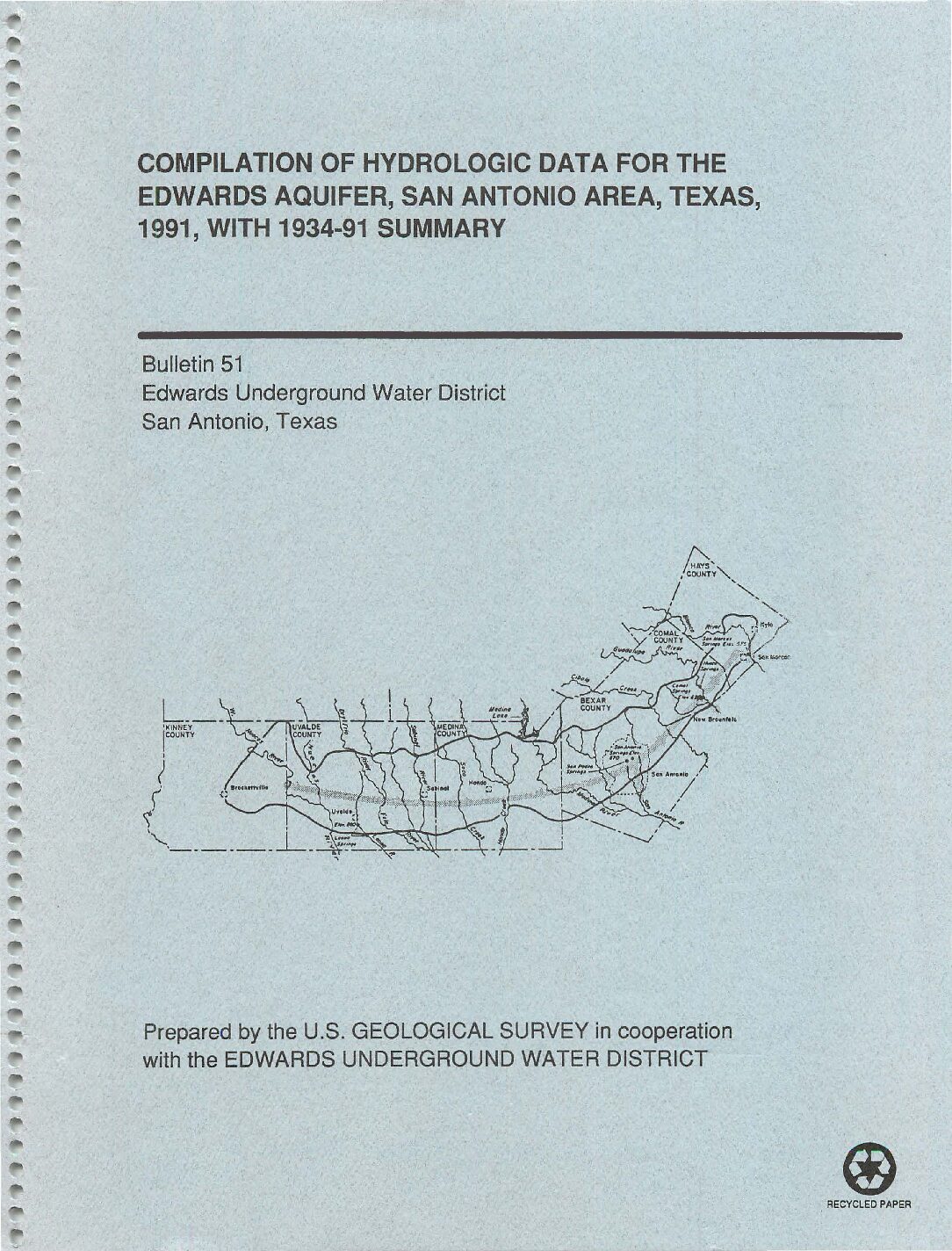
Description: Annual report for 1991 on recharge, discharge, water levels and water quality in the Edwards Aquifer San Antonio Region
Report Number: Bulletin 51
Location: Edwards Aquifer - San Antonio Area
Summary:The average estimated annual ground-water recharge to the Edwards aquifer in the San Antonio area, Texas, from 1934 through 1991 was 651,700 acre-feet. Recharge in 1991 was 1,508,400 acre-feet, which is the third largest estimated annual recharge since 1934. The maximum annual recharge of 2,003,600 acre-feet occurred in 1987, and a minimum annual recharge of 43,700 acre-feet occurred in 1956.
The estimated annual discharge from the Edwards aquifer by wells and springs in 1991 was 790,300 acre-feet, which is the fourteenth largest calculated annual discharge since 1934. Annual discharge by wells and springs ranged from a maximum of 960,900 acre-feet in 1977 to a minimum of 388,800 acre-feet in 1955.
Water-level data for wells during 1991 reflected a less-than- to about average volume of ground water in storage in the aquifer during most of the year.
Water samples from 61 wells (including wells drilled in 1985 that transect the freshwater/saline-water interface) and 3 springs in the Edwards aquifer were analyzed for more than 90 properties or constituents, most of which affect the suitability of the water for domestic use. Concentrations of constituents in water from three wells completed in the freshwater zone exceeded the maximum contaminant levels established for public water systems. Trace concentrations of volatile organic compounds were detected in samples from seven wells.
Surface-water data for the San Antonio area, which were used to calculate annual recharge to and annual discharge from the Edwards aquifer, consisted of discharge data for streams and springs and contents data for reservoirs. The data are stored in the National Water Information System, a computerized data base operated by the U.S. Geological Survey.
1990 Hydrologic Data Report Compilation of Hydrologic Data for the Edwards Aquifer, San Antonio Area, Texas, 1990, with 1934-90 Summary
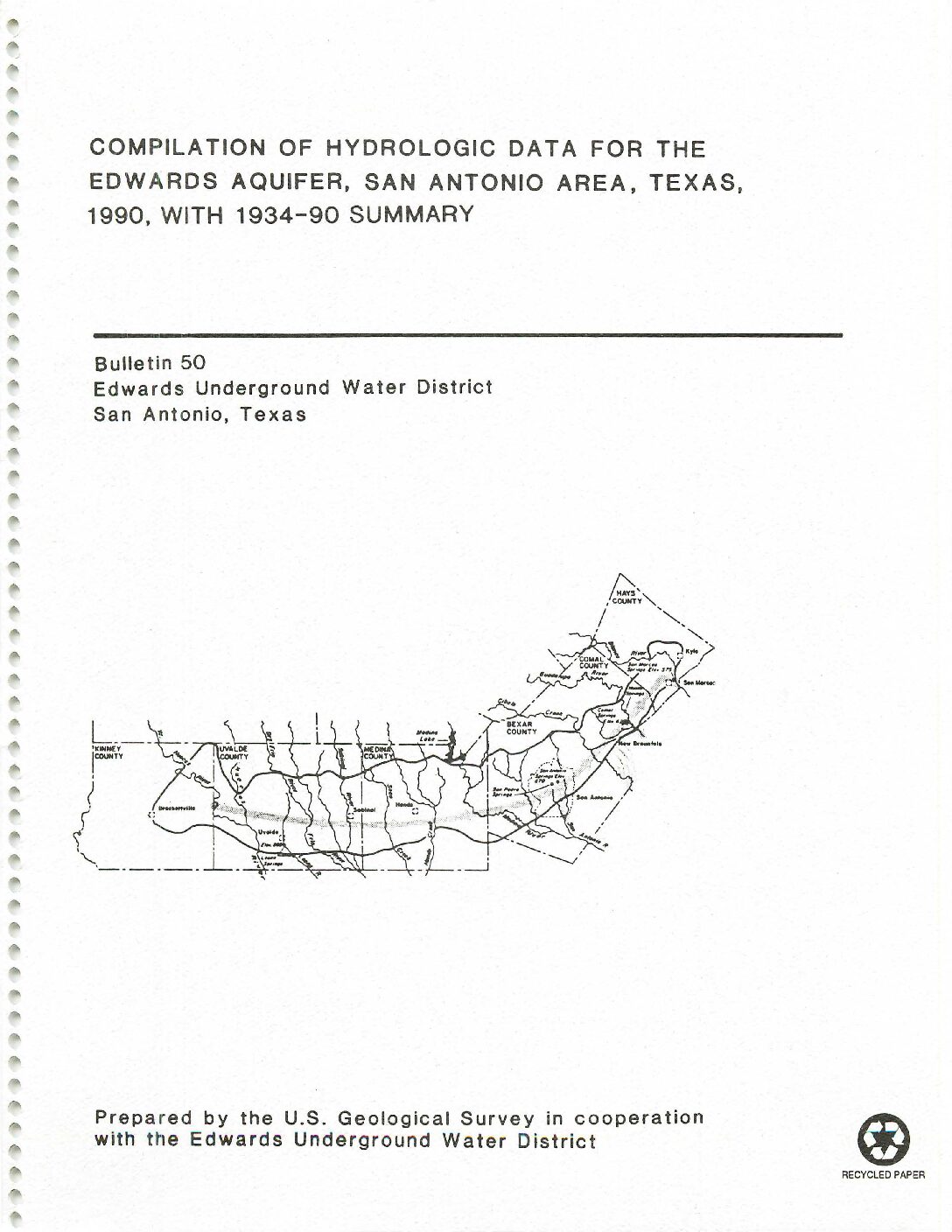
Description: Annual report for 1990 on recharge, discharge, water levels and water quality in the Edwards Aquifer San Antonio Region
Report Number: Bulletin 50
Location: Edwards Aquifer - San Antonio Area
Summary:The average estimated annual ground-water recharge to the Edwards aquifer in the San Antonio area, Texas, from 1934 through 1990 was 636,700 acre-feet. Recharge in 1990 was 1,123,200 acre-feet, which is the eighth largest estimated annual recharge since 1934. The maximum annual recharge of 2,003,600 acre-feet occurred in 1987, and a minimum annual recharge of 43,700 acre-feet occurred in 1956.
The estimated annual discharge from the Edwards aquifer by wells and springs in 1990 was 730,000 acre-feet, which is the seventeenth largest calculated annual discharge since 1934. Annual discharge by wells and springs ranged from a maximum of 960,900 acre-feet in 1977 to a minimum of 388,800 acre-feet in 1955.
Water levels in many of the wells during 1990 fluctuated near the midpoint between record high and low levels, reflecting a greater-than- to about average volume of ground water in storage in the aquifer during most of the year. In 1990, water levels rose during the early winter and early spring, after which water levels generally remained about average in most of the area.
Water samples from 87 wells (including wells drilled in 1985 that transect the freshwater/saline-water interface) and 3 springs in the Edwards aquifer were analyzed for more than 90 properties or constituents, most of which affect the suitability of the water for domestic use. Concentrations of constituents in water from the freshwater zone did not exceed the maximum contaminant levels established for public water systems. Trace concentrations of volatile organic compounds, however, were detected in samples from 14 wells.
Surface-water data for the San Antonio area, which were used to calculate annual recharge to and annual discharge from the Edwards aquifer, consisted of discharge data for streams and springs and contents-data for reservoirs. These data are stored in the National Water Information System, a computerized data base operated by the U.S. Geological Survey.
1989 Hydrologic Data Report Compilation of Hydrologic Data for the Edwards Aquifer, San Antonio Area, Texas, 1989, with 1934-89 Summary
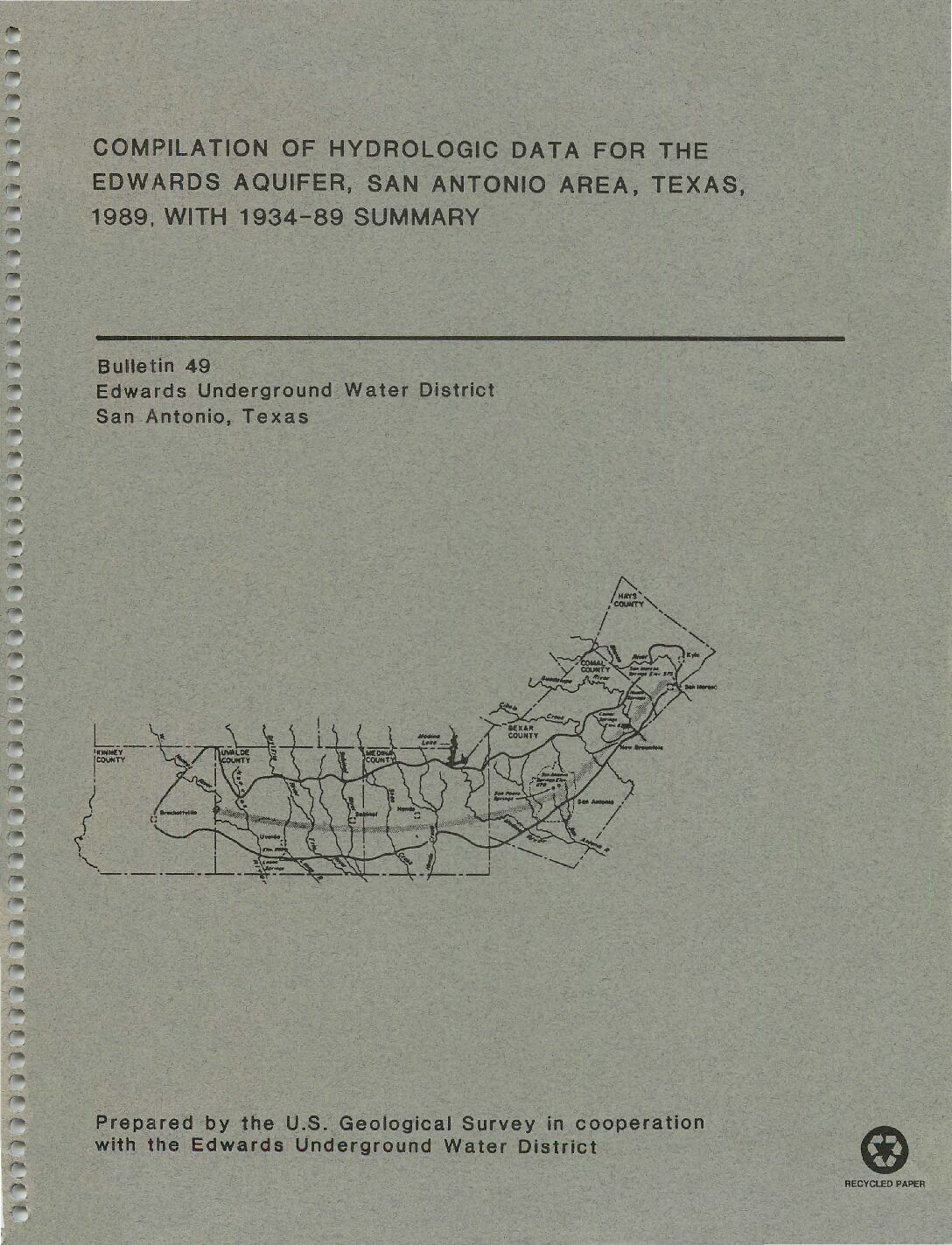
Description: Annual report for 1989 on recharge, discharge, water levels and water quality in the Edwards Aquifer San Antonio Region
Report Number: Bulletin 49
Location: Edwards Aquifer - San Antonio Area
Summary:The average estimated annual ground-water recharge to the Edwards aquifer in the San Antonio area, Texas, from 1934 through 1989 was 628,000 acre-feet. Recharge in 1989 was 214,400 acre-feet, which is the tenth smallest estimated annual recharge since 1934. The maximum annual recharge of 2,003,600 acre-feet occurred in 1987, and a minimum annual recharge of 43,700 acre-feet occurred in 1956.
The calculated annual discharge from the Edwards aquifer by wells and springs in 1989 was 766,500 acre-feet, which is the fifteenth largest calculated annual discharge since 1934. Annual discharge by wells and springs ranged from a maximum of 960,900 acre-feet in 1977 to a minimum of 388,800 acre-feet in 1955.
Water levels in many of the wells during 1989 fluctuated near the midpoint between record high and low levels, reflecting a near average volume of ground water in storage in the aquifer during most of the year. In 1989, substantial increases occurred during the late winter and early spring, after which water levels remained near average in most of the area.
Water samples from 71 wells and 3 springs in the Edwards aquifer were analyzed for more than 50 properties or constituents, most of which affect the suitability of the water for domestic use. Concentrations of constituents in water from the freshwater zone did not exceed the maximum contaminant levels established for public water systems. However, trace concentrations of organic compounds were detected at five wells. In 1989, samples were collected and analyzed from wells transecting the freshwater/saline-water interface.
The Edwards Aquifer Extremely Productive, But
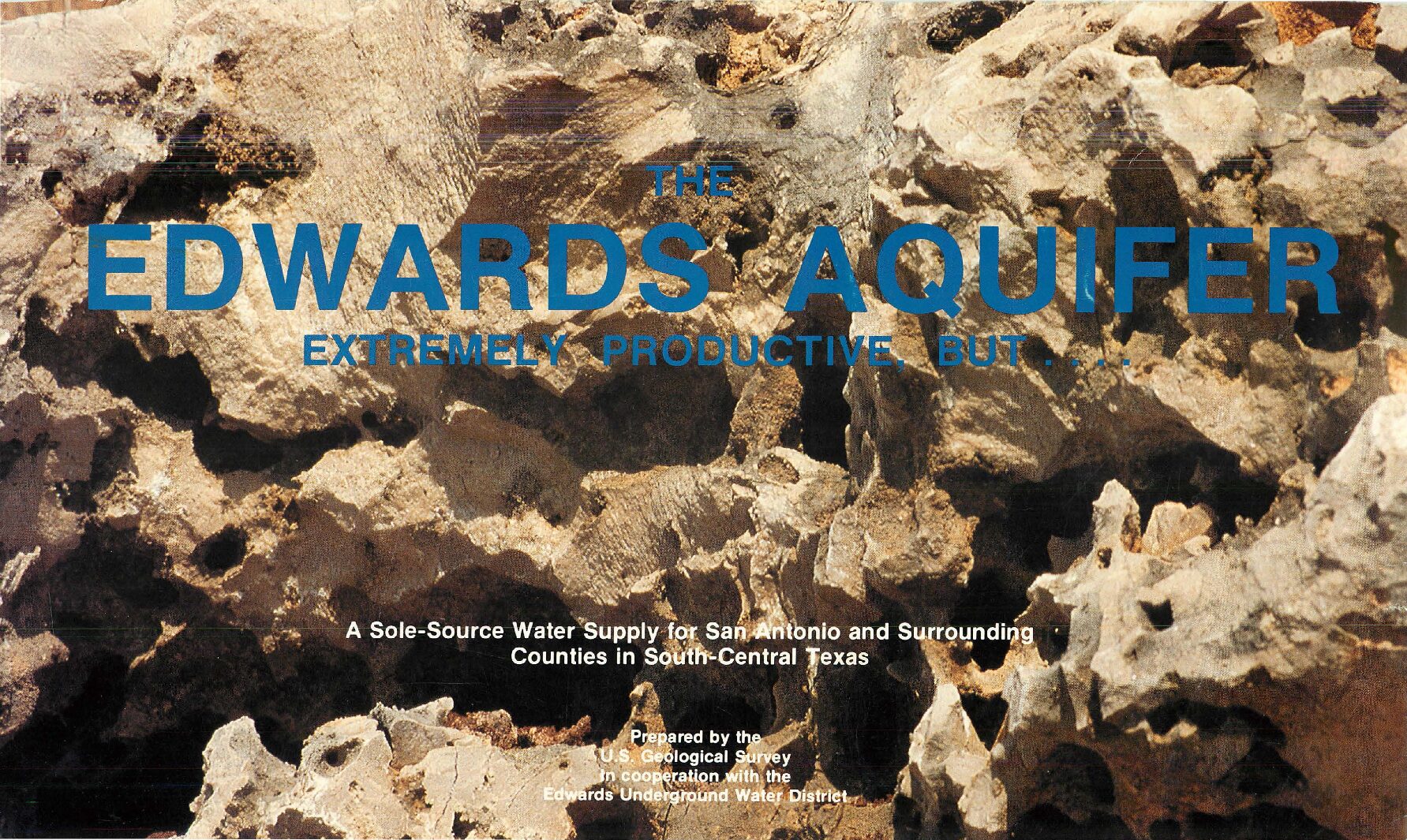
Description: Semi-technical description of the Edwards aquifer and considerations for its use and preservation for the general public and policy-makers
Location: Edwards Aquifer - General
Summary:Note: This report is included for its historical value and may not reflect current scientific understanding of the Edwards Aquifer.
This reportis a compilation of technical information presented in a manner to be useful to the lay reader and particularly for the decision-makers of the region. It is intended to bridge the gap between the basic information contained in a textbook, Water, Water Conservation and the Edwards Aquifer and the numerous technical reports of the District and others.
The need for protection of the Edwards Aquifer water quality and the growth of this region with the resultant increasing demand for the water resource, requires a greaterunderstanding of the Edwards Aquifer by all and how it should be protected and managed. The publication of this report will further the general understanding of the Edwards Aquifer and assist everyone in their efforts to reach decisions on the future of our water resource.
Continued economic development in south-central Texas will depend upon the available water supply. The principal source of water for San Antonio and the surrounding area will continue to be the Edwards aquifer, although supplemental supplies will need to be developed. Intelligent management decisions concerning how, when, and where to develop the additional water supplies can be made only if pertinent data concerning the total water resource are available to the decision makers. Information needed by elected officials and professional water managers include: Rainfall-runoff data on surface streams, maximum potential recharge to the aquifer, storage capacity of the aquifer, movement of water through the aquifer, and safe withdrawal rates.
It is readily recognized that the future supply of water provided by the Edwards aquifer will have a significant effect on continued economic development in south-central Texas. Most decision makers agree that alternative
water development will be needed to accommodate increased economic development. However, there may be disagreement on the most reliable and cost-effective means of developing alternative water supplies. Supplementing ground-water supplies by constructing surface water reservoirs and increasing the ground-water supply by enhancing recharge are being considered. Conservation measures have been introduced throughout the area and discussion has begun on considering a water reuse program. The decision makers“the elected public officials and the professional water managers-need information concerning the hydrology of the Edwards aquifer to select the most suitable plan of water development. The first of many critical decisions is to determine if existing hydrologic information, knowledge, or data are adequate for selection of a proper water development plan. Subsequent decisions regarding the implementation of plans for supplemental water development also will require detailed information about the aquifer.
Information needs include data for determination of the maximum recharge potential and the maximum quantity of water that can be safely withdrawn from the aquifer during periods of various climatic conditions without endangering the quality of the resource and without causing severe hardship for the many various water users. Investigations of the Edwards aquifer are necessary to obtain these data. To make timely and critical decisions, the planners and water managers need to have knowledge and understanding of many specific and related technical hydrological considerations such as: Quantity of precipitation and its distribution in time and space, an understanding of the recharge mechanism, how water is contained in and moves through the aquifer, the quality of water in the aquifer and the potential for contamination, and the effects of temporary partial depletion of water in storage during droughts.
The report has been prepared to enhance the public’s general understanding of the Edwards aquifer, and to aid officials in making decisions about the aquifer. The report also is intended to identify limitations in the understanding and knowledge of the aquifer, thereby facilitating the planning of investigative programs. This report is not intended to provide solutions to currently prevailing unanswered questions.
1987 Hydrologic Data Report Compilation of Hydrologic Data for the Edwards Aquifer, San Antonio Area, Texas, 1987, with 1934-87 Summary
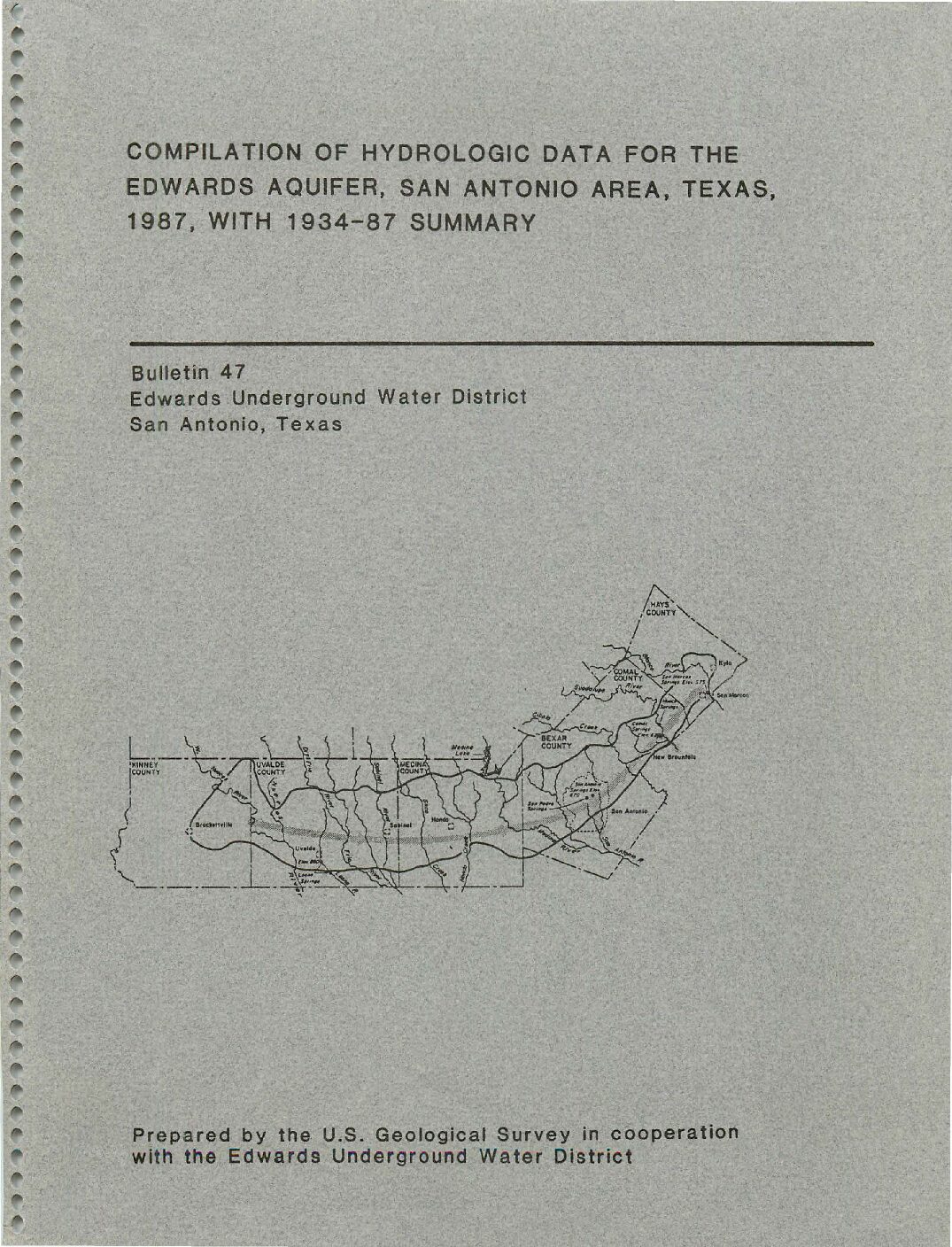
Description: Annual report for 1987 on recharge, discharge, water levels and water quality in the Edwards Aquifer San Antonio Region. Note: Large-format versions of the plates for this report are available Here
Report Number: Bulletin 47
Location: Edwards Aquifer - San Antonio Area
Summary:The average estimated annual ground-water recharge to the Edwards aquifer in the San Antonio area, Texas, from 1934 through 1987 was 640,600 acre-feet. Recharge in 1987 was 2,003,600 acre-feet, which is the highest estimated annual recharge since 1934. The previous maximum annual recharge of 1,711,200 acre-feet occurred in 1958, and a minimum annual recharge of 43,700 acre-feet occurred in 1956.
The calculated annual discharge from the Edwards aquifer by wells and springs in 1987 was 940,400 acre-feet, which is the second highest calculated annual discharge since 1934. Annual discharge by wells and springs ranged from a maximum of 960,900 acre-feet in 1977 to a minimum of 388,800 acre-feet in 1955.
Water levels in many of the wells during 1987 fluctuated above the midpoint between record high and low levels, indicating an above average volume of ground water in storage in the aquifer during most of the year. In 1987, substantial increases in storage occurred during the late spring and early summer, after which water levels remained above average in most of the area.
Analyses of water samples from 83 wells and 3 springs in the Edwards aquifer show that the water quality in the freshwater zone is significantly better than the level established for public water systems. However, trace concentrations of organic compounds were detected in many of the analyses. Analyses of water samples collected from 10 wells in Uvalde County showed concentrations of tetrachloroethylene in excess of 5 micrograms per liter. In 1987, samples were collected and analyzed from wells along the badwater line and did not detect changes in water quality as the potentiometric head in the Edwards aquifer changed.
Note: Large-format versions of the plates for this report are available at:https://www.edwardsaquifer.org/wp-content/uploads/2019/05/1988_NalleyRettman_1987HydrologicData.pdf
1988 Hydrologic Data Report Compilation of Hydrologic Data for the Edwards Aquifer, San Antonio Area, Texas, 1988, with 1934-88 Summary
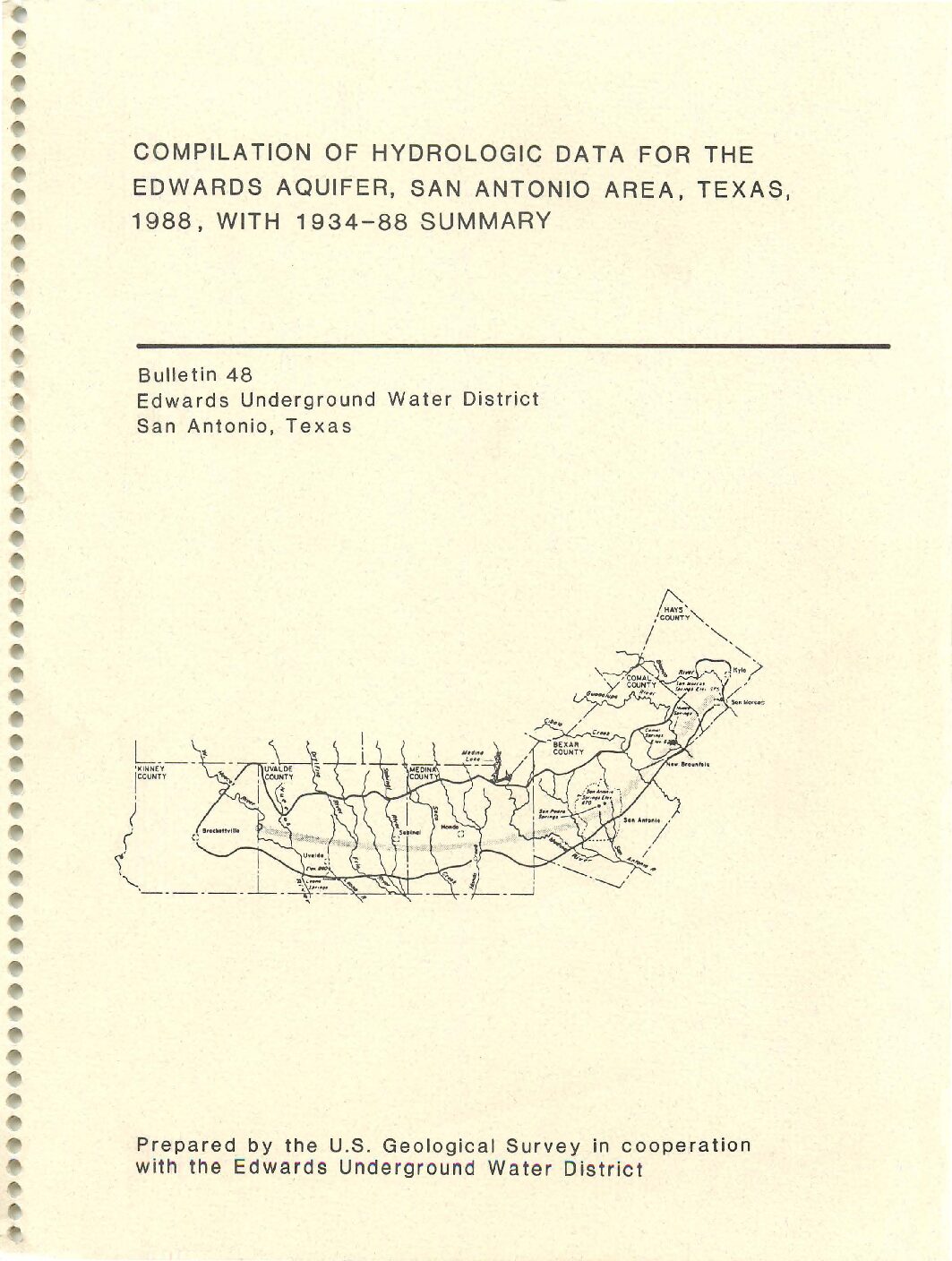
Description: Annual report for 1988 on recharge, discharge, water levels and water quality in the Edwards Aquifer San Antonio Region. Note: Large-format versions of the plates for this report are available at: https://www.edwardsaquifer.org/wp-content/uploads/2019/05/1989_Nalley_1988HydrologicData.pdf.
Report Number: Bulletin 48
Location: Edwards Aquifer - San Antonio Area
Summary:The average estimated annual ground-water recharge to the Edwards aquifer in the San Antonio area, Texas, from 1934 through 1988 was 635,500 acre-feet. Recharge in 1988 was 355,500 acre-feet, which is the fifteenth smallest estimated annual recharge since 1934. The maximum annual recharge of 2,003,600 acre-feet occurred in 1987, and a minimum annual recharge of 43,700 acre-feet occurred in 1956.
The calculated annual discharge from the Edwards aquifer by wells and springs in 1988 was 926,400 acre-feet, which is the third largest calculated annual discharge since 1934. Annual discharge by wells and springs ranged from a maximum of 960,900 acre-feet in 1977 to a minimum of 388,800 acre-feet in 1955.
Water levels in many of the wells during 1988 fluctuated above to near the mid-point between record high and low levels, reflecting an above to near average volume of ground water in storage in the aquifer during most of the year. In 1987, substantial increases occurred during the late spring and early summer, after which water levels remained above average in most of the area. Water levels then remained above to near average throughout 1988. Analyses of water samples from 56 wells and 3 springs in the Edwards aquifer show that the water quality in the freshwater zone is significantly better than the level established for public water systems. However, trace concentrations of organic compounds were detected in many of the analyses. In 1988. samples were collected and analyzed from wells transecting the badwater line and no significant changes in water quality were detected as the potentiometric head in the Edwards aquifer changed.
Note: Large-format versions of the plates for this report are available at: https://www.edwardsaquifer.org/wp-content/uploads/2019/05/1989_Nalley_1988HydrologicData.pdf
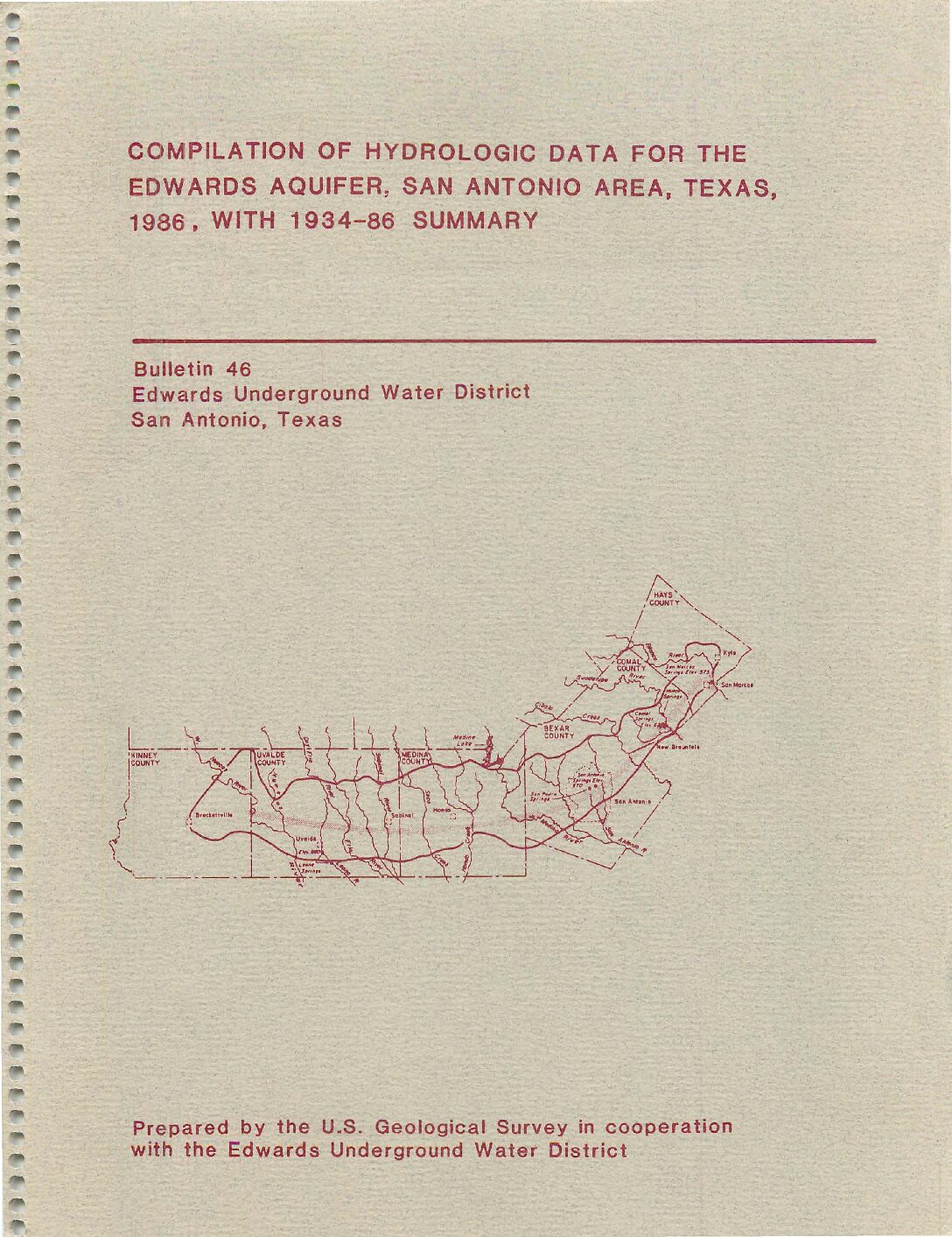
1987 Hydrologic Data Report Compilation of Hydrologic Data for the Edwards Aquifer, San Antonio Area, Texas, 1987, with 1934-87 Summary
Conduits and Turbulent Flow in the Edwards Aquifer
Description: Description of the Edwards Aquifer Balcones Fault Zone as a typical karst aquifer and recommendations for locations of conduits in the MODFLOW model
Location: Edwards Aquifer, Balcones Fault Zone
Summary:The purpose of this study was to address the existence of aquifer-scale conduit networks in the Edwards Aquifer and how they could be incorporated in the model of the aquifer constructed by the U.S.G.S. The study was completed in April 2004 by Stephen Worthington of Worthington Groundwater, Toronto, Ontario, Canada. (Report is dated December 2003.)
This report has recommendations for locations of conduits in the Edwards Aquifer Balcones Fault Zone based on tests conducted from a literature review.
[Excerpts from the report:]
Over the period 2000-2003 the US Geological Survey developed a new numerical model to simulate flow in the San Antonio segment of the Edwards Aquifer. In the early stages of this process the question arose as how to best incorporate into the model the high permeability found in some areas of the aquifer. It has generally been recognized that the high permeability in the Edwards Aquifer is due to dissolution of the limestone bedrock (Maclay, 1995), and Halihan et al. (2000) concluded that conduits control regional-scale permeabilities and have turbulent flow (Halihan et al., 2000, p. 129). If the location and characteristics of conduits could be either predicted on theoretical evidence or determined from aquifer measurements then this would offer the possibility of incorporating the conduits into the model and thereby produce a more accurate representation of the aquifer. This would be especially true if the conduits are organized into an aquifer-scale network. On the other hand the possibility was raised that conduits might only be local features, and that the aquifer might behave like a porous medium at a large scale. This raised three important questions:
a) What are the characteristics of aquifer-scale conduit networks?
b) What tests can be applied to determine whether there are aquifer-scale conduit networks in the Edwards Aquifer?
c) where might such conduit networks be located and how could they be incorporated in the USGS numerical model?
The median lag between rainfall and maximum water level was 60 days, but there is much variability.[There were] two distinct responses in the aquifer. A few wells in the recharge zone together with Comal and San Marcos Springs show a rapid and large response, with peak levels being reached within a few days of the storm. The peak responses in the springs are driven by high heads in the conduits that feed the springs, with the pressure pulse from the increased water levels in the recharge zone being transmitted quickly to the springs. Conversely, most wells show a much slower and smaller response, with peak water levels being attained after about two months. These wells are not located on conduits and their response is attenuated by the much lower permeability in the matrix and smaller fractures in the aquifer.
Comparison between the Edwards Aquifer and other karst aquifers shows that the scaling effect is similar (Figure 11). The implication is that the Edwards is similarly karstified to other karst aquifers and thus has a well-developed conduit network.
Each of the six tests provides evidence that flow in the Edwards Aquifer is more like an ideal karst aquifer than an ideal porous medium aquifer. This strongly supports the concept that there is an integrated network of conduits connecting the major sinking streams with the springs
[The conclusion] recommended location of conduits for the USGS MODFLOW model.
1985 Hydrologic Data Report Compilation of Hydrologic Data for the Edwards Aquifer, San Antonio Area, Texas, 1985, with 1934-85 Summary
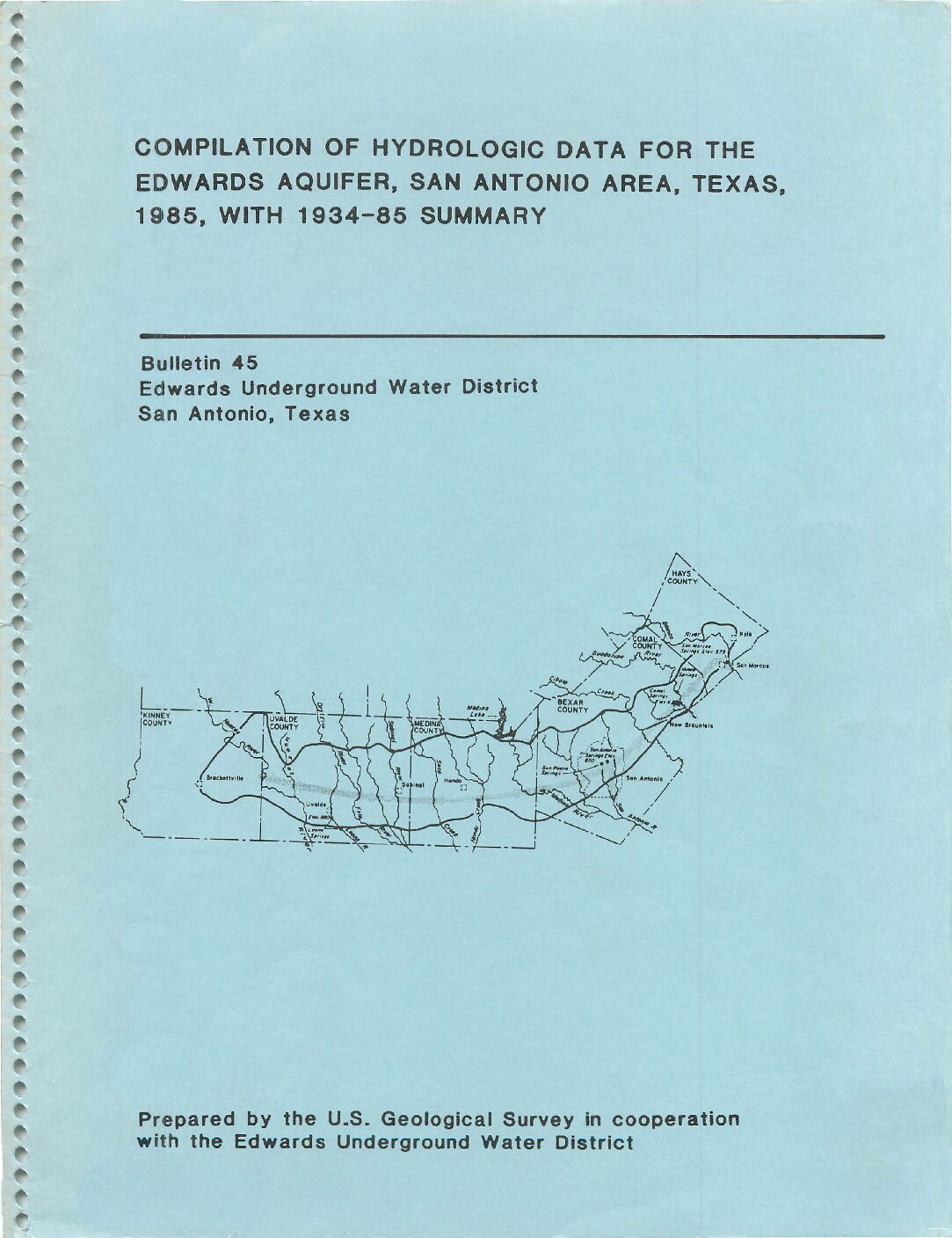
Description: Annual report for 1985 on recharge, discharge, water levels and water quality in the Edwards Aquifer San Antonio Region. Note: Largeformat versions of the plates for this report are available at: https://www.edwardsaquifer.org/wp-content/uploads/2019/05/1987_Ozuna-etal_1985HydrologicData.pdf.
Report Number: Bulletin 45
Location: Edwards Aquifer - San Antonio Area
Summary:The average annual ground-water recharge to the Edwards aquifer in the San Antonio area, Texas, from 1934 through 1985 was 604,500 acre-feet. Recharge in 1985 was 1,003,300 acre-feet, which is the seventh highest estimated annual recharge since 1934. A maximum annual recharge of 1,711,200 acre-feet occurred in 1958, and a minimum annual recharge of 43,700 acre-feet occurred in 1956.
The calculated annual discharge by wells and springs in 1985 was 856,500 acre-feet. Annual discharge by wells and springs ranged from a maximum of 960,900 acre-feet in 1977 to a minimum of 388,800 acre-feet in 1955. In 1985, the annual discharge by wells was 522, 500 acre-feet. This is near the record high of 529,800 acre-feet in 1984.
Although water levels in many of the wells fluctuated near or above the midpoint between record high and low levels in 1985, the volume of ground water in storage in the aquifer was near average during most of the year. In 1985, substantial increases occurred during the fall and winter, and water levels then remained above average in most of the area.
Analyses of water samples from 94 wells and 3 springs in the Edwards aquifer show that the water quality in the freshwater zone is significantly better than the level established for public water systems. However, trace concentrations of organic compounds were detected in many of the analyses. Analyses of water samples collected from nine wells in Uvalde County showed concentrations of tetrachloroethylene in excess of 5 micrograms per liter. In 1985, samples were collected from wells along the bad-water line to detect changes in water quality as the potentiometric head in the Edwards aquifer changed.
Note: Largeformat versions of the plates for this report are available at:
https://www.edwardsaquifer.org/wp-content/uploads/2019/05/1987_Ozuna-etal_1985HydrologicData.pdf.
Recharge and Recirculation / Edwards Aquifer Optimization Program Phase III / IV Report Final
Description: Continued and final analyses using improved flow model and recent agency rules for optimizing recharge and streamflow in the Edwards Aquifer
Location: Edwards Aquifer, Balcones Fault Zone, Comal Springs, San Marcos Springs, San Antonio Pool
Summary:The R&R Phase III/IV Report consists of baseline modeling scenarios, evaluation of R&R facility operational parameters, evaluation of source water availability, scenario modeling, and engineering and cost estimates for seven scenarios.
[Excerpted from the Executive Summary and Summary]
For more than three decades, the Edwards Aquifer Authority (EAA), its predecessor, and others have evaluated groundwater management strategies to more productively use the shared resource of the Edwards Aquifer. These strategies have involved, among others, enhancing natural recharge and recirculating groundwater discharge back into the aquifer system. This study builds on previous investigations and reevaluates recharge and recirculation (R&R) strategies incorporating:
*analysis with an improved computer flow model,
*updated estimates of available source water, and
*recentlyadopted EAA rules for various aspects of aquifer management.
The study also evaluates combinations of strategies and provides preliminary costs for facilities to support implementation of an R&R program. Benefits to the region are evaluated in terms of increased water supply and maintaining minimum springflow at key springs including Comal and San Marcos springs.
Based on the analyses provided in this report, the following conclusions can be made.
*An R&R program can be developed that increases water supply while maintaining minimum required springflow.
*Considerations for optimizing the program should be based on specific management objectives developed by EAA and stakeholders such as when and under what conditions additional water supply is needed and what minimum flows are required for Comal Springs and during what time period.
*Using the water balance output from the model, benefits from enhanced recharge can be assessed for five main categories: enhanced pumping (for recharge recovery), Permit pumping (due to lessening of CPM stages), Comal Springs, springflow at other springs, and aquifer storage (water remaining in aquifer).
*Baseline conditions developed for this study indicate that the aquifer is in critical period stages for most of the model time period. For the San Antonio Pool, critical period stages occur 65 percent of the time. Springflow at Comal Springs is significantly lower than the historical record and ceases to flow for 25 months during the drought of record (19471956).
*The EAA model, as modified, simulates newlyadopted CPM rules and pumping cap, and provides a valuable tool for evaluating R&R scenarios.
1983-84 Hydrologic Data Report Compilation of Hydrologic Data for the Edwards Aquifer, San Antonio Area, Texas, 1983-84, with 1934-84 Summary
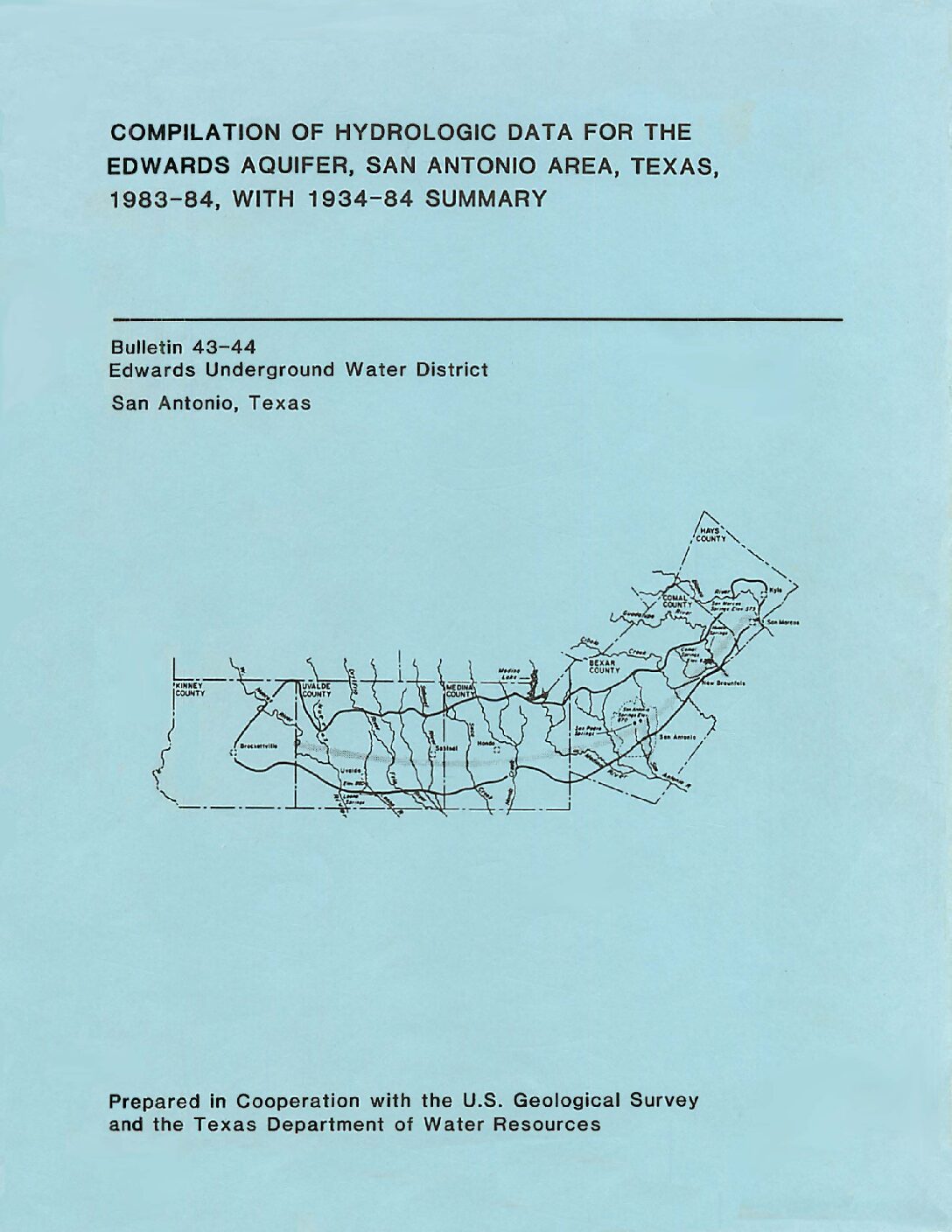
Description: Annual report for 1983-84 on recharge, discharge, water levels and water quality in the Edwards Aquifer San Antonio Region
Report Number: Bulletin 43-44
Location: Edwards Aquifer - San Antonio Area
Summary:The average annual ground-water recharge to the Edwards aquifer in the San Antonio area, Texas, for 1934-83 and 1934-84, was 604,700 and 596,700 acre-feet, respectively. Annual recharge for 1983 and 1984 was significantly below the average annual recharge. The recharge in 1983 was 420,100 acre-feet. Recharge in 1984 was 197,900 acre-feet, which is the ninth lowest estimated annual recharge since 1934. A maximum annual recharge of 1,711,200 acre-feet occurred in 1958, and a minimum annual recharge of 43,700 acre-feet occurred in 1956.
The calculated annual discharge by wells and springs in 1983 and 1984 was 720,100 and 702,300 acre-feet, respectively. Annual discharge by wells and springs ranged from a maximum of 960,900 acre-feet in 1977 to a minimum of 388,800 acre-feet in 1955. The annual discharge by wells was 418,600 acre-feet in 1983. In 1984, the annual discharge by wells was 529,800 acre-feet, which is a record high for the 1934-84 period of record.
Although water levels in many of the wells fluctuated near or below the midpoint between record high and low level s in 1983, the volume of ground water in storage in the aquifer was above average during most of the year. In 1984, substantial declines occurred during the spring and summer, and water levels then fluctuated below average conditions in most of the wells. Water levels in many of the wells fluctuated just above the 1956 record low during the summer. The volume in storage in the aquifer was below average during most of 1984.
Analyses of water samples from 158 wells and 3 springs in the Edwards aquifer show that the water in the freshwater zone is of a significantly better quality than the level established for public water systems. However, 62 percent of samples from 77 wells and 3 springs contained 1 or more organic compounds. Analyses of water samples collected from six wells in Bexar and Uvalde Counties showed concentrations of tetrachloroethylene in excess of 5 micrograms per liter. In 1984, samples were collected from wells along the bad-water line to detect changes in water quality as the potentiometric head in the
Edwards aquifer changed.
Edwards Aquifer Authority Hydrologic Data Report for 2011
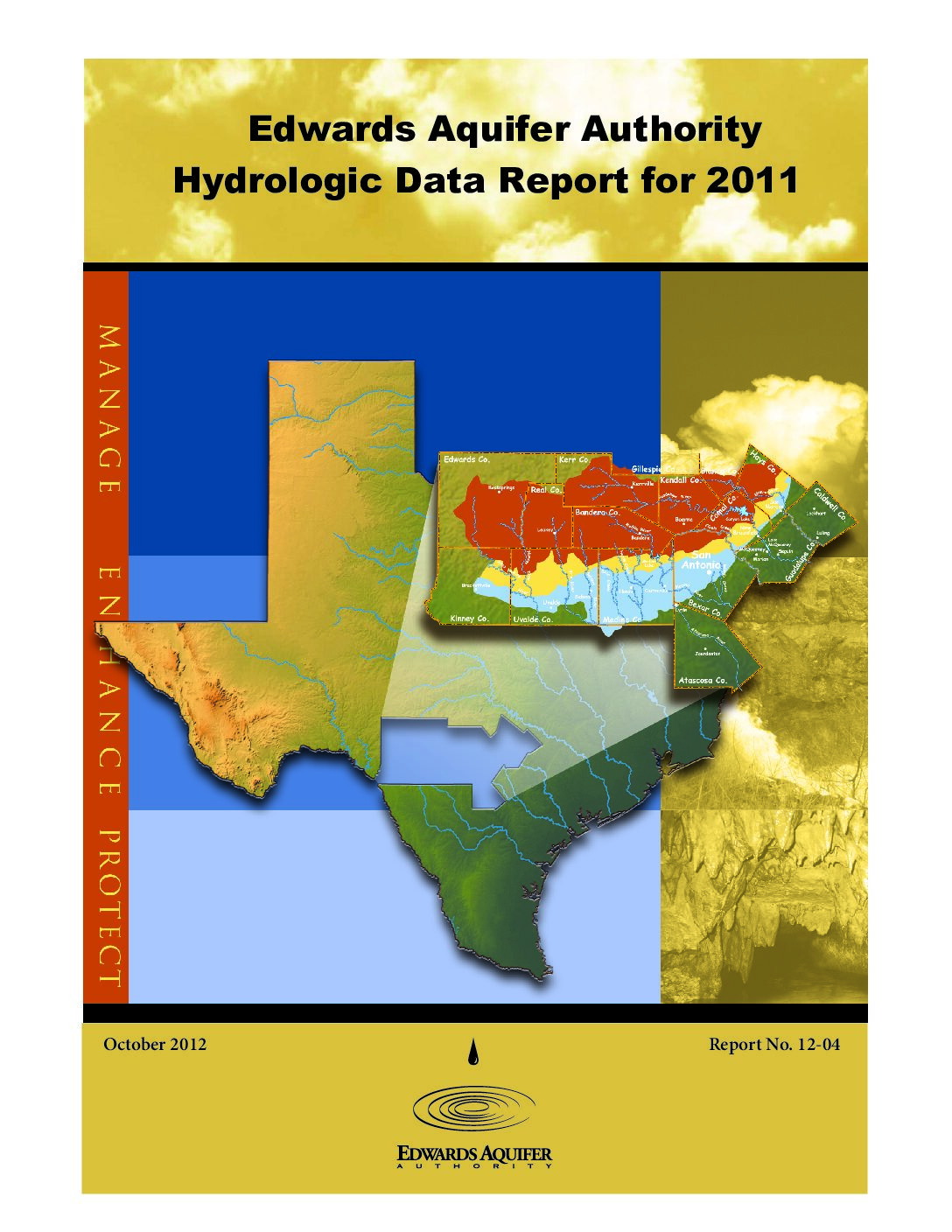
Description: Annual report for 2011 on recharge, discharge, water levels and water quality in the Edwards Aquifer San Antonio Region
Report Number: 4-Dec
Location: Edwards Aquifer-San Antonio Region
Summary:(Excerpted from the report Summary)
This report presents results of the Edwards Aquifer Authority's (EAA's) Edwards Aquifer Data Collection Program for calendar year 2011.
Water levels at the Bexar County (J-17) index well were below the historical mean for most of the year.Other wells in the region exhibited similar behavior with regard to lower than normal water levels.Precipitation in the Edwards Aquifer region for 2011 was below that of the period of record (1934“2011). In general, the region received between 50 and 60 percent of mean (or normal) precipitation during the year.In 2011, total groundwater discharge from the Edwards Aquifer through wells and springs was estimated at 692,870 acre-feet. This amount is below the median total discharge of 699,200 acre-feet for the period of record (1934“2011). Discharge from wells in 2011 was estimated to be 427,653 acre-feet, almost 100,000 acre-feet above the 327,500 acre-foot period of record (1934“2011) median.Discharge from springs in 2011 was estimated at 265,217 acre-feet, significantly below the period of record median of 384,200 acre-feet.
Analytical testing for the following compounds was performed: bacteria, nutrients, volatile organic compounds (VOCs), semivolatile organic compounds (SVOCs), metals, pesticides, herbicides, polychlorinated bi-phenyls (PCBs), and limited analyses for personal care and pharmaceutical products (PPCPs). Whereas most sample results did not indicate anthropogenic impacts at the sample point, some compounds of concern were detected at low concentrations in various wells and springs and one surface water sample.[None of the detections were in excess of the applicable regulatory standards. Samples collected at springs indicated some detections of VOCs, SVOCs, pesticides, herbicides, metals, and one PCB, indicat[ing] the possibility of anthropogenic impacts.Detections included one PCB compound in a sample from Comal Springs at a concentration above the regulatory limit.Four VOC detections were noted out of 78 spring samples (five percent), and seven pesticide detections in 77 samples (nine percent). Arsenic was detected above the regulatory limit in one Comal Springs sample, as was antimony in a Blanco River sample.
Personal care and pharmaceutical product sampling performed in 2011 provided some insight into the presence of these compounds in groundwater. In the five wells and one spring sampled, only one well was nondetect with regard to these compounds. Unlike other analytical results previously discussed, PPCP analyses are performed such that these compounds are detected at nanogram per liter (ng/L) concentrations or parts per trillion. Therefore, the detections noted were all at very low concentrations. The types of PPCP compounds detected were estrogen hormones (one well and at Comal Springs), antibiotics (four wells), an antibacterial soap ingredient (one well), and nicotine metabolite (one well). Note that at the time of testing for these compounds, no regulatory standards existed for their presence in drinking water. Concentrations for detected PPCP compounds ranged from 0.31 to 6.9 ng/L.
The most significant event affecting the Edwards Aquifer during the year was the record-setting drought that affected the entire state as well as the Edwards Aquifer region. According to the state climatologist, the period October 2010 through September 2011 was the driest 12-month period on record for the state. Extremely low rainfall amounts were exacerbated by higher than normal temperatures and frequent high winds across the state. The aquifer received approximately 20 percent of normal recharge for the year. However, the drainage basins that recharge Kinney, Uvalde, and Medina counties received only about ten percent of normal recharge for the year. Dry conditions and lack of recharge caused aquifer levels to drop throughout most of the year, resulting in mandatory water conservation measures across the region.
Analysis of Recharge and Recirculation Edwards Aquifer Phase 1
Description: Testing the MODFLOW model with historical data of recharge and recirculation at two hypothetical recharge sites prior to release of the model
Location: Edwards Aquifer, Balcones Fault Zone
Summary:The concept of recharge and recirculation (R&R) for the Edwards Aquifer embodies the integrated use of groundwater, surface water, and storage units to optimize the availability of water for pumpers during drought periods and to accommodate water needs for endangered species in Comal and San Marcos springs. The purpose of this Phase 1 report is to outline work performed by Todd Engineers to evaluate various documents related to the concept of R&R and to document Todd Engineers review of a MODFLOW groundwater model of the Edwards Aquifer for use in simulating R&R scenarios. The report also discusses two preliminary R&R scenarios simulated with the model. Subsequent phases of the project will use the model to simulate numerous R&R scenarios to evaluate possible benefits for aquifer water levels and springflows.
[From Introduction of Phase 2 report]
In April 2004, Edwards Aquifer Authority (EAA) contracted with Todd Engineers to conduct a multi-phase study on enhanced recharge and recirculation (R&R) strategies. Phase 1 of that work was completed in September 2004. This Phase 1 report includes a review of existing studies, an analysis of Edwards Aquifer hydraulics, installation and operation of the 2004 U.S. Geological Survey (USGS) MODFLOW model of the Edwards Aquifer, and application of the model for test runs at two hypothetical recharge sites. Test runs indicated that long-term benefits measured in years can be achieved for Comal Springs flow by increasing aquifer recharge. Further, the magnitude and duration of increased springflow was found to vary significantly from site to site.
Edwards Aquifer Authority Hydrologic Data Report for 2005
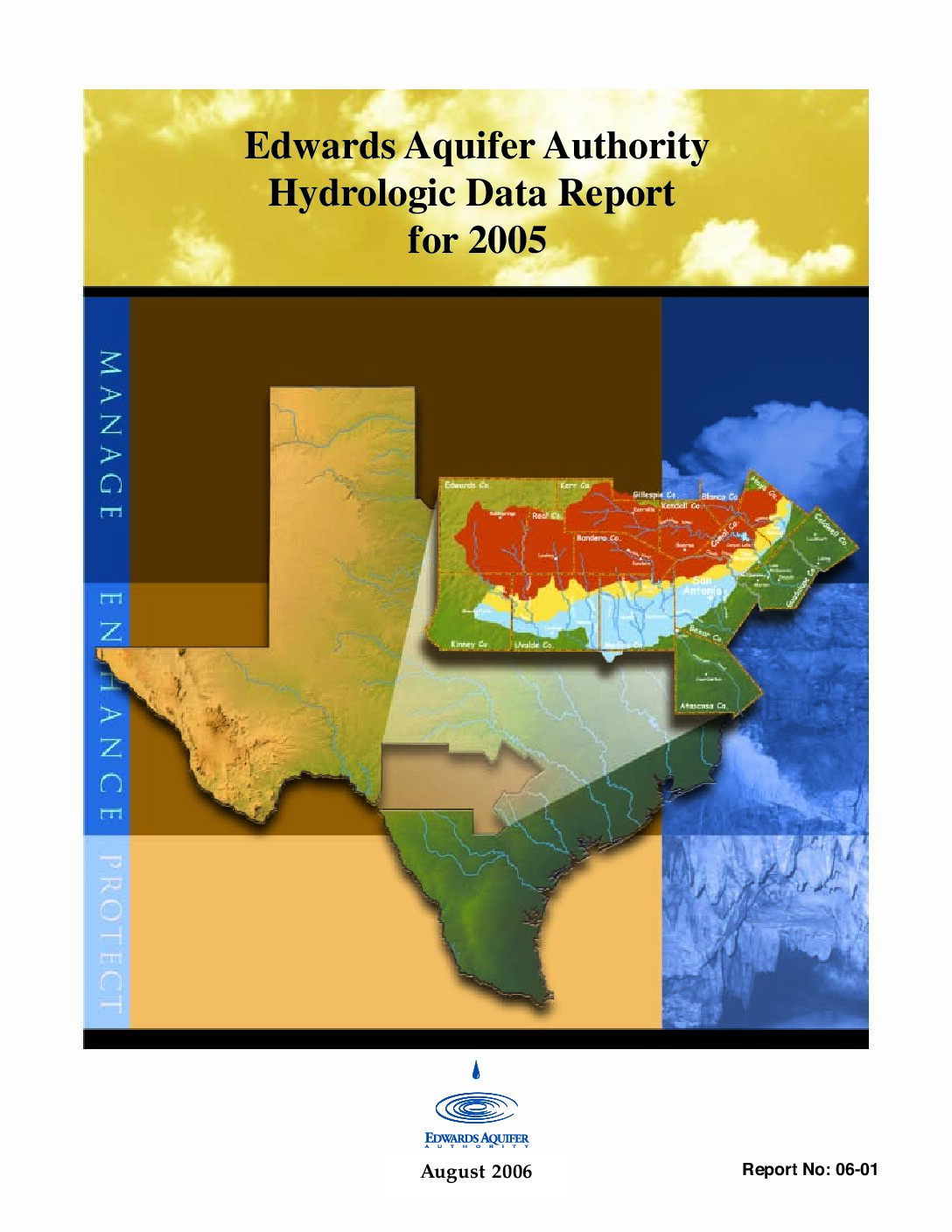
Description: Annual report for 2005 on recharge, discharge, water levels and water quality in the Edwards Aquifer San Antonio Region
Report Number: 1-Jun
Location: Edwards Aquifer - San Antonio Area
Summary:This report presents the results of the Authority's Edwards Aquifer Data Collection Program for calendar year 2005.
Water levels remained above the historical mean value at the Bexar County (J-17) index well throughout 2005. Other wells in the region exhibited similar behavior. In 2005 aquifer (groundwater) levels remained above historical mean values but generally decreased for most of the year.Precipitation in the Edwards Aquifer region was below mean in 2005. However,rainfall in the drainage area (the northernmost counties in the region) was higher than that recorded within the recharge and artesian zones of the aquifer.
Total recharge to the Edwards Aquifer was 764,000 acre-feet in 2005, approximately 30 percent above the median of 585,700 acre-feet for the period of record (1934“2005).In calendar year 2005, groundwater discharge from the Edwards Aquifer through wells and springs totaled 1,035,700 acre-feet. This amount is approximately 52 percent above the median of 681,500 acre-feet for the period of record (1934“2004).Discharge from wells in 2005 was estimated to be 388,527 acre-feet, within approximately one percent of the 382,800 acre-foot ten-year median (1996“2005).Discharge from springs in 2005 was estimated to be 647,146 acre-feet, approximately 32 percent more than the ten-year mean of 488,500 acre-feet. For the period of record, 2005 experienced the second highest annual discharge from springs, exceeded only by the 1992 discharge value. Spring discharge for years 2005, 2004, 2003, and 2002 represents the second-, third-, fourth-, and fifth-highest discharge amounts for the period of record.
For well water samples collected in 2005, lead was detected at one location at 28.6 μg/L, well above the 15.0 μg/L MCL. Other metals detected include strontium, iron, and manganese at concentrations above their respective PCLs, or secondary standards. Surface and spring water sample analyses did not indicate the presence of any analyzed metals above their respective standards.
For samples collected in 2005, nitrate-nitrite as nitrogen concentrations ranged from below the laboratory reporting limit of 0.015 mg/L to 7.34 mg/L in samples from wells, streams, and springs in the Edwards Aquifer region.None of the samples collected exceeded the MCL of ten mg/L of nitrate as nitrogen.
One VOC was detected at or above its associated MCL in the 45 wells sampled. The compound tetrachloroethene (PCE) was detected at 30.5 μg/L in Bexar County well AY-68-36-1DR. The MCL for PCE is five μg/L. One additional VOC was detected in a well sample below the MCL in Bexar County.
Several VOC compounds were detected in San Marcos Springs during the March and November sample events. In 2005, 25 wells and six spring groups were sampled for SVOC's. The compounds phenol and n-nitroso-di-npropylamine were detected in well samples, whereas the compounds bis(2-ethylhexyl)adipate and benzoic acid were detected in spring water samples.
In 2005, samples from 38 wells and six spring groups were analyzed for herbicides, pesticides, and PCB's. No sample tested positive for these compounds. Edwards Aquifer water is generally of such high quality that it normally requires only chlorination to meet public drinking water standards. However, the detection of nitrates and organic compounds, as well as trace quantities of metals, in the aquifer is a concern, and the Authority will continue to monitor for these compounds to determine possible sources and trends. Nitrate as nitrogen was detected frequently in all sample types; however, well samples had the highest concentrations, with 31 of 95 wells sampled testing positive for nitrate-nitrite at 2.0 mg/L or higher. Five of the 95 wells had nitrate-nitrite concentrations above 5.0 mg/L; the MCL for nitrate-nitrite is 10 mg/L.
Confirmed detections of VOCs, such as PCE froma Bexar County well and 1,2,4-trimethylbenzene, xylene, and 1,2-dichloroethane at the San Marcos Springs, are a concern and warrant continued monitoring in the future. The Authority's aquifer wide water-quality sampling program will continue to monitor wells, streams, and springs for indications of water quality impacts throughout the region.
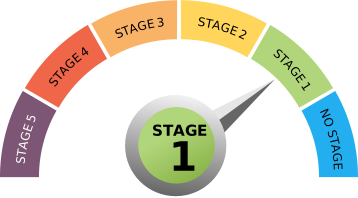


 CURRENT